To grow your salon business, you have to move one of three numbers: how many clients you serve, how often each of them comes back, or how much they spend per visit. Salon revenue is clients × visits per client × average ticket, and the chair hours you can sell put a ceiling on all three. So there are four growth levers: more new clients, more repeat visits, a higher average ticket and more capacity.
Social media, loyalty cards, a new hire or new software only help if they move one of those numbers. Below, each lever gets its own section with the formula, a worked example in euros and what to do this month. Swap in your own figures as you go.
The salon revenue formula, with numbers
Here is the example salon used throughout this article. The figures are assumptions for illustration, not industry benchmarks:
- 4 chairs, open 10 hours a day, 26 days a month: 4 × 10 × 26 = 1,040 chair hours a month
- An average appointment takes about an hour and brings in €55
- 60% of chair hours are booked: 1,040 × 60% = 624 appointments a month
- Those appointments come from 480 different clients, who visit 1.3 times a month on average (480 × 1.3 = 624)
Monthly revenue: 480 clients × 1.3 visits × €55 = €34,320.
What +10% on each lever is worth
| Lever | What +10% means in the example | Monthly revenue | Change |
|---|---|---|---|
| Today | 480 clients, 1.3 visits, €55 ticket | €34,320 | – |
| More new clients | 480 → 528 clients | €37,752 | +€3,432 |
| More repeat visits | 1.3 → 1.43 visits per client | €37,752 | +€3,432 |
| Higher average ticket | €55 → €60.50 | €37,752 | +€3,432 |
| More capacity | 1,040 → 1,144 chair hours | €34,320 | €0 until the new hours are booked |
| First three together | 528 × 1.43 × €60.50 | €45,680 | +€11,360 (+33%) |
Two things stand out. The levers multiply, so three 10% gains add 33%, not 30%. The combined case needs about 755 appointments (528 × 1.43), which is 73% of the chair hours, so the current salon can still take it. And capacity on its own earns nothing. A new chair only pays once the existing ones are full at the times clients want to come.
Which lever to pull first
Your calendar usually tells you where to start:
| What you see | Start with |
|---|---|
| Gaps in the calendar on most days | Lever 4: fill the hours you already have, then lever 1 |
| Plenty of first visits, few second ones | Lever 2: repeat visits |
| Full calendar, flat revenue | Lever 3: average ticket and prices |
| Peak hours booked out for weeks, clients turned away | Lever 4: a chair, a hire or a second location |
| Few new names in the client base each month | Lever 1: new clients |
Lever 1: more new clients
New clients are the most expensive lever, so judge every channel by what one paying client costs you, not by reach or followers.
Channels that bring new salon clients
- Google Business Profile is free, and it’s where people nearby compare salons on Maps. Keep hours, services, prices and photos up to date, reply to every review and add a booking button, so a search turns straight into an appointment.
- Your own booking link on Instagram and your website lets people book at 11 pm without waiting for you to answer a direct message. Put it in your bio and on every page of the site. Here are four ways to add an Instagram booking link without marketplace commission.
- Referrals work because your regulars know people like them. Give both sides a small reward, for example €10 off the next visit for the client and €10 off the first visit for the friend.
- Gift cards often bring in people who have never been to you, and the visit is paid before they arrive. See how to set up salon gift cards in seven days.
- Booking marketplaces list many salons in one app, and many charge a commission on the clients they send you. The cost comparison is below.
How to calculate cost per acquired client
Use one formula for every channel:
Cost per acquired client = everything you spent on a channel in a month ÷ new clients from that channel who came in and paid
Count people who sat in the chair, not clicks, follows or messages. Count discounts and fees as spend: a €10 welcome discount costs you the same as €10 of ads. Here’s an example month with assumed figures:
| Channel (example) | What you paid in the month | New clients who came in | Cost per acquired client |
|---|---|---|---|
| Instagram ads | €400 ad spend | 16 | €25 |
| Referral rewards | €10 + €10 per referral, 12 referrals = €240 | 12 | €20 |
| Booking marketplace | 20% of a €60 first appointment, 10 clients = €120 | 10 | €12 |
| Google Business Profile with your own booking link | €0 in fees, about 3 hours of your time | 8 | €0 plus your time |
Then look past the first visit. A first visit that never repeats is worth €55. A client who comes back six times a year is worth 6 × €55 = €330 a year in revenue. So also work out the cost per returning client: divide the cost per acquired client by the share of those clients who book a second visit.
If 40% of the clients from your ads come back, each returning client cost €25 ÷ 0.4 = €62.50. If 60% of referred clients come back, each cost €20 ÷ 0.6 ≈ €33. A channel full of one-off bargain hunters can turn out to be your most expensive one.
None of this works unless you know where each new client came from. Ask at the first visit and write it in the client’s record.
Your own booking channel vs a marketplace commission
A marketplace commission is the price of the new client it brings. Fresha, for example, charges a one-time 20% fee on a new client who books through its marketplace (checked November 2026). On a €60 first appointment that’s €12, cheaper per client than the ads in the table above.
The cost to watch comes later. The client found you in an app that also lists other salons nearby. If they keep booking through it, you depend on the platform’s ranking for your flow of new names, and the relationship is partly the platform’s. An appointment booked through your own link carries no commission, and the client comes straight back to you next time.
Put a number on it. Say 20 new clients a month arrive through a marketplace at a €60 first ticket: 20 × €60 × 20% = €240 a month, or €2,880 a year. For a new salon with an empty calendar, that can be good value. It’s poor value if many of those people would have found you on Google anyway. Check each quarter what share of your new clients the marketplace brings.
If you use a marketplace:
- Treat it as one paid channel with a known cost per client, not as your booking system.
- Book the second appointment in your own calendar before the client leaves, and give them your direct booking link. Read the marketplace’s terms first.
- Send reminders and follow-ups from your own system, so the client hears from you.
The wider risks, including EU rules, are covered in booking marketplaces for salons and clinics.
In Altegio, Online Booking gives you a booking link for Instagram and Google and a widget for your website. Every appointment lands in the same calendar as phone and walk-in appointments, and Altegio takes no commission on them.
Lever 2: more repeat visits
A returning client costs almost nothing to bring back and already trusts your team. For most salons this is the cheapest lever. It’s also easy to neglect, because nothing visibly breaks when clients drift away.
Example: the salon gets 120 first-time clients a month, and 40% of them come back within 90 days, which is 48 clients. Rebooking at checkout and a follow-up message lift that to 55%, or 66 clients. That’s 18 more regulars from each month’s new clients. If each of them visits four more times over the next year at €55, one month’s intake brings in 18 × 4 × €55 = €3,960 extra. Next month’s new clients add the same again.
Rebook before the client leaves
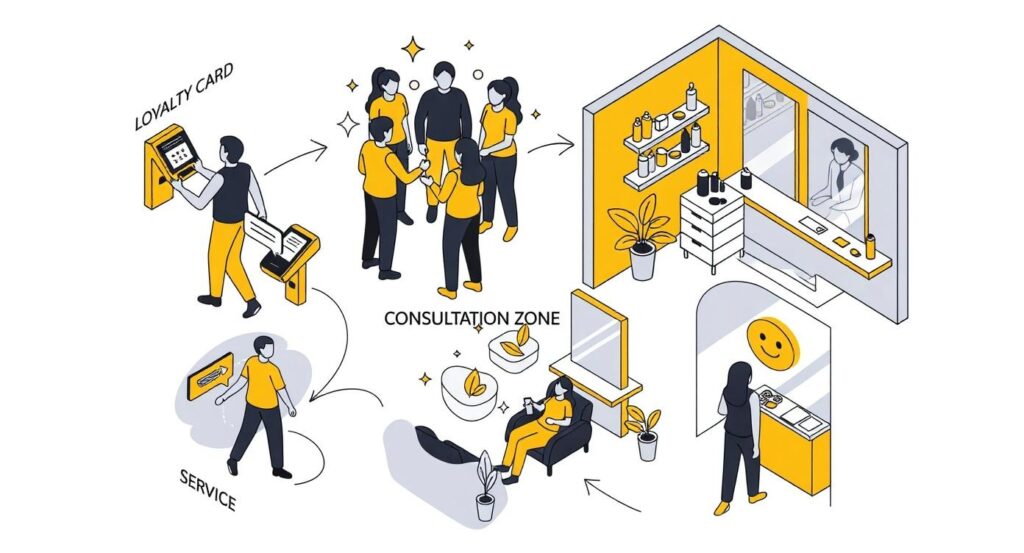
The easiest moment to book the next appointment is while the client is still in the chair, looking at the result. “Your colour will need a refresh in about six weeks. Shall I keep Thursday the 14th at 6 pm for you?” Clients hear that as part of the service.
Make it a habit for the whole team. Agree on the usual return interval for each service, for example three to four weeks for a men’s cut or six weeks for root colour. Then track the rebooking rate every week: appointments booked before the client left ÷ appointments completed, per team member. Our five rebooking rules to reduce client churn go into the detail.
Automatic reminders and follow-ups
Reminders protect the appointments you already have. Follow-ups create the next ones. Set up three messages:
- a reminder a day before each appointment, with a way to confirm or move it
- a thank-you after the visit with a request for a review
- a nudge when a client who didn’t rebook is due for their next service
Altegio sends appointment reminders automatically by SMS, email, push or WhatsApp, so nobody on the team has to phone clients the day before.
Memberships and packages
A membership or prepaid package turns future visits into money today and gives the client a reason to come back to you rather than try somewhere new. They suit services people need on a schedule: blow-dries, brows, nails, massage.
Example: a pack of 10 blow-dries for €300, where a single one costs €35. The client saves €50, and you get €300 upfront plus ten visits in the calendar. Keep the discount small enough that the ticket holds up: here each visit is worth €30 instead of €35.
A loyalty program
A loyalty program rewards frequency: cashback on each visit, a discount that grows with total spend, or every tenth service free. Keep the rules short enough that a client can explain them to a friend in one sentence. Altegio’s Loyalty Program covers discounts, cashback, memberships and gift cards.
Win back lapsed clients
Every salon has a list of people who came regularly and then stopped. Decide what “lapsed” means for each service, for example twice the usual interval: six to eight weeks for a barbershop client, three to four months for colour. Once a month, pull the list and send a personal message from the team member who usually looked after them, with a link to book. Try a plain “We haven’t seen you since March, shall I keep your usual Saturday slot?” before you reach for a discount. You can add an offer to the second message.
Altegio’s client base keeps every client’s visit history, so you can see who hasn’t been in for a while and export the list for your win-back messages. For more ideas, see four low-effort moves to boost client retention.
Lever 3: a higher average ticket
Average ticket = revenue ÷ number of appointments. Raising it needs no extra clients and often no extra chair time, so it’s the lever for a salon whose calendar is already full.
Add-on services
An add-on is a short extra that belongs with what the client already booked: a gloss with colour, a tint with a brow shape, paraffin with a manicure, a beard trim with a cut. Suggest it during the consultation with a reason that fits this client, not at the till. Also list add-ons in online booking, so clients can pick them when they book.
Example: if 20% of the salon’s 624 monthly appointments take a €15 add-on, that’s 624 × 20% × €15 = €1,872 a month. The average ticket goes from €55 to €58.
Retail products
Clients ask “what did you use on my hair?” every day. A small shelf of products your team actually uses turns that question into revenue. Have the stylist put the product in the client’s hand rather than point at the shelf.
Example: if 10% of appointments end with a €25 product, that’s 624 × 10% × €25 = €1,560 a month in sales. Retail revenue isn’t profit, though. You keep the margin after the product’s cost, and stock that doesn’t sell ties up cash.

Altegio’s Inventory tracks retail products and the materials used on clients, and writes off materials automatically for each service. You can see what sells and what sits on the shelf.
Service menu and prices
Plenty of owners put off a price rise for years for fear of losing clients. Do the sums first.
Example: a 5% rise takes the average ticket from €55 to €57.75. On 624 appointments that’s 624 × €2.75 = €1,716 a month. To end up with less revenue than before, you’d have to lose about 30 appointments a month, roughly 5% of volume: at €57.75, it takes €34,320 ÷ €57.75 ≈ 594 appointments to match today’s revenue, and 624 − 594 = 30. If your busiest team members are booked two weeks ahead, that’s a sign demand can take the rise.
Other menu changes that lift the ticket:
- Price by level. A senior stylist with a waiting list should cost more than a junior with gaps in the day.
- Price by time. Long hair or complex colour at the same price as a short cut is a hidden discount.
- Cut what doesn’t earn. Services that take a long time, sell rarely and need special stock clutter the menu.
For layout and wording, see how to sell more with a clearer service menu. For margins, read our salon pricing strategy.
Lever 4: more capacity
Capacity is the number of chair hours you can sell. It caps the other three levers, but adding more only pays once the hours you already have are full. So start with the gaps.
Worked example: 4 chairs, occupancy up 10 percentage points
Occupancy is the share of available chair hours that are booked. Assumptions: 4 chairs, open 10 hours a day, 26 days a month, an average appointment of one hour at €55, and occupancy of 60% today. For the profit step, assume the team earns 40% commission and products cost about 10% of the ticket.
- Available chair hours: 4 × 10 × 26 = 1,040 a month.
- Booked today at 60%: 1,040 × 60% = 624 hours, so 624 appointments.
- Booked at 70%: 1,040 × 70% = 728 appointments.
- Extra appointments: 728 − 624 = 104 a month, which is 4 a day over 26 days.
- Extra revenue: 104 × €55 = €5,720 a month, or €68,640 a year.
- What stays in the business: €5,720 − €2,288 commission − €572 products = €2,860 a month. Rent and equipment don’t cost a cent more.
If you read “10% more” as relative growth, from 60% to 66%, the gain is 1,040 × 6% × €55 = €3,432 a month. Either way, there’s no new lease and no new hire.
Where do four more appointments a day come from?
- Fewer no-shows. Send reminders with a confirm button, and ask for a deposit or card guarantee on long, expensive services.
- Fewer dead gaps. Set each service’s duration to the time it really takes, so the calendar doesn’t leave 20-minute holes nobody can book.
- Off-peak demand. Weekday mornings and early afternoons are hard to sell in many salons. Offer them to people who can come then, such as retirees, shift workers or parents after the school run.
- Booking at any hour. People plan their week in the evening, when you’re closed. A booking link that works at 11 pm catches appointments a phone line misses.
Our article on salon occupancy rate shows how to measure it per team member and per hour. In Altegio, Analytics shows average occupancy for the location and for each team member, so you can see whose calendar has room.
A second chair or a new hire
Add capacity when the hours clients want are full, not when the monthly average looks high. A salon at 65% overall can still turn people away every Friday evening and Saturday morning. Check occupancy by day and hour before you sign anything.
Example: a fifth chair in the example salon adds 10 × 26 = 260 chair hours a month. If it’s 40% booked in its first months, that’s 104 appointments and €5,720 in revenue, the same as the 10-point gain above. This time, though, a new stylist’s pay, products, recruitment and possibly more space come out of it. Filling the four chairs you have is the cheaper way to the same number.
A practical signal that you’re ready to hire: peak hours have been 85–90% booked for a couple of months, your busiest team members have waiting lists, and you know where the new person’s first clients will come from, such as overflow from busy colleagues or a service you don’t offer yet.
A second location
A second location is a second business with your name on it. It makes sense when the first salon runs most days without you on the floor, its numbers have been steady over the last year, and there’s demand you can’t serve at the current address, for example clients who travel in from one particular part of town. If the first salon still depends on you being there, a second one splits your time and weakens both. Read multi-location salon management before you sign a second lease.
Altegio runs several locations in one account with a shared client base, so a client can book at either salon and their history comes with them.
Which capacity move fits
| Move | A practical signal | Main cost |
|---|---|---|
| Fill gaps in existing hours | Occupancy below roughly 75–80%, or very uneven across the week | Reminders, deposits, off-peak offers; little fixed cost |
| Longer opening hours | Clients keep asking for early or late slots you don’t offer | Staff hours at the edges of the day |
| Second chair or new hire | Peak hours fully booked for months, waiting lists | Pay, recruitment, training time, possibly space |
| Second location | First salon runs without you; demand from another area | Lease, fit-out, a manager, months before it fills |
How to grow a beauty business without working more
Most owners first grow by working more themselves: longer days in the chair, evenings answering messages, Sundays on the rota and payroll. That works until your own hours run out. Growing without working more means taking growth off your personal hours and putting it on your team’s occupancy, your prices and your routines.
Example: you work 140 paid hours a month at €55, so your own chair brings in €7,700 a month and can’t go much higher. Earning the €5,720 from the worked example with your own hands would take 104 more hours a month, about 24 more hours a week. Filling 10 points of your team’s empty time brings the same money without a single extra hour from you.
Hand over what doesn’t need you
For one week, write down everything you do outside client work and how long it takes. Mark each task “only I can do this”, “someone on the team can do this” or “software can do this”. Hand off the last two groups first. Typical candidates are the phone and messages, stock orders, the first draft of the rota and the weekly social posts. Then train a senior stylist to run consultations and rebook the way you would.
Automate booking, reminders and payroll
Anything that happens the same way every time should run without you:
- Online booking replaces phone tag. A client picks a time at 11 pm and you see it in the calendar in the morning.
- Automatic reminders confirm appointments without anyone ringing round.
- Deposits on long services protect your best hours without you chasing anyone.
- Payroll that calculates staff commission from the scheme you set saves an evening with a spreadsheet at the end of every month.
In Altegio, Online Booking, reminders and Payroll run in the same account, so staff commission is calculated from the appointments and sales you’ve already recorded.
Raise the ticket, not your hours
Your own time is the scarcest thing in the salon, so price it that way. A 15% rise on your own services adds €7,700 × 15% = €1,155 a month without one extra appointment. The 5% rise across the whole salon from lever 3 adds €1,716. Add-ons and retail lift the ticket too, and your team sells them, not you. If part of the team’s pay depends on rebooking and retail, those numbers keep moving on the days you’re not in.
Write the routines down
A salon grows without you when the things you do by instinct are written down and the team does them the same way: the consultation, the rebooking line at checkout, what to do when a client is late, how to close the till. Then keep one fixed half hour a week to look at occupancy, rebooking rate, average ticket and new clients. The daily, weekly and monthly checklists and KPI formulas are in our salon management guide.
A 90-day salon growth plan
Don’t pull all four levers at once. This order suits most salons: fix the leaks in the hours and clients you already have, then work on the ticket, then spend on new clients and capacity.
| Weeks | Focus | What to do | Number to check |
|---|---|---|---|
| 1–4 | Baseline and repeat visits | Work out clients, visits per client, average ticket and occupancy for the last three months. Turn on automatic reminders. Rebook every client at checkout. Put your booking link on Instagram and your Google Business Profile. | Rebooking rate; occupancy by day and hour |
| 5–8 | Average ticket and lapsed clients | Choose one add-on for each main service and brief the team. Review prices by level and duration. Send the first win-back messages. Launch a pack or membership for one regular service. | Average ticket; how many lapsed clients rebook |
| 9–12 | New clients and capacity | Start a referral reward. Calculate cost per acquired client for each channel and cut the most expensive one. Put an offer on your emptiest hours. Decide on a hire or a chair only if peak hours are full. | Cost per acquired client; peak-hour occupancy |
On day 90, run the formula again with the new numbers and compare it with week one. You’ll see which lever moved and where the next 90 days should go.
Next step: take last month’s figures and fill in clients × visits per client × average ticket, plus occupancy. Whichever number looks weakest is your first lever. If you want the calendar, client base, reminders and reports in one place while you track it, Altegio’s plans are on the pricing page.
FAQ
How do I grow my salon business?
Work on the four things that make up salon revenue: new clients, visits per client, average ticket and the chair hours you can sell. Start with the cheapest: fill empty hours and rebook every client before they leave. Then raise the ticket with add-ons, retail and a price review, and only after that spend more on new clients or extra capacity.
How much does it cost to get a new salon client?
Divide what you spent on a channel in a month, including discounts and fees, by the new clients from that channel who actually came in. Then divide that by the share who come back to get the cost per returning client. In our example, ads cost €25 per new client, which becomes €62.50 per returning client when 40% come back.
Is a booking marketplace worth it for a salon?
It can be, as one paid channel, especially for a new salon with an empty calendar. Fresha, for example, charges a one-time 20% fee on a new client who books through its marketplace, which is €12 on a €60 first appointment. Book the next visit in your own calendar and give clients your own booking link, so you don’t come to depend on the platform.
How can I increase salon revenue without more clients?
Get the clients you have to come back more often and raise what each visit is worth. Rebooking at checkout, reminders, memberships and win-back messages lift visits. Add-ons, retail and a price review lift the ticket. In the example salon, a €15 add-on on 20% of appointments adds €1,872 a month.
When should a salon hire another stylist or add a chair?
When peak hours have been fully booked for months, your busiest team members have waiting lists and you know where the new person’s first clients will come from. If the calendar still has gaps on most days, fill those first. They bring the same revenue without a new wage.
How do I grow a beauty business without working more hours?
Take growth off your own chair. Delegate the phone and admin, automate booking, reminders and payroll, raise your own prices instead of adding hours, and write down the routines so the team rebooks and recommends without you. Your own hours can’t grow much, but your team’s occupancy and your prices can.