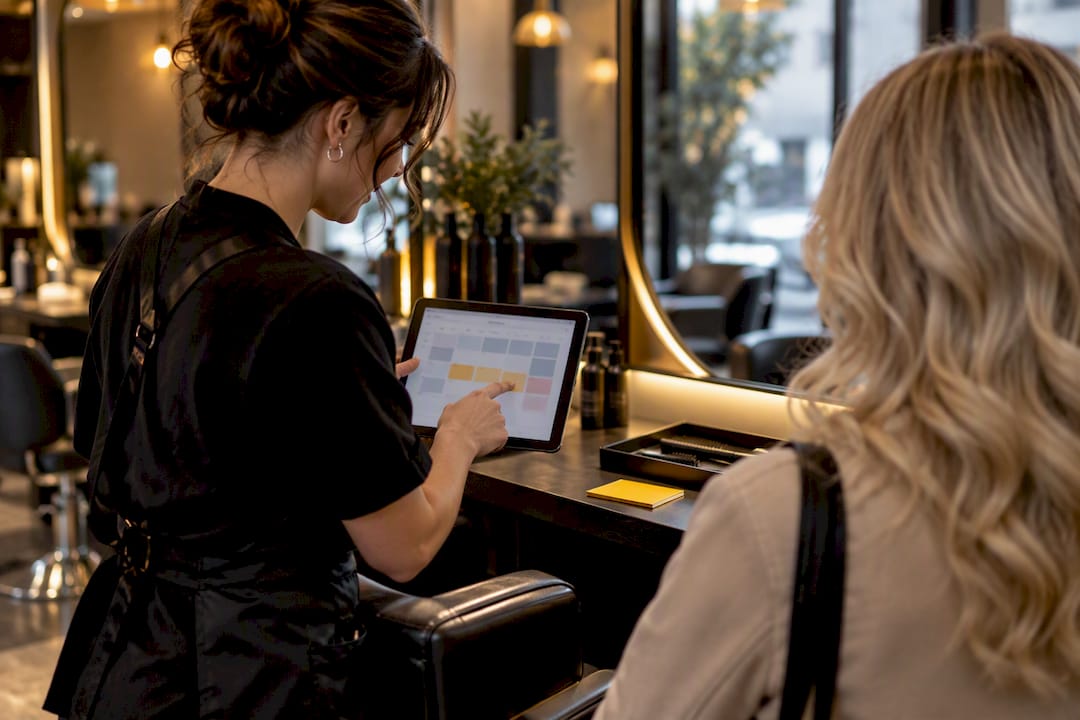
The fastest way to reduce salon churn is to make rebooking a default step and to remove friction from every route a client has back to your chair. Five rules do most of the work: book the next visit before the client leaves, take the friction out of booking and reminders, onboard new clients across their first three visits, measure retention by team member, and catch lapsed clients before they are gone. Once those are in place, loyalty schemes and win-back campaigns multiply your results instead of patching holes.
TL;DR:
- Ask for the next appointment at checkout, every time, with a reason tied to the service. The habit costs nothing and shows quickly whether your team will run the rest of the playbook.
- Let clients book at any hour and switch on reminders; in Altegio, the email channel for automatic notifications is free and a reminder goes out no earlier than 24 hours before the appointment.
- Treat the first three visits as onboarding and the pre-booking rate as your leading indicator. Retention moves more slowly because it needs at least one full service cycle.
- Measure retention by team member over a window that fits your service cycle, and review lapsed clients every week, not once a quarter.
- Invitations to come back and win-back offers are marketing: under the ePrivacy Directive, email and SMS marketing generally needs the client’s prior consent, so record it before you send.
Quick wins: what to change this week
You don’t need new software to slow the leak this month. You need four habits that most owners know about and rarely enforce.
- Rebook at checkout, every time. Train the front desk to ask “Shall I book you in for six weeks from today?” rather than “Would you like to book again?” The first question assumes a yes; the second invites “I’ll think about it”.
- Follow up within a day of the visit. A short thank-you or a feedback request keeps the conversation open while the visit is fresh. If the message also invites the client to book again, it is marketing, so check consent first (see rule 5).
- Check that reminders are actually on. Open your notification settings and confirm that reminders go out for every service, not just the ones someone set up years ago.
- Measure your pre-booking rate for two weeks. Count how many clients leave with their next appointment booked, then set next month’s target a few points above that baseline.
None of this costs more than a script change and a few minutes in the settings. It is also the quickest diagnostic: if your team resists asking for the next appointment, you have found the real churn problem before spending anything on technology.
Rule 1: book the next visit before the client leaves
Rebooking works when it is a default step, not a favour someone remembers to ask for on a good day. Make it as routine as taking payment.
- Build the ask into the payment moment. Whoever takes payment also confirms the next visit, so it never becomes a separate conversation that can be skipped.
- Give stylists a maintenance script, not a sales one. “Your colour will start to fade around week five – shall I hold your usual Thursday slot?” frames the ask as care rather than upselling.
- Match the interval to the service. A balayage client doesn’t need the same six-week cadence as a fringe trim. Timing the ask to real regrowth or wear makes it feel considered rather than automatic.
- Track the pre-booking rate weekly and reward the team for hitting the target, not only for total revenue booked.
In Altegio, the front desk can book the next visit without leaving the calendar. Open the client search panel in the Appointment Calendar (the square icon in the top right corner), find the client by name or phone number and click Professional’s Schedule: the weekly schedule of the team member the client was booked with opens, so you can pick a free slot and create the appointment while the client is still at the desk. Create Appointment copies the client’s details into a new individual appointment, so nothing has to be typed twice.
For clients on a fixed cycle, such as a weekly blow-dry or a monthly colour touch-up, set up a series instead. The Repeat appointment tab in the appointment window lets you choose how often the appointment repeats, the start date and time, and either a maximum number of repeats or an end date. Our guide to setting up recurring appointments walks through the options.
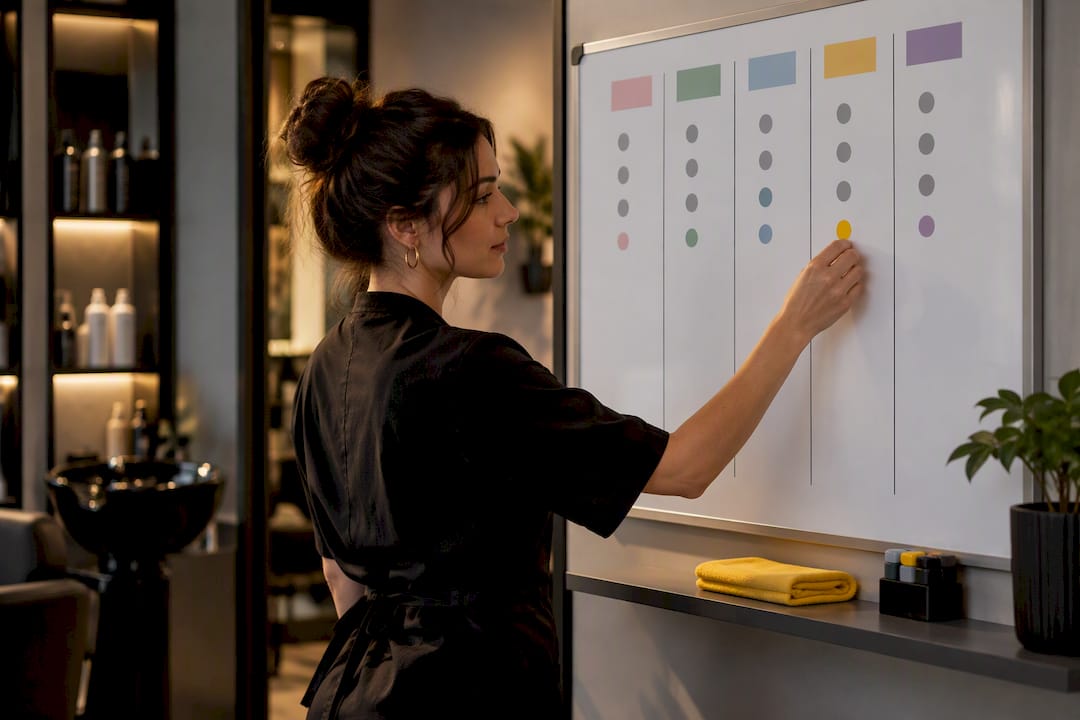
Pro tip: Put the pre-booking rate on a board in the staff room, by stylist. Nobody wants to sit at the bottom of a list everyone can see, and that quiet peer pressure often does more than a bonus.
Rule 2: take the friction out of booking and reminders
Every step between a client wanting to rebook and actually booking is a chance for them to drift elsewhere or simply forget. If a client thinks about their next appointment at 9 pm and your only channel is a phone that answers during the day, “I’ll call tomorrow” easily becomes “I never called”.
Test your own path the way a client would: open your booking page on your phone and count the taps to a confirmed appointment. Every extra screen is another chance to give up.
- Online booking at any hour. With Altegio online booking, clients book whenever it suits them. They can also book through a Book now button on Instagram and Facebook, connected through the app in the Integrations Hub, and through Reserve with Google, which is free.
- Automatic reminders. Altegio sends automatic notifications when an appointment is created or changed, as well as confirmation requests and reminders. The email channel is free, a reminder goes out no earlier than 24 hours before the appointment, and SMS runs through a connected provider who bills for it. Altegio’s help centre cites 30–40% fewer no-shows after SMS or push reminders are switched on.
- Payment policies for high-risk slots. A deposit at booking works with any payment provider available in your region; a card guarantee works only with Adyen, in EU countries. See payment policies and no-show protection.
- A waiting list someone actually works. Altegio’s waiting list has no automations, so when a slot frees up, someone calls or messages the next client on it. Make that part of your cancellation routine.
Before you choose or renew any booking system, check how it handles each of these. A calendar without reminders does only half the job.
Rule 3: onboard new clients across their first three visits
Whether a new client becomes a regular is often settled in the first few visits, so treat visits one to three as onboarding rather than leaving the second appointment to chance.
- Right after visit one, follow up with something specific to the service they had. In Altegio, once the visit is marked Arrived, a feedback request can go out automatically – one per visit, through Altegio’s internal review form.
- Around two weeks in, share aftercare that fits what they booked: colour care, a product that suits their hair, whatever is relevant. Send it personally, and only to clients who agreed to hear from you.
- Just before their expected return window, prompt the second appointment with the same maintenance framing stylists use in the chair. In Altegio, the Invitation for a follow-up visit does this automatically, with an interval you set for each service.
- After visit three, move them out of the onboarding track and into your normal cadence.
Track how many first-time clients reach a third visit: it is the most direct early read on future retention. In Altegio, the client filter Number of appointments shows who came once or twice and stopped, and a client category such as “New – onboarding” (Clients > All Clients > Bulk actions > Add to category) keeps the group visible to the whole team.
Rule 4: measure retention by team member, not only salon-wide
Revenue tells you what happened last month; retention tells you what next quarter will look like. Track it as carefully as takings.
Retention rate = clients who returned within the window ÷ all clients served in the period × 100. For example, if you served 120 clients and 78 came back within the window, retention is 78 ÷ 120 × 100 = 65%. Pick the window to fit your service cycle: if most clients come every six weeks, a 30-day window will undercount them, so use the typical interval plus a buffer, and a longer window to confirm that changes held.
- Break the results down by new and established clients, by team member, by service category and by whether the client pre-booked.
- Watch retention by team member closely. A salon-wide average can hide one chair quietly losing a third of its clients.
- Use the pre-booking rate as the leading indicator. It moves within weeks; retention needs at least one full service cycle to respond.
In Altegio, the Client Retention report in Analytics shows retention by team member. The Lost filter in the client base lists clients who have not come back within the lost-client period, which you set in Analytics > Settings > Client Churn, so match it to your own service cycle rather than a generic number.
There is no reliable universal benchmark for salon retention: it varies with service mix, price point and how often each service is needed. Compare yourself with your own baseline, by service and team member, and judge the trend over a quarter.
Rule 5: catch lapsed clients before they are gone
Clients rarely announce that they are leaving. They just stop booking, which is why catching the drift early matters more than a grand gesture months later.
- Nudge when a client passes their usual interval. In Altegio, the Invitation for a follow-up visit goes out after the interval set for the service, and a separate invitation can follow a no-show or cancellation.
- Follow up personally if the automatic nudge doesn’t land within a week or two, with a short message or call from their usual stylist.
- Offer a priority slot rather than a discount as the final nudge. It protects margin and still gives the client a reason to act now.
- Segment the list first so one client doesn’t get three overlapping campaigns. In Altegio, filter the client base (Lost, or clients who have not booked this month), then send through Clients > All Clients > Bulk actions: SMS or messengers through a connected provider or chat-bot from the Integrations Hub, or push to your branded Altegio app or to Altegio.me. Bulk messaging is switched on by Support. There is no bulk email in Altegio, so for an email campaign, export the client list to Excel and use a separate email service.
Track the recovery rate, the share of lapsed clients who book again after the sequence, separately from your overall retention figure.
Consent first. A reminder about an appointment the client has already made is part of the service. An invitation to come back or a win-back offer promotes your services, so treat it as direct marketing, and that includes automatic follow-up invitations. Under Article 13 of the ePrivacy Directive 2002/58/EC, marketing by electronic mail generally needs the client’s prior consent, and the Directive’s definition of electronic mail covers text messages too. The exception is the soft opt-in: if you got the client’s contact details when they bought a service from you, you can market your own similar services, provided they can object free of charge and easily when the details are collected and in every message. The safe course is to apply the same standard to messenger messages. Altegio’s booking form has only the mandatory personal-data consent checkbox, with no separate marketing consent, so record marketing consent yourself; when a client opts out, set Exclude in their client card. Each EU country implements the Directive in its own law, so check your national rules.
Loyalty that rewards frequency without eroding margin
A loyalty programme should make clients want to come back sooner, not train them to wait for a discount. Reward frequency and behaviour, not only spend.
- Keep the mechanics simple: points per visit, or “book within your window and earn a reward”, something a client can explain to a friend in one sentence.
- Reward with things that cost you little but feel valuable: priority slots, a complimentary add-on, early access to new treatments.
- Don’t lead with blanket discounts. They erode margin quickly and teach clients to book only when there is an offer.
- Go digital rather than paper. A balance held in your system can’t be left at home like a punch card.
- Pilot with one service category or one location first and check whether visit frequency actually shifts before rolling it out everywhere.
In the Altegio Loyalty Program you can set up discount programs, cashback and bonus cards, client categories with automatic rules, memberships and gift cards. Cashback can be tiered by number of visits, so the bonus grows the more often a client comes, which rewards frequency rather than spend. For more options, see seven salon loyalty program models.
Staff practices that make the rules stick
Systems only work if the people running them believe in them. A monthly retention review by team member turns an abstract goal into a concrete coaching conversation.
- Review each stylist’s retention one-to-one every month, not only at the annual appraisal.
- Tie part of any incentive to retention and pre-booking rate, not only to service revenue.
- Roleplay the rebooking script in team meetings until it sounds natural rather than scripted.
- Plan the handover for when a stylist leaves. When visit history and notes live in the client card rather than on someone’s phone, the relationship stays with the business. Our client card template shows what to record.
Pro tip: Ask your best-retaining stylist to run a 15-minute session showing exactly how they phrase the rebooking ask. Peer coaching often lands better than a memo from the manager.
A 90-day rollout plan, week by week
Rolling everything out at once overwhelms the team, and little of it sticks. Stagger it.
- Weeks 1–2: audit the booking path, fix the checkout script, confirm reminders are on and start counting the pre-booking rate.
- Weeks 3–6: set up the onboarding touches for new clients, switch on follow-up invitations with an interval per service, sort out marketing consent and pilot one simple loyalty mechanic with one team or service line.
- Weeks 7–12: start monthly retention reviews by team member, run coaching on the rebooking script and adjust messages based on what the first two months show.
- Around day 90: the pre-booking rate should be the first number to move; retention follows over the next quarter as onboarding and win-back sequences mature.
Don’t judge the programme at 30 days. The pre-booking rate is the leading indicator; retention is the lagging one that proves it worked.
Practical limits and trade-offs
Rollouts tend to fail from over-automation rather than under-automation. Owners add complex loyalty rules and several message sequences before the team has mastered the basic rebooking ask, and the system collapses under its own weight. Start with rebooking and follow-up invitations, prove they work, then add loyalty, and treat every change as a small, measured pilot rather than a salon-wide leap.
How Altegio supports this playbook
Altegio is booking and business management software for appointment-based businesses, from beauty and wellness to clinics, auto services and fitness, so you don’t have to stitch together separate tools for booking, reminders, loyalty and reporting. Altegio also follows a Zero-Competition Policy: it isn’t a marketplace, so clients book through links that belong only to your business, they don’t see competitors while booking, and your client base is never resold.
- Rebooking: the client search panel in the Appointment Calendar opens the team member’s weekly schedule, and the Repeat appointment tab creates a series for fixed cycles.
- Booking and reminders: online booking, a Book now button on Instagram and Facebook, free Reserve with Google and automatic notifications with a free email channel.
- Follow-up: a feedback request after the visit, an Invitation for a follow-up visit with an interval per service and an invitation after a no-show or cancellation.
- Measurement: the Client Retention report by team member and the Lost filter with a lost-client period you set.
- Loyalty: discount programs, cashback and bonus cards, client categories, memberships and gift cards.
Altegio doesn’t charge its own commission on payments; card processing is billed by the connected payment provider. The price depends on the number of team members and the billing period (see pricing), migration and support are free, and you can test the setup on your own appointment flow with a 7-day free trial.
FAQ
How can I reduce my salon’s churn rate?
Start with three basics: ask for the next appointment at checkout, let clients book online at any hour and switch on reminders. Once those run smoothly, add a structured onboarding for new clients and retention tracking by team member.
Why do hair salons close down?
Closures usually have several causes, such as rising costs, staffing problems and competition. Slow client loss is the one you can measure early: when rebooking isn’t systematic, clients drift away and nobody notices until revenue has already dropped. Tracking retention monthly gives you time to act.
Is a higher or lower churn rate better for a salon?
Lower is better. It means more clients come back instead of leaving after one or two visits, and every client who stays is one you don’t have to replace through marketing.
What does “reducing churn” actually mean for a salon?
It means increasing the share of clients who come back for repeat visits instead of booking once and disappearing. You measure it with your retention rate, the percentage of clients who return within a window that fits your service cycle, both overall and by team member and service.
What is a good salon retention rate to aim for?
There is no reliable universal figure: retention depends on service mix, price point and how often each service is needed. Measure your own baseline by service and team member, then aim to improve it quarter by quarter rather than chasing someone else’s number.
Do rebooking messages need the client’s consent?
A reminder about an appointment the client has already made is part of the service. An invitation to book again or a win-back offer promotes your services, so treat it as marketing: under the ePrivacy Directive, email and SMS marketing generally needs prior consent, with a soft opt-in for existing clients for your own similar services and an easy way to opt out in every message. National rules differ, so check yours.
Read next
- Reminders and deposits: how to reduce no-shows
- How to set up recurring appointments in your booking system
- Salon Loyalty Programs: 7 Models That Work in 2026
- Client card – cosmetology, lashes, nails: what to record and a template to download
This article is general information, not legal advice. Rules differ between EU countries, so check your national law before you send marketing messages.