Why Most Salon Loyalty Programs Fail Before They Start
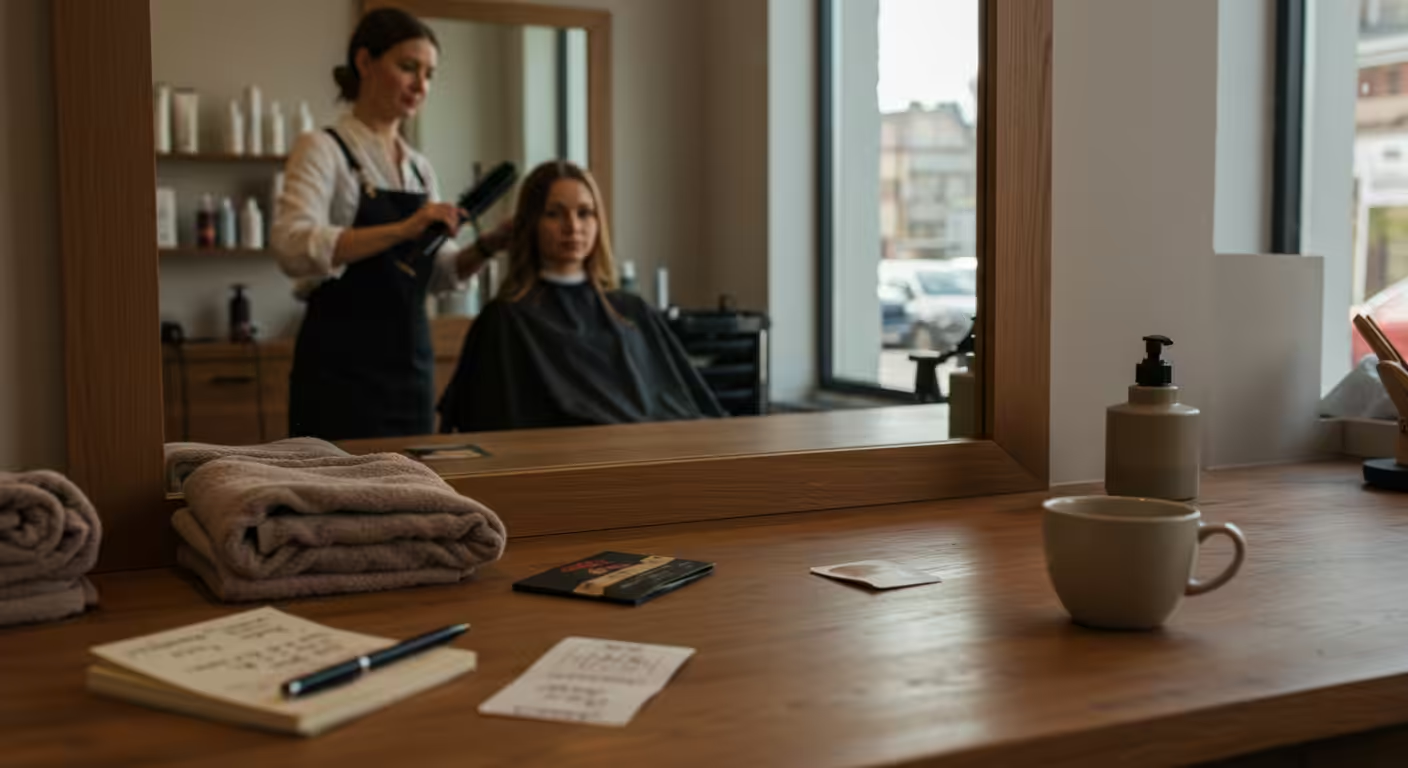
Walk into any salon supply store and you will find the same sad artifact: a cardboard punch card, half-stamped, crumpled at the bottom of a client’s purse. That card represents the industry’s default approach to loyalty — transactional, forgettable, and almost completely ineffective.
The real problem is not the punch card. It is the thinking behind it. Most salon owners treat loyalty as a discount mechanism: spend money, get a stamp, earn a free service. But loyalty is not a transaction. It is an emotional state. A client who comes back because she has five out of ten stamps is a client who will leave the moment another salon offers six.
A client who comes back because she feels genuinely known, valued, and rewarded — that client stays for years, spends more per visit, and tells everyone she knows about you. And that difference is not about budget. It is about design.
In this guide, we will break down exactly how to build a loyalty program that actually changes client behavior — from the psychology that makes rewards feel earned to the booking platform features that make execution effortless.
1. Start With the Psychology, Not the Mechanics
Before you decide between points and tiers, understand what you are actually trying to create. Behavioral science identifies three drivers of repeat behavior in service businesses: progress (the client can see herself getting closer to something), status (she feels recognized as special), and reciprocity (she has received genuine value and wants to give back).
A good loyalty program activates all three. A bad one activates none. The most common mistake is designing a program around what is easy for the salon — automated stamps, generic birthday discounts — rather than what actually motivates the client.
Ask yourself: what would make a client feel a little pang of excitement when she opens her booking app? That is the bar. If your program does not clear it, keep designing.
2. The One-Sentence Rule
Can your client explain your loyalty program in one sentence? If the answer involves charts, tier conversion rates, or the phrase “it depends on the service,” you have already lost half your potential engagement.
The best programs are transparent. “You earn one point for every dollar you spend, and a hundred points gets you a free treatment” — that is a complete explanation. The client understands it instantly, can track it mentally, and makes booking decisions based on it. Complexity kills adoption, and adoption is everything.
3. Match the Reward Pace to How Your Clients Actually Visit
A loyalty program with a reward horizon of eighteen months is not a loyalty program. It is a vague promise nobody believes in. The timeline between joining and your first meaningful reward should be measured in weeks, not quarters.
For clients who visit monthly, the first reward should land within two to three months. For clients on a six-week rotation, stretch that to four or five. The rule is simple: the reward should always feel like the natural next step, not a distant aspiration. If a client opens your booking platform and sees she is one visit away from a free upgrade, she books. If she sees she needs eight more visits, she scrolls past.
Modern salon management platforms let you configure earning rates per dollar or per action. The best approach is to model your loyalty economics against actual visit patterns — not ideal ones. Look at your average client’s annual spend and visit frequency, then work backward to a reward cadence that feels tangible.
4. Reward the Behaviors You Want to Grow, Not Just Spend
The narrowest loyalty programs reward only dollars. The smartest ones reward engagement. Think about which client behaviors actually drive your business forward: booking online instead of calling (frees your front desk), showing up on time (protects your schedule), leaving a review (builds social proof), referring a friend (no-cost acquisition).
A well-designed points system can award points for each of these actions. A client who books through your online platform, arrives for her appointment, and leaves a Google review in the same week should see her loyalty balance grow meaningfully. That kind of multi-touch reward structure makes every positive interaction feel like progress — and progress keeps people coming back.
5. Design Rewards That Feel Luxurious, Not Discounted
The economics of loyalty rewards have a counterintuitive truth: the most motivating rewards are usually the cheapest for you to deliver. A complimentary ten-minute scalp massage added to a color appointment costs almost nothing in materials or time. But to the client, it is an elevated experience — something she would not buy for herself but genuinely looks forward to receiving.
Compare that to a 10% discount. The discount costs you more in real revenue, positions your services as negotiable, and does not feel like a gift — it feels like a price reduction. Over time, discount-heavy programs train clients to wait for the deal. Experience-based programs train them to chase the next milestone.
Build your reward menu around things that have high perceived value and low marginal cost: service upgrades, exclusive add-ons, early access to new treatments, a birthday upgrade, a complimentary product sample that leads naturally to a retail sale.
6. The Economics Have to Work — Here Is the Math
Loyalty is not charity. A program that bleeds margin is unsustainable, but one that is too stingy generates no excitement. The industry benchmark is straightforward: aim to return roughly 3-5% of a loyal client’s annual spend in rewards.
For a client spending $1,200 a year, that is $36 to $60 in reward value — enough to feel meaningful without hurting your bottom line. The key insight here is that acquiring a new client costs five to seven times more than retaining an existing one, depending on your marketing channels. Even at the top end of the reward range, a loyalty program is dramatically cheaper than the alternative.
Track the numbers closely during the first quarter: reward redemption rate, average spend of loyalty members versus non-members, and visit frequency. If the gap is not widening after three months, your reward structure or communication cadence needs adjustment.
7. Digital Tracking Beats Paper Cards Every Time
Physical punch cards have exactly one advantage: they are cheap to print. Everything else about them is worse. Clients lose them. Stylists forget to stamp them. You have zero visibility into who is close to a reward and who abandoned their card six months ago.
A digital loyalty system integrated with your booking platform eliminates all of that. Points accrue automatically when a client checks out. Balances are visible in the client’s account at all times. And critically, you get data: which rewards are actually being redeemed, which clients are most engaged, and where your program is losing momentum.
The data alone is worth the switch. Knowing that 60% of your loyalty members are within one visit of their next reward is actionable in a way that a drawer full of half-stamped cards never will be.
8. Tiered Memberships Build Status, and Status Builds Retention
If points are the engine of your loyalty program, tiers are the aspiration. A well-designed tier system gives clients a reason to consolidate their spending with you rather than spreading it across three different salons.
Start with three levels. The first tier is automatic on enrollment — everyone gets something for joining. The second tier activates at a realistic spend threshold that your regulars hit within four to six months. The third tier is aspirational: reserved for your top 10% of clients, with genuinely exclusive perks like priority booking during peak hours, a quarterly members-only event, or first access to new service launches.
The psychology here is powerful. Clients who are close to the next tier tend to book a little sooner and upgrade a little more often — not because they are chasing discounts, but because status feels good. You are not selling them a cheaper haircut. You are inviting them into a club.
9. Make the Referral Loop Automatic
Your most loyal clients are already telling people about you. A referral program does not create that behavior — it amplifies it by giving both sides a reason to act.
The structure is simple: when an existing client refers a friend who books and completes an appointment, both receive a reward. The reward should be genuinely motivating — a substantial discount on the next service, bonus loyalty points, or a complimentary add-on. For the new client, the incentive reduces the perceived risk of trying a new salon. For the referrer, it turns passive word-of-mouth into active advocacy.
Make the referral link easy to share. If your booking platform supports it, give every client a unique referral code visible in their account. One tap to copy, one tap to share in a text message or Instagram DM. Friction is the enemy of referrals.
10. The Launch Matters More Than the Design
A beautifully designed loyalty program that nobody knows about is worth exactly nothing. The launch phase — roughly the first month — determines whether your program becomes part of your salon’s culture or fades into the background.
The single most effective launch tactic is personal outreach to your existing regulars. A message that references their actual history with you lands far better than a generic Instagram post. “We have loved having you in the chair seven times this year, so we built something to celebrate that. Under our new program, you would already be close to your first reward — and from your next visit, every appointment counts.” That message gets responses.
Segment your client base for launch communications. Your three-year regulars get one message. Your once-a-month clients get another. New clients from the last quarter get a third. The closer the message feels to a personal note rather than a marketing blast, the higher the enrollment rate.
11. Bake Loyalty Into Every Client Touchpoint
For the first month after launch, the loyalty program should surface everywhere: the booking confirmation email, the pre-appointment reminder, the check-in conversation at the desk, the checkout script, the follow-up message the next day.
This is not about being pushy. It is about consistency. A client who hears about the program from their stylist, sees it in their confirmation message, and gets a follow-up that mentions their current points balance experiences the program as a natural part of the relationship — not a marketing add-on.
The checkout moment is especially important. “You just earned 45 points on today’s appointment — you are only two visits away from your free treatment” is useful information delivered at exactly the right moment. It costs five seconds and has one of the highest returns of anything you will do that day.
12. Your Team Is the Program’s Most Important Channel
Your stylists and front desk staff are the interface between your loyalty program and your clients. If they are bored by it, the program will fail — regardless of how well it is designed.
Get your team involved before launch. Show them the reward structure, ask for their input on what clients would genuinely value, and give them ownership of the rollout. When a stylist is excited to tell her regulars about the new program, clients feel that energy and respond to it. A fifteen-second mention during checkout, delivered by someone who genuinely believes in the program, converts at a rate no email campaign can match.
Consider a small internal incentive during the launch month: a bonus for the stylist who enrolls the most loyalty members, or a team celebration when the program hits its first hundred sign-ups.
13. Use Automated Reminders to Keep the Program Alive
The danger zone for any loyalty program is the gap between visits. A client who comes every six weeks has forty-two days to forget about your program entirely — and about you.
Automated messaging solves this. A booking platform with built-in loyalty tracking can trigger messages based on real data: a reminder that points are about to expire, a nudge when the client is one visit away from the next tier, a celebration when a reward becomes available. These messages are not spam — they are service. They tell the client something she genuinely wants to know, at the moment it is most relevant.
Set up at least three automated loyalty messages: a post-appointment points update, a mid-cycle status reminder, and a re-engagement trigger at the eight-week mark for clients who have not rebooked. The re-engagement message should reference their actual balance: “You have 140 points waiting for you — one more visit unlocks your reward.” That is infinitely more effective than a generic “we miss you.”
14. Track the Numbers That Actually Matter
Vanity metrics will mislead you. Total loyalty enrollments means nothing if those clients are not changing their behavior. The numbers you should have on a dashboard — ideally inside your salon management platform — are:
- Visit frequency: loyalty members vs. non-members, tracked monthly
- Average spend per visit: are loyalty members upgrading more often?
- Retention rate at 6 and 12 months: are loyalty members staying active longer?
- Referral conversion: how many new clients arrived through a loyalty member’s referral link?
- Reward redemption rate: are clients actually using their rewards, or are they accumulating points with no intent to redeem?
If redemption rates are low, your rewards are either not desirable enough or not visible enough. If visit frequency is flat between members and non-members, your reward timeline is too long to influence booking behavior.
15. Re-engage Quiet Clients With Their Own Loyalty Data
Every salon has a segment of clients who were once regulars and then quietly stopped booking. Life gets busy, routines shift, a new salon opens closer to their office. The worst response is silence. The best response is a warm, data-informed reach-out.
A loyalty program gives you the perfect reason: “You have a reward waiting for you” is one of the best messages a client can receive from a business. It does not feel like marketing. It feels like someone remembered them — because someone did.
Set up an automated trigger at the eight-to-ten week mark for lapsed loyalty members. Reference their tier status, their points balance, and the specific reward they are close to unlocking. Make rebooking frictionless: include a direct link to your booking platform, pre-populated with their last service. Every extra click between the message and the confirmed appointment costs you conversions.
16. Start Simple, Then Layer In Complexity
The most common failure mode in loyalty program design is trying to launch with everything at once: points, tiers, referrals, exclusive events, birthday upgrades, product discounts, and a gamified leaderboard. The result is a confused client base and an overwhelmed team.
Start with points. Just points. Set a clean, simple earning rule, create one genuinely desirable reward, and make sure every client knows about it. Run that for two months. Watch the data. See how your clients engage.
Once points are running smoothly and clients are actively tracking their balances, add tiers. Once tiers are established and your top clients are proudly identifying with their status level, add referrals. Each layer builds on the one before it, and each addition has a proven foundation of engagement to work with.
17. Integrate Loyalty With Your Full Booking and Management Platform
A standalone loyalty program is an island. It does not talk to your booking calendar, your client profiles, your payment history, or your marketing tools. That means manual data entry, missed touchpoints, and a program that requires constant babysitting.
An integrated platform — where loyalty lives inside the same system that handles scheduling, payments, and client communication — changes everything. Points accrue at checkout automatically. Clients see their balance when they book their next appointment. Your marketing messages reference real loyalty data rather than generic templates. The program runs in the background while you and your team focus on what you do best.
This is where choosing the right salon management software becomes a strategic decision. When your booking system, client profiles, payment processing, and loyalty tracking all share the same data layer, the operational overhead of running a loyalty program drops to near zero — and the client experience becomes seamless.
18. Keep the Program Fresh With Seasonal and Event-Based Rewards
A loyalty program should not be static. The reward menu that works in January may feel stale by June. Build in seasonal refreshes: a summer upgrade reward, a pre-holiday double-points weekend, a client-anniversary bonus that triggers automatically on the one-year mark of their first visit.
These limited-time rewards create urgency without feeling manipulative. They give your team something new to talk about and give your regulars a fresh reason to engage with the program. The key is to plan these seasonal touches in advance — a quarterly reward refresh takes an afternoon to design and pays dividends in sustained engagement.
Your booking platform’s reporting tools should make it easy to identify which seasonal promotions drove the most redemptions. Double down on what works and quietly retire what does not.
The Bottom Line
The best loyalty program is not the most elaborate one. It is not the one with the most tiers or the flashiest rewards catalog. It is the one that is live, that your team talks about with genuine enthusiasm, and that makes your clients feel like being a regular at your salon actually means something.
Start with points. Make the rewards feel luxurious rather than discounted. Integrate the program into your booking platform so it runs automatically. Launch with personal outreach to your existing regulars. Track the numbers that matter, not the ones that flatter. And remember: a client who opens her booking app and feels a small spark of excitement about her progress is a client who is already planning her next visit before she has finished her current one.
That is not a discount strategy. That is a retention engine — and it is the single highest-return investment you can make in your salon’s future.