
Booking marketplaces can fill empty slots, but they come with four trade-offs: the platform often sits between you and the client’s contact details, fees can keep applying when the same client rebooks through it, the platform may use client data for its own purposes, and suspensions or sync problems can disrupt your day. None of this rules marketplaces out. It means you should read the terms, test the channel with a 90-day pilot and make sure every client also ends up in a booking system and client base you control.
TL;DR:
- Marketplaces often hold the client relationship: contact details and appointment history sit in the platform, which makes direct rebooking harder.
- In C-492/23 (December 2025), the EU Court of Justice treated an online marketplace operator as a controller of personal data it could exploit for its own commercial purposes, so read what a platform’s terms allow it to do with client data.
- The EU P2B Regulation requires platforms to describe data access in their terms, give at least 15 days’ notice of changes and state reasons for suspensions.
- A 90-day pilot with fixed KPIs – net-new clients, net revenue after fees and direct return rate – shows whether the channel pays for itself.
- Run your own booking channel in parallel, so every client a marketplace brings can come back to you directly.
What a booking marketplace really costs: client ownership, fees, data and brand
Think of a marketplace like a hypermarket. Your service sits on a shelf next to a dozen competitors, and the hypermarket, not you, decides who sees it, who gets the loyalty card and who keeps the receipt. That is the real trade-off.
The biggest issue is client ownership. Marketplaces typically mediate contact between you and the client, so the client’s phone number, email and appointment history often sit in the platform’s database rather than yours. You can’t invite back someone whose contact details you never received.
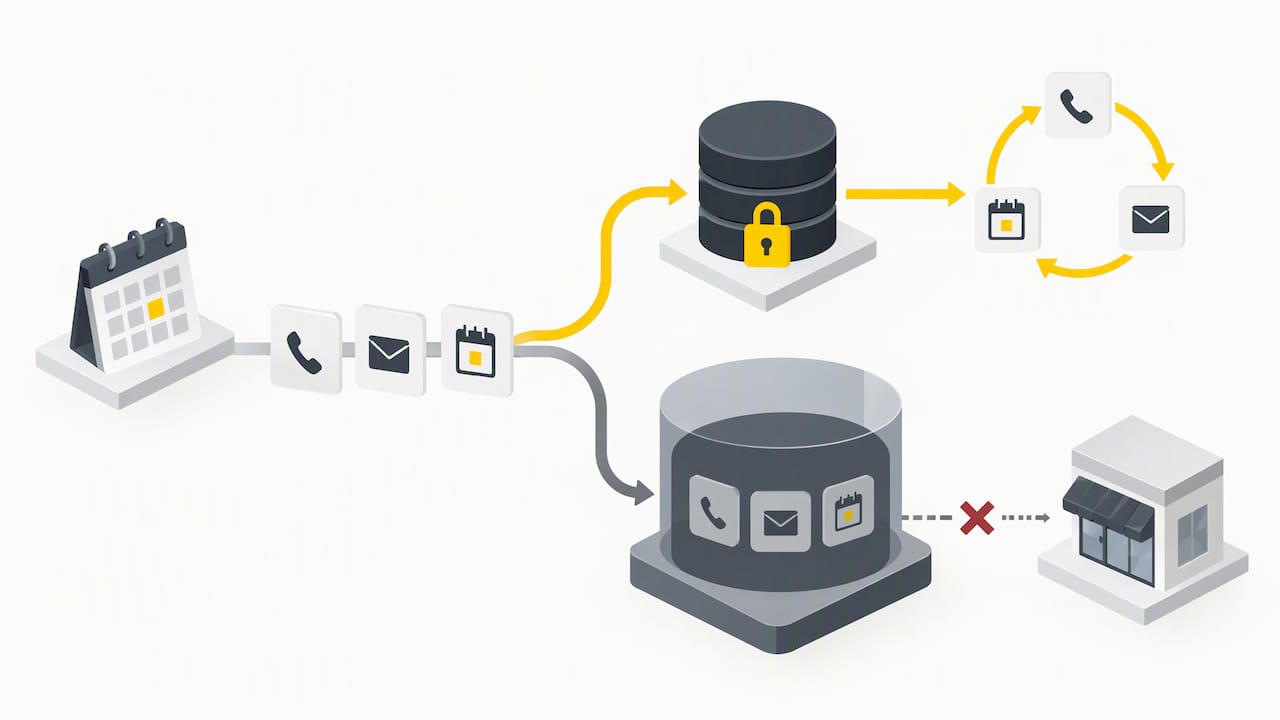
Then there is margin. Fee models differ between platforms and change over time, so check the current price list of the platform you are considering rather than relying on averages. Whatever the model, a fee that also applies to repeat appointments made through the platform keeps costing you every time the same client returns, and side-by-side listings put your prices right next to your competitors’ prices.
Platform terms can also give the operator broad rights to use listing content and client information for its own advertising or other commercial purposes. In the EU, the platform has to describe its access to that data in its terms (more on that below), so read that part closely before you sign.
Other issues to plan for:
- Your brand gets flattened into a generic listing, often without the personality that makes clients choose you specifically.
- Calendar conflicts and double bookings appear when marketplace slots and your own calendar aren’t kept in sync.
- Reconciling payments, refunds and no-shows across two systems becomes a monthly headache rather than a quick check.
- Price pressure from side-by-side listings can push you towards discounting just to stay visible.
None of this means marketplaces are worthless. It means they need guardrails.
EU rules: who controls client data and what platforms must tell you
The legal picture is more nuanced than “the platform handles compliance, so you don’t have to”. Under the GDPR (Regulation 2016/679), whoever determines the purposes and means of processing personal data is a controller (Article 4(7)). Whether a marketplace acts only on your behalf, as your processor, or as a controller in its own right changes what it may do with your clients’ information.
In Russmedia (C-492/23, judgment of 2 December 2025), the Grand Chamber of the Court of Justice of the EU looked at a classified-ads marketplace whose terms let it copy, distribute, modify and pass on published content. The Court held that the operator was a controller of the personal data in those ads, because it could exploit them for its own advertising and commercial purposes, and noted that a platform’s terms of use can be evidence of decisive influence over the processing. The case was about classified ads, not appointments, but the lesson carries over: a platform is not automatically a neutral intermediary, and its terms show what it can do with the data.
The Platform-to-Business (P2B) Regulation 2019/1150, which has applied since 12 July 2020, adds transparency duties for online intermediation services that let businesses established in the EU offer goods or services to consumers in the EU, wherever the platform itself is based. A booking marketplace that lists your services and passes appointments to you generally fits that definition. Among other things, the platform must:
- Describe in its terms what personal and other data it can access, what data you can access, and whether data goes to third parties – and, where that sharing isn’t needed for the service, whether you can opt out (Article 9).
- Notify you of changes to its terms on a durable medium at least 15 days in advance (Article 3(2)).
- Give you a statement of reasons when it restricts or suspends your listing, and at least 30 days’ notice with reasons before terminating the whole service, with limited exceptions such as repeated breaches of its terms (Article 4).
- Set out in its terms the grounds for any restriction on offering your services on different conditions through other channels, for example at a different price (Article 10).
- Run an internal complaint-handling system for business users (Article 11).
Transparency is not the same as protection. The Regulation makes platforms tell you the rules, but it doesn’t oblige them to hand over client contact details, so the business decisions below still matter.
Before listing anywhere, check:
- Who the terms name as controller of client personal data, and for which purposes.
- What client data you can see and export – names, phone numbers, emails, appointment history – during the contract and after it ends.
- Whether client data is shared with third parties or used for the platform’s own advertising, and whether you can opt out.
- Any restriction on offering different prices or conditions through your own channels.
- What happens to your listing, reviews and appointment records if the account is suspended or closed.
Operational and financial consequences to plan for
Fees don’t just dent this month’s payout, they compound. A client you acquire through a marketplace and never get contact details for is likely to rebook there, and depending on the fee model you may pay again for that visit, because you have no direct way to bring them back yourself.
Reconciliation gets messier too. Payments, refunds and no-show charges often run through the marketplace’s own ledger, which rarely lines up neatly with your own records, so month-end checks take longer.
- Double bookings happen when marketplace availability and your main calendar aren’t updated in real time.
- Notes and client preferences get lost between systems, which frustrates the team and clients alike.
- Demand swings when the platform runs a promotion you didn’t plan for, and your team schedule has to absorb it.
- If your account is suspended, paused during a dispute, or the platform changes how it ranks listings, those appointments can drop sharply at short notice.
The P2B Regulation gives you reasons and, for a full termination, 30 days’ notice, but it doesn’t guarantee you a copy of your clients’ contact details. Treat a suspension or a platform shutdown as a business continuity risk, not just an inconvenience.
Mitigation checklist: steps to reduce marketplace risk and keep client ownership
You don’t need to choose between “all in” and “all out”. A structured approach gets you the reach without most of the downside.
- Negotiate terms upfront where you can: data export rights, no exclusivity, and written permission to contact clients you acquire through the platform directly.
- Decide how marketplace appointments reach your main calendar – an integration, if the platform and your software offer one, or a fixed routine of entering them straight away – and close slots you have sold elsewhere so the same time can’t be booked twice.
- Record every client in your own client base, whatever the channel, and ask for marketing consent separately from the booking terms.
- Give clients a reason to book with you directly next time: a loyalty programme, a membership or a next appointment booked before they leave.
- Set your own pricing policy for marketplace listings, check any parity restriction against the grounds the platform has published, and train the team to offer direct rebooking.
- Reconcile marketplace payouts against your own records every month to catch discrepancies early.
On consent: under the ePrivacy Directive 2002/58/EC (Article 13), marketing by email – which in the Directive includes SMS – generally needs the client’s prior consent. The exception for existing clients covers only your own similar services, and only if clients can object easily and free of charge when you collect their details and in every message. If the contact details reached you through a marketplace rather than from your own sale, that exception may not apply in the same way, so ask for consent at the first visit. National rules differ, so check yours.
How to run a 90-day marketplace pilot
Treat the pilot as a genuine test, not a formality. Fix the KPIs and the decision rule before the first appointment, then let the numbers decide.
- Net-new clients: people whose first-ever visit came through the marketplace. Check each phone number against your client base, so existing clients who rebook through the platform aren’t counted as new.
- Net revenue after fees: what those clients paid, minus every marketplace fee they triggered.
- Direct return rate: the share of new marketplace clients whose next appointment was booked through your own channels within the 90 days.
- Operational cost: double bookings, no-shows and payout discrepancies linked to the marketplace.
A worked example with hypothetical figures, not any platform’s actual fees: over 90 days a marketplace brings 40 net-new clients with an average first-visit bill of €55, which is €2,200. If the fee is €12 per new client, you pay €480 and keep €1,720, or €43 per client. By day 90, 14 of the 40 have booked their next visit directly with you (35%), 10 have rebooked through the marketplace (25%) and 16 haven’t come back (40%).
Then compare. Is €12 per new client cheaper than what your other channels cost you per new client, and is the direct share growing? If the platform also charges for the 10 rebookings, add those fees to the cost side before you decide. If the numbers don’t justify the fees once you factor in the clients you can’t invite back, that’s your answer.
If you run the pilot in Altegio, note one limit: the Appointments report splits appointments only into online and offline, so it can’t tell you which ones came from a marketplace. A simple workaround is to add every marketplace client to a dedicated client category, for example “Marketplace pilot”, when you enter their first appointment. At day 90, filter the client base by that category and by number of appointments to see who came back, and use the Lost clients filter to find the ones worth inviting back – the lost-client period is a setting under Analytics > Settings > Client Churn. More on the reports in statistics and analytics.
Decision framework: quick questions to decide whether to adopt, test or avoid marketplace bookings
Before signing up, ask yourself:
- Reach versus control: do we need the extra visibility enough to accept the data and fee trade-offs?
- Margin test: will the fees make certain services unprofitable, or force us to raise prices elsewhere to cover them?
- Data capture: can we reliably get contact details and consent at the first visit, so we’re building something of our own?
- Red flags: do the terms block data export, penalise appointments made outside the platform, or leave the controller role vague?
Any “no” to the first three, or “yes” to the last, is a reason to pause before committing.
Your own booking channel: what it covers and what it doesn’t
Your own booking system doesn’t replace a marketplace’s audience. What it gives you is a channel where the client relationship stays with you, so every client a marketplace brings can come back directly. In Altegio, software for appointment-based businesses such as beauty, wellness, clinics, auto services and fitness, that channel looks like this:
- Online booking through your own booking link and website widget, a Book now button on Instagram and Facebook connected through the Integrations Hub, and Reserve with Google, which is free and connected under Integrations > Client acquisition > Google Maps. Appointments from all of them land in the same calendar.
- One client base for every channel, with filters and client categories, and an export of the client list to Excel. Duplicate client cards are merged by hand.
- Altegio.me, Altegio’s free client app. Clients sign in with the phone number they booked with, see their upcoming and past appointments, repeat a past visit with Book again, cancel or reschedule if your online booking settings allow it, and keep their memberships and gift cards in one place. Push notifications through Altegio.me are free, and a branded app under your own name is also available.
- Automatic notifications: reminders, repeat-visit invitations, feedback requests after a visit and birthday greetings by free email, or by SMS and messengers through a connected provider. Bulk messages go out by SMS or messenger, or as push to Altegio.me or your branded app. Bulk messaging is enabled by Support, and there is no bulk email.
- Loyalty program: discounts, bonus cards with cashback, memberships and gift cards, plus a referral program at Chain level.
- No-show protection: deposits through a connected payment provider, and card guarantees with Adyen in EU countries.
Altegio is a subscription: the price depends on the number of team members and the billing period (see pricing). Altegio doesn’t charge its own commission on online payments – only the payment provider’s fees apply.
Two honest limits. The booking form has a mandatory personal-data consent checkbox but no marketing-consent checkbox, so record marketing consent separately; an opt-out is set manually in the client card. And your own channel doesn’t bring a marketplace’s audience by itself: new reach comes from Reserve with Google, social booking, your website and word of mouth.
To try it with your own data, start the 7-day free trial. Moving your client base over is free.
What actually matters here
Most advice on this topic focuses on reading the contract carefully, which is sound but incomplete. The bigger gap is not having your own place to keep client contact details at all, marketplace or not, so even a well-negotiated contract leaves you with nothing to fall back on when the platform changes its terms.
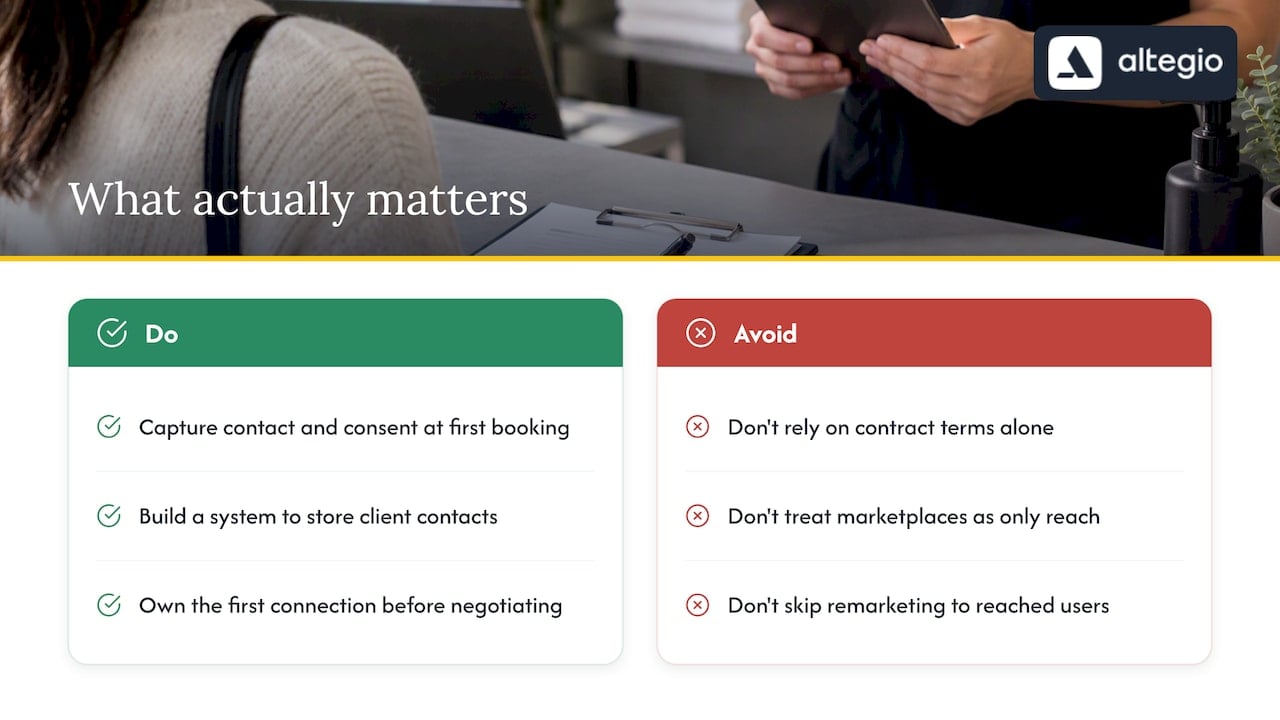
Marketplaces are usually treated as a reach problem. It is more useful to treat them as a data ownership problem first: reach without a way to invite people back is a rented audience, not a growing one.
If you only do one thing from this article, make it this: record every client’s contact details in your own client base from the first visit, and ask for marketing consent separately, before you negotiate anything else. Loyalty programmes, pricing policy and pilot KPIs only work once that first connection is yours.
FAQ
Are marketplace bookings inherently risky for small service businesses?
Not inherently, but they carry real trade-offs: weaker direct contact with clients, fees and possible use of client data by the platform. The risk is manageable with the right terms, a 90-day pilot and a parallel booking channel of your own.
Who owns client data collected through a booking marketplace?
It depends on the platform’s terms and on its actual role. Under the GDPR, a platform that uses client data for its own purposes can be a controller in its own right – in C-492/23 the Court of Justice treated a classified-ads marketplace that could exploit published data for its own commercial purposes in exactly that way. Check the data-access section that the P2B Regulation requires in the platform’s terms.
Does the P2B Regulation protect businesses from unfair marketplace terms?
Partly. It requires plain and intelligible terms, at least 15 days’ notice of changes, reasons for restrictions and suspensions, 30 days’ notice before a full termination and an internal complaint-handling system. It is mainly a transparency rule, though: it doesn’t oblige a platform to hand over client contact details.
What’s the simplest first step to reduce marketplace dependency?
Record every client’s contact details in your own client base from the first visit and ask for marketing consent separately. That single habit is what makes direct rebooking and loyalty programmes possible later.
Can my own booking system replace a marketplace?
It can take over booking, reminders, payments and loyalty without a fee to a platform for each appointment. It doesn’t bring a marketplace’s audience on its own, so pair it with Reserve with Google, social booking and your website, or keep a marketplace as one channel and measure it with a pilot.
Read next
- Reserve with Google and Reserve with Meta (Instagram/Facebook): social booking in one place.
- Reminders and deposits: how to reduce no-shows.
- Salon Loyalty Programs: 7 Models That Work in 2026.
- Client card – cosmetology, lashes, nails: what to record and a template to download.
This article is general information, not legal advice. Rules differ between EU countries.