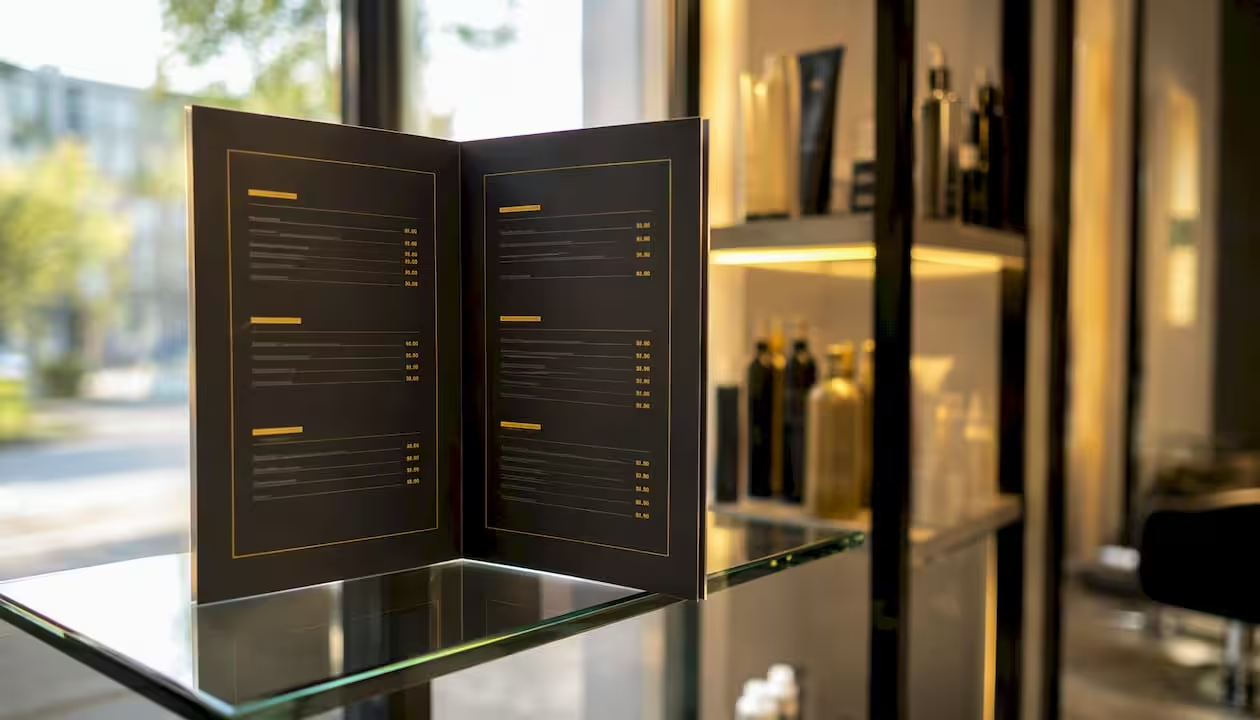
Your service menu works as a salesperson every hour you are open and every hour you are not. A clear menu guides clients towards the right appointment, sets accurate expectations on time and price, and protects your margins. A confusing one leaves clients guessing, and clients who are guessing book less, or not at all.
A strong menu does three jobs: it sells outcomes, organises what you offer and protects your margins. The elements it needs:
- Clear service categories (Hair, Colour, Nails, Skin, Waxing, Makeup, Massage, Barbering, Packages).
- Benefit-led service names and descriptions of two to three lines.
- A duration for every service.
- A price or price band including VAT, with “from” used only where the variation is genuine.
- Add-ons listed next to the services they belong to.
- Packages with a modest saving (5–10% off the à la carte total).
- Short policy snippets: cancellation, deposits, surcharges, payment methods.
Two things you can do in the next 48 hours:
- Pull your last 90 days of appointments and find your top five services by volume. These are your anchors.
- Pick the category that brings in the most revenue and restructure it first, using the templates below.
Key takeaways
| Point | Details |
|---|---|
| Structure before price rises | Fix categories, durations and add-ons first, then review prices once you know what each service costs you. |
| Anchors shape perception | One premium service at the top of each category makes the rest of the list read as good value. |
| Add-ons sit next to the main service | Price them at roughly 20–30% of the base service. |
| EU price rules apply | Show consumers the total price including taxes; when you announce a reduction on a product, show the lowest price of the previous 30 days. |
| Altegio runs the menu from one catalogue | Prices per team member or as a range, durations, descriptions, images and online prepayment are set per service. |
What does your salon service menu actually need to achieve?
A menu has two bosses: the client and the business. For the client, it must answer three questions instantly: what do you offer, how long will it take and what will it cost? Anything that makes those answers harder to find is friction, and friction loses appointments.
For the business, the menu is a commercial tool. It shapes your average ticket, spreads chair use across the week, creates a natural path to add-ons and shows how stylists progress. A list of 60 services with no hierarchy does none of that.
Pro Tip: Put one genuine premium service at the very top of your most-viewed category. Pricing psychology calls this anchoring: the first price a client sees changes what feels reasonable for everything below it. A €190 balayage at the top of the colour list makes an €85 root tint read as a considered choice rather than a budget option.
How much an anchor moves your own average ticket depends on your clients and positioning, so treat it as something to test, not a guaranteed uplift.
What services should your salon menu include?
Use this checklist of categories as a starting point and adapt it to your clientele and your team’s actual skills. Don’t list services you can’t deliver consistently.
| Category | Typical services and durations |
|---|---|
| Hair | Women’s cut and blow-dry (60 min), men’s cut (30–45 min), children’s cut (30 min), blow-dry (30–45 min), occasion styling (60–90 min) |
| Colour | Highlights (120–180 min), balayage (150–180 min), root tint (60–90 min), toner and gloss (30–45 min), corrective colour (180 min, priced on consultation) |
| Nails | Classic manicure (45 min), gel manicure (60 min), classic pedicure (60 min), gel pedicure (75 min), nail art (15–30 min) |
| Skin and facials | Classic facial (60 min), express facial (30 min), anti-ageing facial (75 min), LED light therapy (30 min) |
| Waxing | Full leg (45 min), half leg (30 min), bikini (20–30 min), eyebrow wax and shape (15 min) |
| Makeup | Bridal trial (90 min), bridal makeup on the day (60–90 min), occasion makeup (45–60 min) |
| Massage and spa | Swedish (60 min), deep tissue (60–90 min), hot stone (75–90 min), back, neck and shoulders (30 min) |
| Barbering | Wet shave (30–45 min), beard trim (20–30 min), cut and beard (45–60 min) |
Packages belong in their own category, clearly labelled: a “Pamper package” is easier to sell than a list of services the client has to add up. Use “from” pricing only where the variation is real and explainable – long or thick hair, corrective colour, complex nail art. If every client pays the same, show a fixed price.
In Altegio, categories and services live in one catalogue. The order you drag services into within a category is the order clients see in the online booking widget, so put the anchor first there too. A service you want to keep but stop selling can stay in the catalogue with its online booking toggle switched off. If you run a nail studio, see how Altegio for nail salons turns a service list into online booking.
How do you set prices that actually cover your costs?
Gut feel is not a pricing strategy, and neither is copying the business down the road. Combine cost-plus for accuracy, a market check for positioning and revenue per hour to compare services.
Step-by-step pricing checklist
- Labour cost. Multiply the stylist’s hourly cost (pay plus employer contributions) by the service duration in hours.
- Product cost. Measure the product actually used. Colour is where margins most often disappear unnoticed.
- Overheads. Divide monthly fixed costs (rent, utilities, software, insurance) by total billable hours, then multiply by the service duration.
- Target margin. Decide what you need on top of cost to pay yourself, reinvest and absorb quiet weeks. There is no single right figure.
- VAT. The menu shows what the client pays, so include VAT if you are registered. Rates, and any reduced rates for particular services, are set nationally – check with your accountant.
- Market check. Compare two or three similar businesses nearby. If you price above them, your descriptions must justify it.
- Revenue per hour. Divide the price by the chair time. This shows which services really pay for the hour.
Worked example: balayage vs. men’s cut
A balayage at €180 takes three hours of chair time: €60 per hour. A men’s cut at €30 takes 30 minutes: also €60 per hour. But the balayage uses around €30 of colour product and the cut about €1. After product cost, the balayage leaves €150 over three hours, or €50 per hour; the cut leaves €29 over half an hour, or €58 per hour. High-volume, low-product services carry a profitable week, while premium colour must be priced for its true cost.
Altegio helps with the product side. Link a bill of materials to a service and consumables are written off automatically at each visit at their cost price; the Sales by Services report then shows consumables cost, payroll and profit per service. See inventory control.
Surcharges and stylist tiers
Typical surcharges are long or thick hair (an extra €10–€25) and corrective colour or extensions (priced on consultation). State them on the menu and in the confirmation: “Prices may vary for long or thick hair – your stylist will confirm at consultation.”
Three tiers – for example New Talent, Stylist and Senior – let clients choose by budget or experience. Clients who want the most experienced stylist trade up; clients on a tighter budget fill junior diaries. In Altegio a service can carry a different price for each team member, or a price range with a minimum and maximum, and each team member can have their own duration for the same service.
How do you name services so clients actually book them?
Write for the client’s result, not the technique. “Keratin smoothing treatment” means something to a hairdresser; “Frizz-free, glossy hair that lasts for weeks” means something to the client.
| Technical name | Outcome-led name |
|---|---|
| Balayage with toner | Sun-kissed colour, blended to perfection |
| Microdermabrasion | Smooth, radiant skin in one session |
| Indian head massage | Tension-release scalp and shoulder treatment |
A template that works: [Promise]: [What it includes] – [Duration] – [Who it’s for]. For example: Glossy, frizz-free finish: deep conditioning with blow-dry and style – 60 minutes – ideal for dry or colour-treated hair.
Keep descriptions to two or three lines, lead with the benefit, explain any abbreviation and don’t copy one description across a whole category. For complex services, describe the goal: “Maintain my colour – 90 minutes” tells the client what to choose without asking them to know a root tint from a half head of highlights.
In Altegio, each service has an online booking tab with a separate client-facing name, a description of up to 450 characters and an image (recommended size 645×300 pixels). The Languages tab holds translations of the service name for clients who switch the booking widget to another language.
How do add-ons and packages increase your average ticket?
Add-ons are often the highest-margin items on a menu: little extra chair time, small amounts of product. Yet many businesses list them at the bottom where no one reads them.
Price add-ons at roughly 20–30% of the base service. A €10 scalp treatment on a €45 blow-dry (about 22%) is an easy yes; a €40 add-on on the same service is a hard sell. Illustrative bands: bond-building treatment €15–€25, gloss or toner €15–€30, scalp treatment €10–€20, deep conditioning mask €10–€15, nail art €2–€5 per nail, paraffin hand treatment €8–€15. Prices differ a lot between European cities, so run your own numbers.
Package templates: entry, signature and luxury
| Package | What it includes | À la carte | Package price | Client saves |
|---|---|---|---|---|
| Entry | Gel manicure (€40) + gel pedicure (€45) + eyebrow wax (€15) | €100 | €92 | €8 (8%) |
| Signature | Root tint with blow-dry (€85) + toner (€30) + scalp treatment (€15) | €130 | €120 | €10 (about 8%) |
| Luxury | Balayage (€170) + bond-building treatment (€20) + deep conditioning mask (€15) | €205 | €190 | €15 (about 7%) |
The entry package lowers the barrier to a first combined visit, the signature package should become your most-booked combination, and the luxury package sets the ceiling for perceived value.
In Altegio, add-ons work best as short services of their own, placed directly after the main service so clients see them while choosing. For fixed combinations there are package services: 2 to 10 services in one appointment, delivered one after another by one team member or at the same time by several (a manicure and pedicure in parallel, for example), with their own package price. Package services are still being rolled out, so if you don’t see them yet, ask Altegio support.
Promotions, gift cards and memberships
Promotions work best when they are time-bound and tied to a reason: a launch, a season or a quiet period. Rather than cutting core prices, add value: “Book a balayage in January and get a complimentary gloss.” If you do announce a reduction, follow the reference-price rule in the EU section below.
Gift cards and memberships extend the menu beyond one visit. In Altegio, gift card and membership types are created in the Loyalty section of the Chain interface and, with a payment system connected, can be sold online through the booking widget or a direct sales link. For individual services you can require an active membership to book online and deduct visits from it automatically. More on loyalty programs, memberships and gift cards.
How should your menu look in print and online?
- Lead with your premium anchor. The first service sets the price reference for the rest.
- Use three levels of hierarchy at most: bold category headings, regular service names, slightly smaller descriptions.
- Badge two or three best sellers with “Most popular” or “Client favourite” to make choosing easier.
- Group policies at the bottom, kept short.
- Design for mobile first. Most clients will read your menu on a phone.
- Keep it readable: at least 12 pt in print and 16 px on the web, a text contrast ratio of at least 4.5:1 (the WCAG AA level for normal text) and alt text on every image.
Pro Tip: For print, use a single A4 or A5 sheet folded in three, one panel per major category, with your booking link on the back. Clients keep compact menus and throw away booklets.
Match the format to the channel. A reception board needs name, duration and price. Your website needs full descriptions and a booking button per category. On social media, feature one or two services per post with a booking link; a full price list posted as an image is unreadable on a phone. Altegio lets you create as many online booking links as you need – a general one, one per service category or one per team member – so a post about bridal styling can open the bridal category directly.
Sample menus you can copy and adapt
The prices are illustrative for a mid-priced city business and include VAT. Price bands run from the New Talent tier to the Senior tier; replace them with your own cost-plus figures and set durations from your appointment records.
Hair salon sample menu
| Service | Description | Duration | Price band |
|---|---|---|---|
| Women’s cut and blow-dry | Precision cut, blow-dry and style | 60 min | €45–€75 |
| Men’s cut and style | Classic or textured cut with finish | 30–45 min | €25–€45 |
| Balayage | Freehand colour, toner included | 150–180 min | €150–€190 |
| Root tint | Full root coverage, blow-dry included | 75–90 min | €75–€95 |
| Toner and gloss | Shine and tone refresh | 30–45 min | €25–€40 |
| Occasion styling | Bridal, graduation or event styling | 60–90 min | €75–€95 |
Nail and spa sample menu
| Service | Description | Duration | Price band |
|---|---|---|---|
| Classic manicure | File, cuticle care, polish | 45 min | €20–€30 |
| Gel manicure | Long-lasting gel colour | 60 min | €30–€45 |
| Gel pedicure | Gel colour with full foot treatment | 75 min | €40–€50 |
| Classic facial | Cleanse, exfoliate, mask, moisturise | 60 min | €60–€75 |
| Swedish massage | Full-body relaxation massage | 60 min | €60–€80 |
| Pamper package | Classic facial + Swedish massage + classic manicure (€140–€185 à la carte) | 2 h 45 min | €130–€170 |
The pamper package saves the client 7–8% on the à la carte total, in line with the 5–10% rule.
How does your menu connect to scheduling and payments?
A menu that doesn’t match your booking system creates chaos. A client books 60 minutes for a service that really takes 90, the next appointment starts late and the day unravels. In Altegio:
- Set real durations from your records, per team member where speeds differ.
- Add a technical break after a service, up to one hour in 5-minute steps; online booking respects it when offering slots. This setting is still being rolled out.
- Assign services to team members. Clients can book a service only with the team members assigned to it.
- Add resources such as a pedicure chair or a room to the service, so their availability is taken into account when it is booked.
- Change the catalogue and the menu on the same day. Online booking uses the catalogue; printed menus and website pages still need updating by hand.
Deposit and cancellation examples
- Under €50: no deposit; 24 hours’ cancellation notice.
- €50–€150: 25% deposit at booking; 48 hours’ notice for a full refund.
- Over €150: 50% deposit at booking; 72 hours’ notice for a full refund.
- No-show: the deposit is not refunded. Say so clearly at booking.
In Altegio, online prepayment is switched on per service and can be 100% or any percentage. A deposit works with any payment provider available in your region; holding a card as a guarantee works only with Adyen, in EU countries. If a client cancels in time, the deposit stays on their client balance, and refunds are made manually. See payment policies and no-show protection.
Show accepted payment methods on the menu and in the confirmation – usually cash, card, bank transfer and gift cards – and explain what happens to a held card if the client cancels in time. With Adyen via Altegio, clients can also pay with Apple Pay, Google Pay and local methods such as Bizum, BLIK or Girocard.
What policies should your menu display?
Keep each policy to one or two sentences on the menu and link to your full terms. Copyable snippets:
- Cancellation: “Please give us 48 hours’ notice to cancel or reschedule. Later cancellations may incur a fee.”
- Deposits: “A deposit of [X]% secures colour services and packages. Deposits are not refunded for no-shows.”
- No-show: “If you don’t attend without notice, we charge [X]% of the service price.”
- Surcharges: “Prices are for standard hair lengths. Long or thick hair costs €[X]–€[X] more; your stylist will confirm at consultation.”
- Corrective colour: “Priced on consultation, based on time and product used. A strand test may be needed first.”
What price information rules apply in the EU?
EU law sets the baseline and each country implements it, sometimes with extra detail. The main points for a service menu:
- Services: total price, taxes included. The Consumer Rights Directive 2011/83/EU (Article 5(1)(c) for contracts on your premises, Article 6(1)(e) for distance contracts such as online booking) requires the total price inclusive of taxes before the consumer is bound. Where the price can’t reasonably be calculated in advance, you explain how it will be calculated – exactly what a good “priced on consultation” note does.
- Services: price or method on request. Article 22 of the Services Directive 2006/123/EC requires providers to make the price available where it is set in advance; where it isn’t, clients can ask for the price, the method of calculation or a detailed estimate.
- Retail products: selling price and unit price. The Price Indication Directive 98/6/EC covers products offered to consumers – the shampoos and serums on your shelf. The selling price is the final price including VAT and all other taxes, and a unit price (per litre, kilogram or another customary unit) is generally required too.
- Price reductions: show the prior price. Article 6a of the same Directive, added by Directive (EU) 2019/2161 and applied since 28 May 2022, requires any announced reduction to show the lowest price applied in at least the 30 days before it. The Directive is written for products; ask your national consumer authority how your country treats discounts on services.
VAT rates are national, so there is no single EU rate to print. In Altegio you can set the VAT rate and a separate invoice name for each service; ask your accountant what invoices and receipts must show in your country.
What mistakes are costing your menu money?
- Too many services. If a service hasn’t been booked in 90 days, remove it or move it to a “by request” section.
- Buried add-ons. Put the scalp treatment directly under the colour services, not at the end.
- Flat pricing across tiers. If your most experienced stylist charges the same as your newest, you undervalue expertise.
- Vague “from” language. “Colour from €45” creates distrust; show the range (“€45–€95 depending on length and technique”).
- No anchor and hidden policies. Without a premium reference, clients can’t judge value; without visible policies, a fee at checkout feels like an ambush.
Testing one change at a time
Brief your team, publish the new menu to your website and booking system on the same day, then change one thing at a time and give it two to four weeks so a single busy Saturday doesn’t decide the result. Good first tests:
- List the add-on clients most often ask for on the day right under the main service in online booking.
- Make the service with the highest profit per hour the anchor of its category.
- Design one package or express option for your quietest weekday.
Compare how often the add-on is booked, average ticket and the number of online appointments before and after. Don’t change prices and names on the same day: update descriptions first, then prices a week or two later.
Altegio keeps your menu working, not just looking good
Many menus go stale because keeping every channel in step is manual work. In Altegio the service catalogue is the menu that online booking and the Appointment Calendar both use: client-facing names, descriptions and images, prices per team member or as a range, package services, online prepayment per service, and gift cards and memberships sold online. Bills of materials and the Sales by Services report show what each service really earns.
To see whether a restructure worked, compare revenue and visits for the month before and after in statistics and analytics; revenue there counts visits marked as Arrived, and average ticket is revenue divided by visits.
Altegio is built for appointment-based businesses – beauty, wellness, clinics, auto, fitness and more. Explore Altegio for beauty businesses, check pricing (it depends on the number of team members and the billing period) or start a 7-day free trial.
FAQ
What is a salon service menu?
A structured list of everything a salon offers, with service names, descriptions, durations and prices. It guides clients and shapes what they book and how much they spend.
How do you create a salon service menu?
Review 90 days of appointments to find your top services, group them into clear categories with outcome-led names, accurate durations and cost-plus prices checked against local rates, add policy snippets and publish the menu to your website and booking system on the same day.
What are six services typically offered in a hairdressing salon?
Women’s cut and blow-dry, men’s cut and style, root tint, highlights or balayage, toner or gloss, and occasion styling. Deep conditioning is a common add-on.
How often should you update your salon service menu?
Review it quarterly – which services aren’t booked, how often add-ons are chosen, whether prices still cover costs – and restructure it once a year based on your appointment data.
Read next
- Cross-selling and upselling in a salon: how to raise the average check
- The salon pricing operating system: how to raise rates and retain clients
- Salon chart of accounts: a template for VAT, card fees and tips
- The hidden benefits of a loyalty program for beauty salons in 2026
This article is general information, not legal or tax advice; rules differ between EU countries.