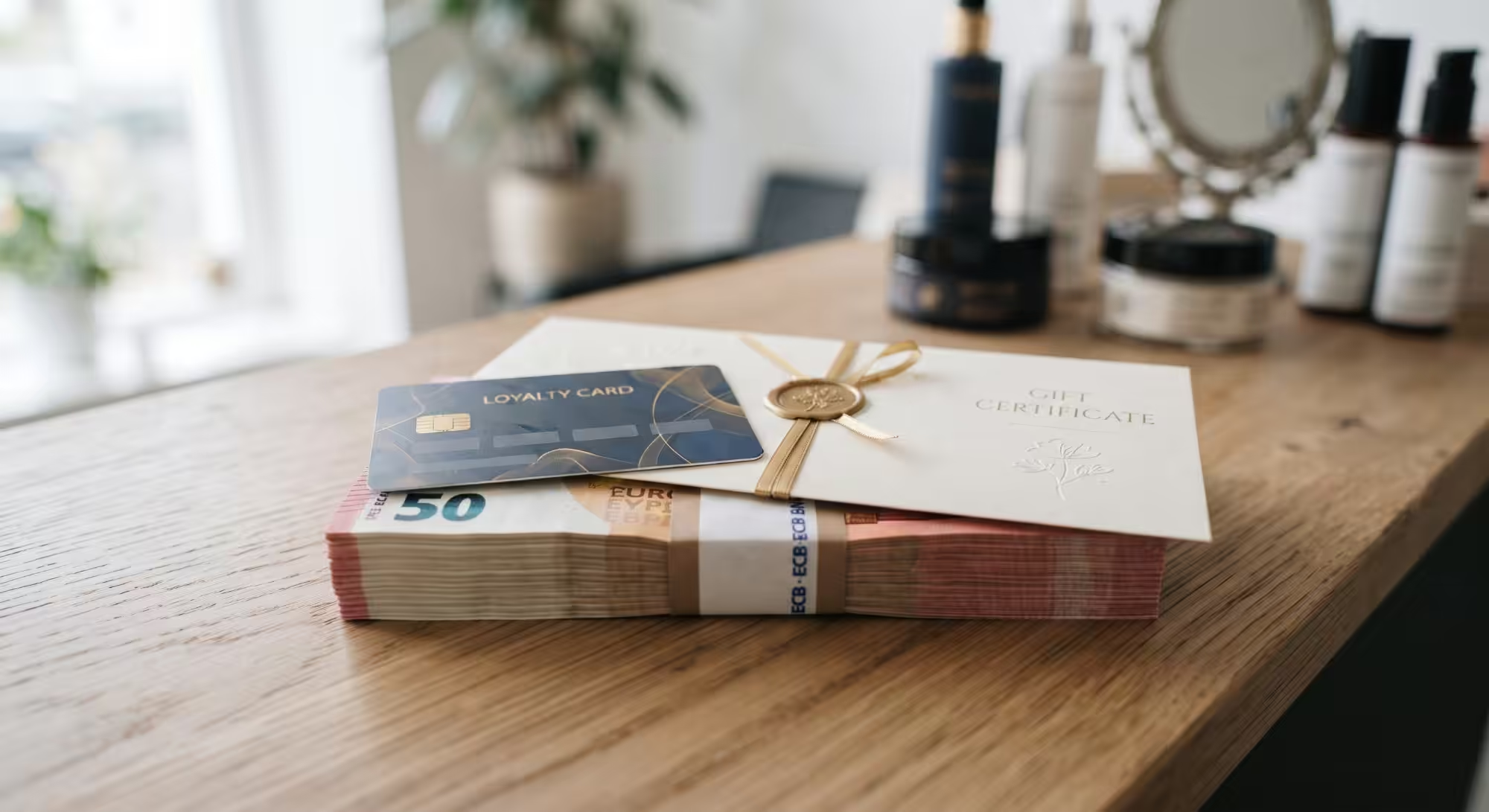
Let’s be honest. When you hear “loyalty program,” you picture a plastic card with a 5% discount. The discount eats your margin. Clients forget the card exists. Your front desk can’t be bothered to scan it. Six months later, the whole “program” is a box of cards collecting dust in the back room.
Sound familiar? Then I’ve got two pieces of news for you.
The bad news: that was never a loyalty program. That was trading money for plastic.
The good news: a real loyalty program answers one single question. Will the client come back to you, not your competitor, and how soon? And in 2026, this thing does more for your revenue than any ad campaign. Because advertising is getting more expensive everywhere: paid social, search, and especially service marketplaces (remember how Fresha “suddenly” went paid in 2025?).
In this article, I’ll show you three things nobody likes to say out loud. With numbers.
- Why controlling your client base means controlling your revenue. And why, without it, any marketing spend is just burning cash.
- How marketplaces quietly dilute your client base. And why “new client flow at 20–50% commission” sounds like growth but works like renting someone else’s business.
- What the salon client lifecycle looks like, and which tools bring clients back at every stage. We’ll walk through Altegio’s toolkit, with the immediate payoff at each step.
Grab a coffee. Let’s go.
Your client base: the asset almost nobody manages
Quick test. Answer four questions about your salon, right now, without opening a single spreadsheet:
- How many clients visited you at least once in the last 12 months?
- What percentage of them came back a second time?
- How many clients have gone “quiet” and haven’t visited in over 90 days?
- How much money does one client bring you per year?
If you were guessing just now, let me be blunt: you don’t have a client base. You have an appointment log.
The difference is fundamental. A log records the past. A base lets you shape the future.
Can’t measure it? Then you can’t manage it. Sounds like a line from a boring textbook, I know. So let’s go straight to the money.
Take a salon with a €25 average ticket (that’s roughly what a haircut costs across Europe) and 3,000 unique clients per year:
| Metric | 30% retention | 50% retention |
|---|---|---|
| Clients per year | 3,000 | 3,000 |
| Became regulars | 900 | 1,500 |
| Visits per regular per year | 6 | 6 |
| Revenue from repeat visits | €135,000 | €225,000 |
Same sign above the door. Same stylists. Same flow of new clients.
The revenue difference: €90,000 a year. And that’s haircuts alone. Add color and treatments, and the gap multiplies.
That entire difference lives in a zone advertising simply cannot touch: the space between the first visit and the second.
The classic retail research says the same thing:
- acquiring a new client costs 5–7 times more than bringing back an existing one (yes, it’s a cliché at this point, but somehow most salons still don’t act on it);
- the probability of selling to a regular client is 60–70%, versus 5–20% for a new one;
- a 5-point increase in retention lifts profit by 25% or more (Bain & Company). Regulars visit more often, buy more services, and bring their friends.
The takeaway is simple. Before you pour money into acquisition, plug the holes in the bucket. And for that, the base has to be yours: visit history, contact details, and the right to message clients directly.
Which brings us to the interesting part.
Service marketplaces: why “easy clients” are the most expensive ones
Beauty marketplaces look like a fair deal. The platform brings you a client, you pay a commission. Everybody wins, right?
Wrong. The commission is nowhere near the most expensive part.
The visible cost: 20–50% of the ticket
For a new client, marketplaces charge anywhere from 20 to 50% of the visit price, depending on the platform and the market. On a €25 ticket, that’s €5 to €12.50 off every first visit.
Now recall that a salon’s margin rarely exceeds 20–30%. Done the math? Exactly: a marketplace client’s first visit breaks even at best. In the typical case, you lose money on it.
The economics only work under one condition: the client comes back directly, bypassing the platform.
And that’s where the trap is hidden.
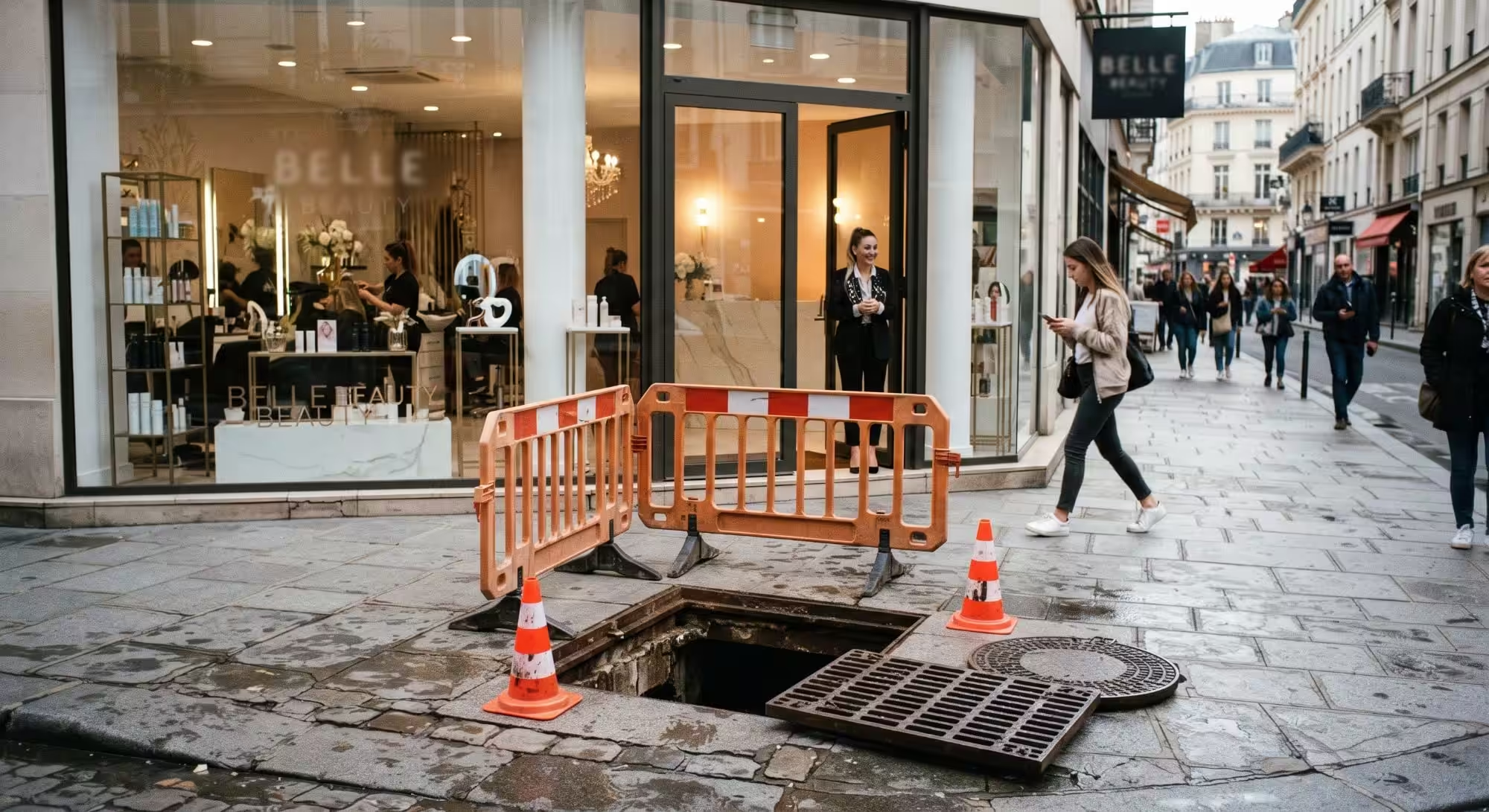
The invisible cost: the client gets hooked on the marketplace, not on you
Look at what actually happens.
A client who found you through a marketplace didn’t remember your salon. They remembered the app. Next time, they’ll open that same app. And they won’t see you. They’ll see a storefront: twenty salons side by side, one with 30% off the first visit, another with a slot an hour earlier, a third with a rating one decimal point higher.
It’s like walking into a hypermarket for a loaf of bread. At checkout, your cart is full of everything except bread. There were deals along the way. Yellow price tags. Free samples. A hypermarket is engineered to scatter your attention.
A service marketplace works exactly the same way. Its business model isn’t built on your clients’ loyalty. It’s built on competition between you and your neighbors for the same client. The more the client compares, the more the platform earns.
Then a quiet process kicks in. One that owners usually notice a year or eighteen months too late. The base dilutes.
- The client is formally “yours,” but their contact info, their history, and the communication channel all belong to the platform.
- You can’t message them directly, or the rules forbid it. Offering a bonus for the next visit? Also forbidden.
- Every return through the platform means another commission. It shouldn’t work that way, of course. But the internet is full of reviews from owners trying to prove they already paid for these clients while the marketplace took its cut anyway. It’s disturbingly common to pay for the same person again and again, as if they were brand new every time.
- Tomorrow the platform raises its commission or tweaks the ranking algorithm, and your “client flow” collapses overnight. There is nothing you can do about it. But there is a way out, and it’s coming below!
Now let’s run the numbers
A salon gets 40 new clients a month from a marketplace. Ticket: €25. Commission: 35% for a new client, 10% for a returning one booked through the platform. Half the clients come back, but out of habit, through the same app.
| Annual cost | Amount |
|---|---|
| Commission on first visits (40 × 12 × €8.75) | €4,200 |
| Commission on repeat visits through the platform (~120 visits/mo × €2.50) | €3,600 |
| Total paid to the platform per year | €7,800 |
€7,800 a year. That’s a fully equipped new workstation. A couple months of rent. Two or three staff salaries.
And here’s the kicker: at the end of the year, you own no asset. The clients stayed in someone else’s app. Tomorrow, the salon across the street can take them with a slightly bigger discount.
Now the second scenario. The same salon puts that money into retention instead of commissions: a bonus program with 5% cashback plus automated reminders. The cost: about €1,800 a year in bonuses (5% of roughly €36,000 in repeat revenue: 120 visits a month × €25 × 12 months) plus a CRM subscription.
The difference between the two scenarios: around €6,000 a year.
But it’s not even about the six grand. Every retained client makes your business worth more. A base with visit history and predictable revenue is something a bank or a buyer will actually price. “Traffic from a platform” is worth nothing.
Does this mean marketplaces should be burned to the ground? No. Use them as a first-touch channel, if the first-visit economics work. But write this down: every client who comes from there enters your base the same day, and their second visit happens directly.
How do you set that up in practice? Let’s walk through it right now, stage by stage.
The client lifecycle: where the money leaks and how to get it back
A client’s journey is nearly identical across the industry, from nail studios to barbershops:
First visit → second visit → regularity → loyalty → referrals.
Clients drop off at every transition. The industry stats are brutal: only 30–40% of new clients ever make it to a second visit. That’s the most expensive leak in the whole funnel.
Let’s go stage by stage. For each one, I’ll show you the Altegio tool. Not as a feature tour. As an immediate payoff, for you and for the client.
Stage 1. First visit: the client enters your base, the appointment actually happens
The problem. Up to 20% of first-time appointments end in a no-show. The client forgot. Mixed up the time. Couldn’t get through on the phone to reschedule. Every no-show kills an hour of a stylist’s day. That hour is gone. You can never sell it again.
What Altegio does. Online booking runs on your own channels: your website, social profiles, maps, and the Altegio.me mobile app. Every booking automatically creates a client card in your base. Phone number, service, staff member, booking source. Then automated notifications take over: appointment confirmations and reminders via SMS, WhatsApp, or push notifications. Salons that turn on automated reminders cut late arrivals and no-shows by up to 60%.
The immediate payoff. A stylist doing 8 appointments a day with one daily no-show loses about €550 a month (22 working days × €25). Automated reminders claw most of that back in the first month. No front-desk effort required.
The payoff for the client. No phone calls. They book in 30 seconds at midnight, get a reminder, and confirm or reschedule in one tap.
Stage 2. Second visit: the most expensive 30 days in a client’s life
The problem. The client loved your salon. A month later, they don’t remember that. If a competitor (or a marketplace with its discount storefront) grabbed their attention in the meantime, there is no second visit.
What Altegio does. The bonus-based loyalty program pays cashback from the very first receipt. A fixed percentage, or a progressive one that grows with spend and visit count. Now the client has a concrete reason to come back to you specifically: there’s real bonus money sitting on their account from the last visit, and it only spends at your salon. In the Altegio.me app, they see their balance and their progress to the next cashback tier. How many visits until the higher rate kicks in.
The immediate payoff. A 5% cashback costs you €1.25 on a €25 ticket. That’s one-seventh of what a marketplace charges you for the same “returned” client. And notice: a bonus, unlike a discount, doesn’t cut the receipt on the spot. It only pays out when the client actually returns. You pay for the comeback, and nothing else.
The payoff for the client. No plastic card to carry. No discount to beg for. Bonuses accumulate on their own, visible on the client’s phone and on the front-desk computer.
Stage 3. Regularity: from “I drop in sometimes” to “I’m here every three weeks”
The problem. Even a happy client stretches the gaps between visits. The manicure “held up” an extra week. The haircut waited until after vacation. Here’s the math on that. A cycle stretching from 3 weeks to 5 means losing a third of the revenue from that same client. Let that sink in.
What Altegio does. Two tools work this stage.
Memberships. The client pays upfront for a package of visits. Say, 4 manicures at a 10% discount. Now they have a built-in reason to show up regularly: paid visits expire if unused. The app reminds them when the membership is running out. It offers to renew online. You get the money before the services are delivered. And your reports show how many memberships are sold, how many are active, and how many visits clients have left. You can plan your stylists’ load a month ahead.
The cumulative discount program. The discount grows with visit count or total spend. The rules are flexible. Count across the whole chain or one location. Count by amount paid or by number of visits. The client sees a clear ladder: two more visits, and they lock in a permanent 10% off.
The immediate payoff. A client with a 4-visit membership hands you about €90 in one payment. Today. Not “maybe €100 over the next three months.” €90 now. Ten memberships sold per month is €900 of prepaid, guaranteed revenue.
The payoff for the client. A discount for paying upfront. A guaranteed spot with their favorite stylist. And zero mental load about booking. The system thinks for them.
Stage 4. Loyalty: the client pays upfront and stops looking around
The problem. Even a regular client is a free agent. Nothing stops them from trying the salon closer to their new office one day.
What Altegio does. Client accounts, also known as deposits. The client puts money on account at your salon, often with a top-up bonus: “deposit €200, get €220 on your account.” Visits are paid from the balance.
This is the highest form of loyalty. The client voted with their money, in advance. The question “where do I go this time” is closed. You get working capital today. And you get a client who is tied to you not by a discount, but by their own decision.
The immediate payoff. Deposits smooth out seasonality. January and May stop being dead months, because part of the revenue was collected in advance. And a client with a deposit barely reacts to competitors’ promos. They’ve already paid.
Stage 5. Referrals: clients bring clients. For free
The problem. Word of mouth is still the number one acquisition channel in the beauty industry. But it’s random. Nobody manages it.
What Altegio does. Three tools turn chaos into a channel.
The Referral Program. A “bring a friend” mechanism built into Altegio’s loyalty toolkit. Your client recommends you to a friend. The friend comes in for a first visit. Both get bonuses. The recommendation stops depending on “it happened to come up.” Your client now has a concrete reason to talk about you. And you see exactly who referred whom, and how many new clients each person brought. Reward your top ambassadors accordingly.
Gift cards. A gift product that doubles as an acquisition machine. A regular client buys a gift card for a friend. That friend walks in with a visit already paid for, carrying a recommendation from someone they trust. Sales run offline and online, through the widget and the app. Around the clock. No front desk involved. You get the money now and deliver the service later. And 10–20% of gift cards never get redeemed at all. Pure revenue.
Reviews. After each visit, the system automatically asks the client to rate the service. Good ratings pile up on your profile and convert new clients. A bad review reaches you before it reaches a public platform. You get a chance to fix things and keep the person.
The immediate payoff. Before the holidays, gift cards spike your revenue without a single service delivered. December gift card sales build a cash cushion. And they deliver dozens of new clients in January, exactly when salons usually sit empty.
High-ticket services: where loyalty and referrals stop being optional
Now pay attention. If your menu includes balayage, keratin treatments, aesthetic procedures, or permanent makeup, this is the most important section in the whole article.
These services run €100–300 a ticket. And the acquisition math changes radically.
First: ads and marketplaces convert poorly on high-ticket. And they cost a fortune. A 35% commission on a €200 color service is €70. Seventy euros. For one client. Every time.
Second: nobody picks a stylist for an expensive service from a banner ad. The cost of a mistake is too high. Ruined hair. Damaged skin. Clients choose based on trust. And trust travels only two ways: personal experience and recommendations.
That’s why, on expensive services, loyalty and referrals stop being a “nice to have.” They become a hard requirement for revenue growth. See for yourself:
- The referral program buys trust cheaper than any channel. A €10 bonus for the referrer and €10 for the new client is €20 total. That’s 10% of the ticket. For a client who walks in pre-warmed by a friend’s recommendation. Compare that to €70 in commission for a cold marketplace client who’s comparing you against ten neighbors as they book.
- Retention multiplies hardest on high-ticket. One retained color client means 5–6 visits a year at €120. That’s €600–720 in annual revenue. From one person. Losing them because nobody sent a reminder or credited a bonus? That’s the most expensive mistake on your price list.
- Cashback finally becomes visible. 5% of a haircut is €1.25. 5% of a €200 color service is €10. That’s a sum worth keeping. Nobody walks away from an account with real money on it.
The practical takeaway: if your menu has services above €100, launch your loyalty program there first. The revenue effect will be the fastest and most visible.
Winning back “sleeping” clients: the gold mine everyone forgets
And now, the most undervalued growth lever of all. Clients who already visited you and vanished.
In any salon older than two years, they’re 40–60% of the base. Think about that. Half your base. These people know you. They liked you. Nobody ever wrote to them. That’s the whole story.
In Altegio, segments are built right on top of your base. Client categories plus visit history let you pull everyone who hasn’t visited in 60–90 days. Then you send a targeted win-back campaign via WhatsApp, Telegram, or SMS: “Maria, we miss you! There’s €8 in bonuses on your account, waiting until the end of the month.”
The message costs cents. And conversion on a “sleeping” base beats cold advertising by miles. Because you’re writing to people who have already bought from you.
Run the numbers. A base of 1,000 clients, 500 of them asleep. The campaign wins back a modest 8%. That’s 40 visits × €25 = €1,000 in revenue. Total campaign cost: a couple dozen euros.
Show me an ad channel with that ROI in 2026. I’ll wait.
Putting the system together
A loyalty program isn’t a tool. It’s a cycle. Each stage hands the client to the next:
- Online booking brings the client into your base (even if the first touch happened on a marketplace).
- Reminders get them into the chair.
- Cashback gives them a reason to come back a second time.
- Cumulative discounts and memberships make visits regular.
- A deposit locks in the relationship financially.
- The referral program, gift cards, and reviews bring in their friends.
- Win-back campaigns recover the ones who slipped away anyway.
The key difference from a marketplace: at every step, the client, their contacts, their history, and their attention belong to you. You don’t pay commission on your own client. And you don’t compete for them on someone else’s storefront.
This whole cycle lives in one place, no integrators or developers needed. See how the loyalty program for salons works in Altegio: bonuses, discounts, memberships, and gift cards are set up in a couple of clicks.
The one-week launch checklist
- Days 1–2. Clean up your base. Every client has a phone number. Every visit is in the system. “Sleeping” clients are tagged as a separate category.
- Day 3. Turn on automated confirmations and appointment reminders.
- Day 4. Launch the bonus program. A simple flat 5% cashback beats a complicated multi-tier scheme. Clients get it instantly. Add complexity later, once you have data.
- Day 5. Create 2–3 gift card types (a fixed amount and a specific service). Enable online sales. If your menu has services above €100, launch the Referral Program too. On high-ticket, it pays back fastest.
- Day 6. Build your first membership around your highest-frequency service.
- Day 7. Send your first win-back campaign to “sleeping” clients, with welcome bonuses attached.
From then on, check three numbers once a month: new-client retention, average gap between visits, and the share of “sleeping” clients. That’s the dashboard of your loyalty program. Three numbers. Not thirty.
FAQ
Discounts kill margin. Why are bonuses better?
A discount cuts the receipt immediately, and everyone gets it. Including the people who would have come anyway. A bonus is a deferred discount that only pays out on a repeat visit. You pay for the comeback, not the visit. Plus, some bonuses are never spent at all.
I run a small salon with two stylists. Do I need this?
The smaller the salon, the more each lost client costs you. And the harder marketplace commissions hit. Automation removes exactly the work a small team has no hands for: reminders, bonus tracking, and gift card sales all run without a front desk.
Should I quit marketplaces entirely?
Not necessarily. Use them as a first-touch channel, if the first-visit economics work. But one rule: every new client enters your base the same day, and their second visit happens directly. Through your online booking. With your bonuses.
How long does the launch take?
Basic setup takes a few hours. Bonus and discount campaign types, notification templates, gift card and membership types are all configured in the interface. No developer needed. You’ll see no-shows drop within the first week. The retention effect shows up after one or two visit cycles, so within 1–2 months.
The bottom line: your base, your loyalty
Let’s wrap up.
Marketplaces rent you your own clients. At 20–50% of every receipt, with no option to buy. Your own loyalty program does the exact opposite: it turns one-time visitors into an asset. An asset that grows, generates predictable revenue, and doesn’t evaporate because some platform changed its algorithm.
And you no longer need integrators or months of setup. In Altegio, the whole cycle works out of the box: online booking, automated notifications, bonus and discount programs, memberships, gift cards, the Referral Program, client accounts, and retention analytics. Setup takes a week with the checklist above.
Try it free for 7 days. Import your base (migration is free), turn on reminders and cashback. Compare your retention two months from now.
The numbers will convince you better than any article. Including this one.
P.S. If you’ve read this far and you’re still on the fence, do one thing. Just one. Pull the list of clients who haven’t visited in 90 days and send them a single message with a bonus attached. The experiment costs a couple dozen euros and half an hour. Judging by the math above, that’s the most profitable half hour of your month.