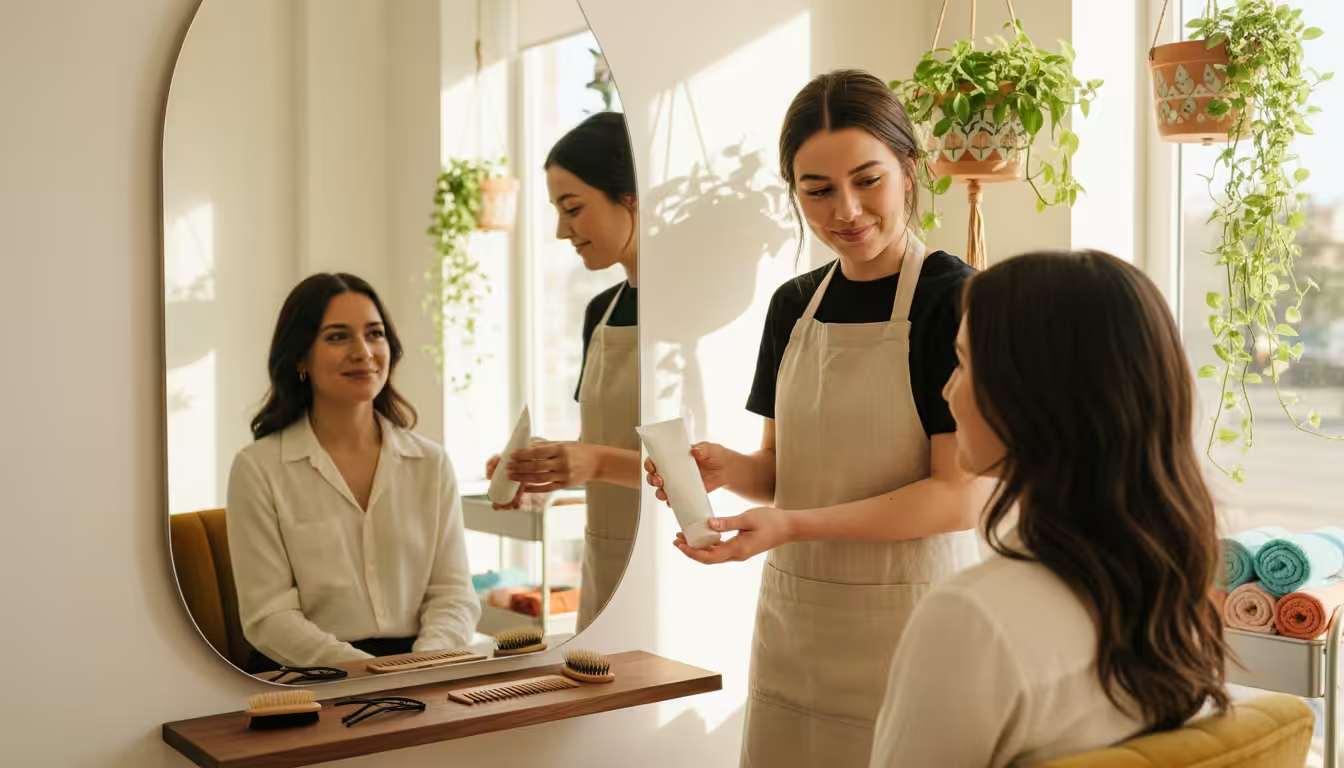
Cross-selling and upselling are not hard selling, they are two decisions made at the chair: offer a higher variant of the service, or add a product to it. One sale per four visits adds over €1,600 of margin a month, without raising prices and without a single extra client. Below: the maths on your own price list, five mechanics and four moments of the appointment
In brief
- One cosmetic per four visits is plus €1,656 of margin a month: at 288 visits and €23 margin on a product, because cross-selling happens at the moment the client is already in the chair, and you do not pay a second time to bring her in
- An add-on inside an existing slot earns the most: the chair hour goes from €50 to €88 of margin, because this kind of upselling adds value to time you have already paid for
- Offer what you see, not what you have on the shelf: one offer per visit and no coming back after a refusal, because a second attempt costs trust you will not win back with one sale
- Watch the average check, not the number of units sold: units also grow when you hand out discounts, while margin stands still
Cross-selling and upselling: what they are and how they differ
Cross-selling is the sale of a complementary item alongside the one the client came for. Colouring plus shampoo for coloured hair. A manicure plus cuticle oil. The core service stays unchanged, the bill grows by a second item.
Upselling is a higher variant of the same service. Instead of colouring alone: colouring with a repair treatment. Instead of a classic manicure: a manicure with extended care. The client buys the same thing, only better.
There is one practical difference and it concerns the schedule. Upselling usually eats minutes, because the higher variant takes longer. Cross-selling a product takes no chair time at all: the cosmetic goes through the till.
You never use either word in front of a client. You talk about the result, not the category: “this shampoo will hold the colour two weeks longer” instead of “we have a cross-selling offer for you”.
What one add-on per visit is worth: run the maths on your own price list
Before you choose a mechanic, do the maths. Below is a model, substitute your own numbers.
An average visit of €60, materials €10, leaving €50 of margin. The salon does 12 visits a day over 24 working days, so 288 visits: €17,280 of revenue and €14,400 of margin.
A cosmetic for home. You sell it at €60, you buy it at €37, €23 stays. One sale per four visits is 72 units a month and €1,656 of margin. That is over 11% more margin without a single extra client in the diary.
An add-on to the service. A treatment worth €55 on the price list costs you about €17 of materials and fifteen minutes of work, so €38 stays. Every tenth visit with such an add-on is 29 times a month and €1,102.
Now the most important number, the one about time. An hour-long visit at €60 gives €50 of margin per chair hour. The same hour with an add-on that fits inside the slot gives €88. If the add-on needs its own 15 minutes, the visit runs 75 minutes and comes to €70 per hour. Both beat €50, but the version that does not stretch the slot beats it almost twice as hard.
That is where the rest of this article comes from: the most profitable thing is the one that adds value to time you have already paid for. Why keeping a client is cheaper than winning a new one we covered separately in the piece on returning clients, and we do not repeat it here.
Five mechanics that raise the average check
The question “how to increase sales in a salon” has five sensible answers. Pick one and start there, not all of them at once.
1. A higher variant of the service
The price list carries two versions of the same item, and the difference is described by result, not by name. Not “premium manicure”, but “a manicure with care that keeps cuticles away for three weeks”. The client chooses knowingly, the team does not have to persuade anyone.
2. An add-on inside the same slot
The most profitable of the five, because it does not touch the schedule. If colouring has 90 minutes booked and really takes 75, you have already paid for those 15 minutes. A treatment, a mask, a short hand care routine: anything that fits into that gap.
3. Home care
This is cross-selling in its purest form and the only item that takes no chair time whatsoever. There is one condition: the product has to follow from what you have just done to the client’s hair or hands.
The display does part of the work for you: products at eye level, complementary ones next to each other, no empty rows. But the shelf only sells what you use at the chair. Stock bought for the display rather than for the work usually just waits on the shelf and freezes cash.
4. Service packages
Several visits bought up front: a course of treatments, a hair-removal pass. The client pays once, you get the cash and a diary filled weeks ahead. In Altegio you can sell a service package with online prepayment right at booking, so the money arrives before the first visit. Packages and passes are taken apart in detail as models in the piece on loyalty programmes, so here we only flag that this is an average-check tool too.
5. A second service with another specialist
The client is already on site and there is a free chair next to you. Brows after a haircut, a pedicure after a manicure. It works when reception can see both diaries and close the booking in one conversation, instead of sending the client back to the phone.
| Mechanic | Who it suits | What it adds to the bill | Cost in time |
|---|---|---|---|
| Higher variant of the service | a salon with a simple price list where an item can be split in two versions | the gap between variants, usually 20–40% of the visit | stretches the slot |
| Add-on inside the same slot | services with slack in the diary: colouring, treatments | €38 of margin on an add-on worth €55 | none, it fits in the slot |
| Home care | any salon using a brand available for resale | €23 of margin on a €60 product | none at the chair, just the till |
| Service packages | courses: hair removal, massages, facial treatments | prepayment for several visits at once | selling and tracking the balance |
| Second service with another specialist | multi-chair salon with gaps in the diary | the full price of the second service | the other person’s slot |
Which mechanic for which business
Not every mechanic fits everywhere. The starting point is the visit rhythm and the price list of your profile, not someone else’s checklist:
| Business | Start with | Add later |
|---|---|---|
| Hair salon with colouring | home care: shampoo and mask for colour | an add-on in the slot while the colour develops |
| Barbershop | an add-on in the slot: beard trim, hot towel | oil or pomade for home |
| Nail studio | home care: cuticle oil | an add-on in the slot: paraffin |
| Lash and brow studio | a second service: brows after lashes | a serum for home |
| Cosmetology and clinics | service packages: treatment courses have a natural rhythm | a higher variant of the treatment |
| Hair extensions | home care: without it the result lives shorter | a package for regular maintenance |
| SPA and massage | a package: 5 massages are bought once | an add-on in the slot: a scrub before the massage |
And if you run several profiles under one roof, do not pick one mechanic for all of them. Match them per service: a package where there are courses, an add-on where the diary has slack, and home care wherever you work with products available for resale.
When and how to offer without pushing
The moment decides more often than the argument. A visit has four of them, and each suits something different.
At booking. Only the higher variant of the service works here, because the client picks from a list and nobody is looking at her. It is enough that the item description shows what she gets more of.
At the start of the visit, during the diagnosis. The best moment for a service add-on. You look at the hair or the nails, you name what you see, and you offer a solution. The client is not thinking about leaving yet.
During the visit, when the result is visible. The moment for home care and the best moment for cross-selling in the whole visit, because the client can see the result you are talking about. Not “we have a promotion on shampoos”, but “this colour will wash out in four weeks with an ordinary shampoo, with this one it will hold six”.
At payment. Only to close what has already been discussed. It is a little late for a first offer here: at the terminal it is easy to come across as adding a charge rather than giving advice.
Four rules on form, all of them coming down to one thing: a product recommendation has to come from the client, not from your stockroom.
- One offer per visit. A second one starts to make the visit sound like selling
- Name the problem, then the product. “The ends are drying out” before the name of the mask, never the other way round
- After a refusal, do not come back. Not the same day, and not through the receptionist at the till
- Do not judge the client’s budget for her. Show it and let her choose
A sentence you can hand to the team in this form: “I can see the ends are dry after the summer. I have a mask that holds this off for a month, it costs €60. Do you want me to show you?”
What to offer when you see
The offer comes out of the diagnosis, so the map starts from what is in front of you, not from a category on the price list. The amounts in the third column use the same model as above, substitute your own.
| What you see during the visit | What you offer | What it adds |
|---|---|---|
| Dry ends after the summer | a repair mask for home | €23 of margin, zero chair minutes |
| Colour refreshed every four weeks | shampoo for coloured hair | €23 of margin and a longer gap without losing the colour |
| Cuticles coming back within a week | oil now, care at the next visit | €23 today, €38 at the next appointment |
| A question about why the result does not hold like a friend’s | a higher variant of the same service | the gap between variants, usually 20–40% of the visit |
| The visit finishing a quarter of an hour before the slot ends | an add-on that fits into that gap | €38 of margin without touching the diary |
| The client booking a course of treatments | a package instead of single visits | prepayment for several visits at once |
What you keep: retail margin and the cost of time
The price list shows revenue, decisions are made on margin. Three items side by side, in the same model as above:
| Item | Price to the client | Your cost | What stays | Chair time |
|---|---|---|---|---|
| Standard visit | €60 | €10 of materials | €50 | 60 minutes |
| Add-on inside an existing slot | €55 | €17 of materials | €38 | 0 extra minutes |
| Cosmetic for home | €60 | €37 purchase price | €23 | 0 minutes |
The add-on leaves more than the cosmetic, but the cosmetic scales better: you can sell it at every visit, while the add-on works only where the diary has slack.
There is one condition that is easy to forget: this only works when you know the real cost. If materials come off stock by hand or not at all, the margin on the add-on is guesswork. In Altegio, inventory and product sales sit in the same visit window as the service: you sell the product at checkout, and consumables are written off automatically according to the service recipe.
How to check the average check actually grew
Four numbers, all of them from the visit history. Compare against the period before the start, over a similar number of weeks:
- Average check: revenue divided by the number of visits. The main number, the rest explain it
- Share of products in revenue: what percentage of takings the shelf produces
- Share of visits with at least one extra item: shows whether the team is offering at all
- Margin, not turnover: turnover grows from discounts too, only margin shows whether it was worth it
The last number is the one most often skipped. You can sell twice as many cosmetics at minus 30% and end up with the same amount in the till. Reports in Analytics count the average check and product sales in one place, so there is no need to assemble it in a spreadsheet.
And one caveat before you start counting: these numbers have to be yours. On a marketplace the average check grows on someone else’s ground: a commission comes off the visit, and the client’s history and her add-on purchases stay on the platform, next to your competitors’ profiles. On your own booking system every extra sale works for your base and your brand.
You will see the first signals after 4–8 weeks. Salon cycles are long and one good week means nothing.
Most common mistakes
- Selling from the shelf, not from the chair: a product you do not use in your work will be bought once and never again
- An offer at the card terminal: that is no longer a recommendation but a surcharge, and it is received as one
- A bonus per unit: the team starts selling everything to everyone, and the client hears it in the first sentence
- Four mechanics at once: the staff remember none of them and offer nothing
- Counting turnover instead of margin: the bill grows, the money stays with the supplier
FAQ
What is cross-selling
Cross-selling is the sale of a complementary item alongside the one the client came for. In a salon that means a home-care cosmetic matched to the service performed, or a second, complementary service in the same visit. The core service does not change, the bill grows. It differs from a promotion in that it follows from the result on site, not from price.
How does upselling differ from cross-selling
Upselling is a higher variant of the same service: colouring with a treatment instead of colouring alone. Cross-selling is a second item alongside: the same colour plus a shampoo for coloured hair. The practical difference concerns the schedule, because upselling usually lengthens the visit, while selling a product takes no chair time at all.
How to raise the average check without raising prices
Add one item to a visit that is happening anyway. At an average visit of €60, one cosmetic with €23 of margin sold every fourth time gives €1,656 of margin a month across 288 visits. The price list stays unchanged, the client sees no increase, and the chair hour earns more.
Does selling cosmetics in a salon pay off
It pays off when you sell what you use in your work, and when you know your margin. A product at €60 bought for €37 leaves €23 and takes no chair time. A shelf with a random assortment freezes cash and does not sell itself.
How to offer without the client feeling pressured
One offer per visit, based on what you see on her hair or hands. Name the problem first, the product second. After a refusal do not come back the same day and do not pass the subject to reception. An offer that follows from a diagnosis does not sound like selling, because it is not.
In Altegio services, products, inventory and analytics sit in one visit window, so you see the average check together with the margin, not separately
- Product sales straight from the visit window, at checkout
- Automatic write-off of consumables according to the service recipe
- Reports with the average check and the share of products in revenue