
This article was prepared by the Altegio team. The comparison is based on the official public documentation of both systems: a full 105-item matrix with verbatim quotes and a source behind every claim.
If you are choosing between Altegio and Booksy, you almost certainly already work with Booksy or have heard about it from every second colleague. So the real question is not “which system is better” but something more specific: how much does a client who came “from the app” actually cost; whose base is it – yours or the platform’s; and what can the system do beyond the booking storefront. And one more thing people usually remember only after subscribing: who controls your calendar – you, or the marketplace rules.
So we did something that rarely happens in comparison articles: we sat down and read the entire public Booksy documentation for Poland – 19 sections, all 329 articles of their help center, plus every page of their business website. Every claim below is backed either by their own article or by ours. No “we believe” statements.
The short version, if you are in a hurry: Booksy is the strongest beauty marketplace in Poland, with an app clients already know and well-designed no-show protection – but as a business management system it is limited: loyalty means stamps only, there is no Payroll and no bills of materials, a chain is assembled from separate accounts via an email to support, and you get your own data by sending a request to their inbox. Altegio is an operating system for a service business: appointments, client retention, loyalty, checkout, inventory, payroll and a chain of locations in one loop – with a client base that you own and control.
And here is why it is worth reading to the end. You will not find a breakdown of these two systems like this anywhere else: we compared 105 items against the official documentation of both sides – with verbatim quotes and a link behind every claim. On 94 items the verdict is unambiguous: 36 – Altegio stronger, 20 – Booksy stronger, 38 – parity. We publish their strengths too: weak points should be known before you choose a system, not after.
The 60-second comparison
The table opens with Altegio’s recent additions – AI assistants, no-show protection and Adyen payments – and with the open API you can use to extend the system to fit your business.
| Capability | Booksy | Altegio |
|---|---|---|
| AI assistants: Claude, ChatGPT, Gemini | ❌ No official connection in their documentation | ✅ Altegio MCP: ask about your numbers or move appointments in one sentence, including by voice in ChatGPT |
| No-show protection | ✅ Prepayments + late-cancellation and no-show fees charged to the card on file | ✅ Payment policy: a deposit or a card guarantee – the client links a card and pays nothing upfront; the late-cancellation or no-show fee is charged only if the rules are broken |
| Online payments: fee and BLIK | 1.89% + 0.49 zł; BLIK available | ✅ With Adyen, 0.99% + ~0.90 zł for EU consumer cards – about 2.88 zł instead of 4.27 zł on a 200 zł visit; BLIK available |
| API and webhooks | ⚠️ Partner API: documentation is closed, access through Booksy | ✅ Open API for every client: a key in the Developer Hub and webhooks – connect your own systems or build a feature around your processes; integration catalogue in the interface |
| WhatsApp reminders | ⚠️ Reminders go out as an SMS 24 hours ahead or as a push in the Booksy app, shared by every business on the platform; WhatsApp reminders are not documented | ✅ Reminders and notifications in WhatsApp from your own business number via WhatsApp Coexistence – in the same chat where your receptionist already talks to the client: one more retention channel |
| Online booking 24/7 | ✅ Yes | ✅ Yes |
| Marketplace with a stream of new clients | ✅ Yes – the strongest in Poland | ❌ No marketplace – direct connectors instead of an intermediary: Book Now in Reserve with Google and Instagram, a booking link for your website and messengers, a branded app; the base stays yours |
| Fee per new marketplace client | 45% of the first visit price + VAT, min. 25 zł, max. 250 zł net (Boost) | No fee per client – subscription only |
| Loyalty Program | ❌ Stamps only: “for now, only stamps are available”, one program, rewards issued manually | ✅ Cashback, automatic tiers, discount programs, a referral program |
| Group bookings | ❌ Clients cannot book online; “it is not possible to settle the entire group booking at once” | ✅ Group Events with online booking and payment in one window |
| Several professionals on one service | ✅ Multi-services “in parallel” | ✅ 4HANDS+ Service Packages – parity |
| Waiting List | ✅ Clients add themselves, automatic notifications | ✅ Managed by the receptionist; a request converts into an appointment in one click |
| Payroll | ❌ Commissions only – no payroll articles at all | ✅ Criteria-based schemes, % of services and products sold, penalties and bonuses |
| Inventory: bills of materials, automatic consumable write-off | ❌ Write-off is manual only, at visit payment | ✅ Bills of materials, cost price, stock audits, barcodes |
| Chain of locations | ❌ “create separate accounts for each location” + an email to support | ✅ A shared client base, service catalog, chain-wide loyalty and inventory – self-service |
| Exporting your own data | ❌ An email request, “up to 5 business days” | ✅ Excel export from the interface |
| Appointment cancellation by the client | ❌ “cancellation is possible at any time” – a platform rule | ✅ You decide: limit online cancellation by time, or allow it with a late-cancellation fee |
| Accepting cards with a phone (Tap to Pay) | ✅ 1.49% | ❌ Not documented |
| Bulk email campaigns | ✅ Free, no limit | ❌ No email channel for bulk campaigns; SMS, WhatsApp and push by segment |
| Out-of-the-box discounts for slow hours | ✅ Flash Sale / Happy Hours / Last Minute + a Premium Hours markup | ⚠️ An automatic discount for online booking and a promo block in the widget; no slot-based discounts |
| Google Calendar sync | ❌ One-time .ics file import only | ✅ Permanent one-way sync (Altegio → Google) for every team member |
| Medical documentation | ✅ Booksy Med for physiotherapists (a separate partner product, +50 zł/month) | ✅ A built-in medical record for clinics and medical centres |
Sources: support.booksy.com/hc/pl-pl and alteg.io/support/knowledge-base, checked 31 July 2026, updated 9 November 2026. Quotes from Booksy’s documentation are translated from Polish; the links lead to the original articles.
1. Two models: whose client is it
Let us start with the main difference, the one everything else grows from.
Booksy is a marketplace. The app where millions of Poles search for “hairdresser near me” is a genuine asset, and for a professional starting out with no client base it is the fastest way to fill a calendar. We are not going to pretend otherwise.
Now the arithmetic. For every new client from the marketplace, Booksy charges the Boost fee: 45% net of the first visit price, minimum 25 zł, maximum 250 zł net. The rate is calculated on the full price of the visit that the client pays, and 23% VAT is added on top. In Booksy’s own example, a 200 zł visit brings a fee of 110.70 zł, leaving the business with 89.30 zł. If your business cannot reclaim VAT, more than half of the first bill stays with the platform; if it can, the real cost is 90 zł, or 45% of the bill. Who counts as “new” is determined by the platform’s own base and the client’s own declaration – with no time limit. Booksy even has a dedicated article, “When the Boost fee is not charged” – on when the Boost fee will not be charged. When a feature ships with an instruction on how to avoid it, that says more about the feature than any review.
Next come the storefront rules, which apply even if Boost is switched off:
- A client can cancel an appointment at any moment: “cancellation is possible at any time in the Booksy app”. You cannot restrict the cancellation window – it is the platform’s rule, not yours
- You can hide your profile from the marketplace for a maximum of 7 days – then online booking switches back on automatically
- Right next to your profile, the client sees your competitors – that is how the catalog is built
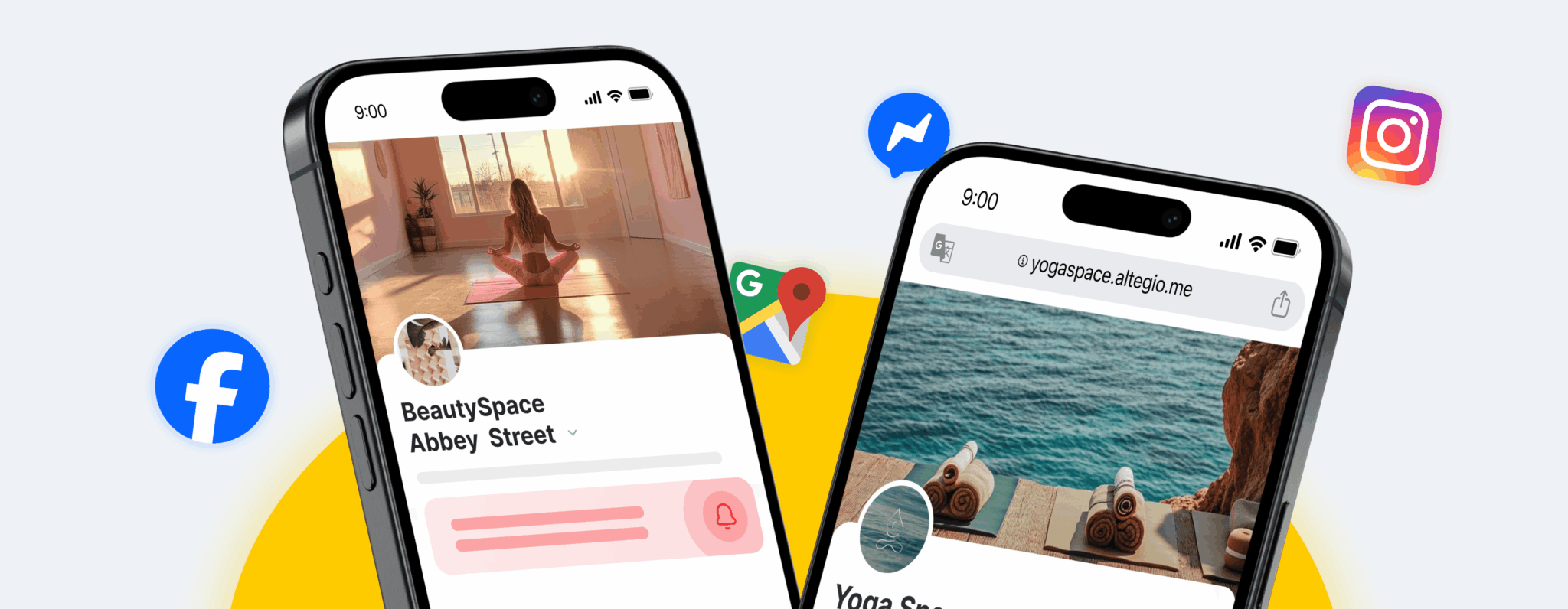
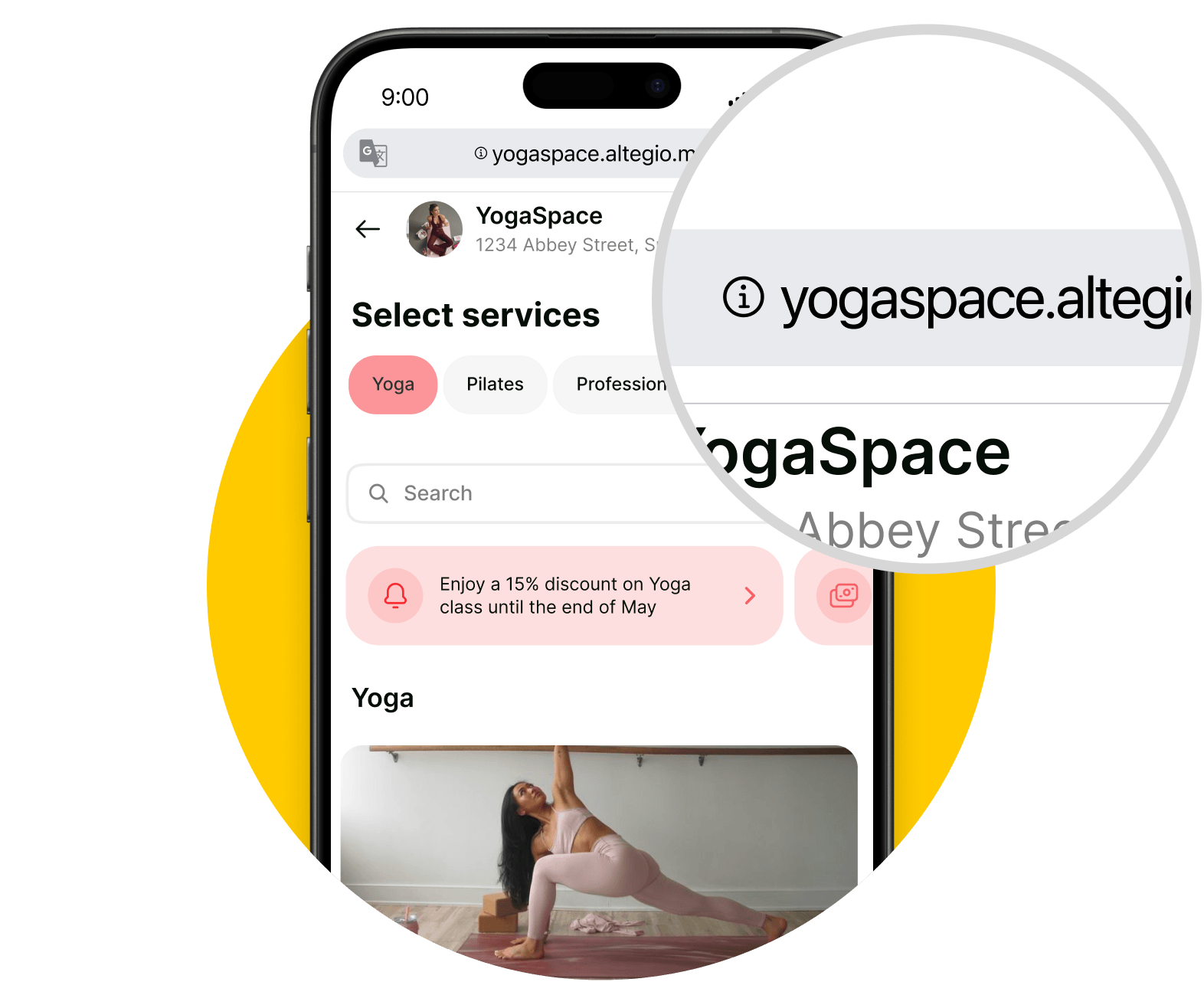
Altegio solves acquisition differently: not with an intermediary storefront but with direct connectors to the main sources of traffic. The Book Now button in Reserve with Google puts booking right into your Google Maps card and search results, and the client books inside Google without leaving for another website. The booking button on Instagram and Facebook turns your profile into a sales channel, the online booking link embeds into your website, social media and messengers, and a branded mobile app lives on the client’s phone. Clients come from the same channels where they are already looking for you – but they book directly with you: no “new client” fee and no catalog showing competitors next to your profile. Cancellation rules, booking windows and schedule visibility are configured by you. The base, the visit history and the loyalty belong to the business.
Elena, owner of the DoLaser chain of laser hair removal studios (9 locations, Poland), tried acquiring clients through Booksy in parallel with running her business in Altegio – and described the experience to us like this:
“To get promoted, you need at least 70–80 reviews. And you pay for every single client. We did the maths and realised: a booking from there costs us more than a booking from targeted ads. And we ran two CRMs – Altegio as the main one, because Booksy has no analytics at all: the only thing you see is the booking that came to you.”
– Elena, owner of the DoLaser chain of laser hair removal studios (9 locations, Poland; from a client interview)
“But my clients book through Booksy”
This is the number-one objection, and we are not going to pretend it does not exist. The Booksy app sits on millions of Polish phones, and some of your regulars will ask to be booked “the usual way” – even after you show them your own booking page.
That is why the owners we spoke to almost never “leave Booksy” in a single day. They split the roles: Booksy remains a storefront for clients who would not book any other way, while the business – the calendar, finances, client base, payroll, inventory – lives in Altegio. From there, simple economics takes over: every appointment through your own channel (the Instagram link, the website button, Google Maps, the branded app) comes with no fee, and the share of such appointments grows as you steer your regulars towards them. Storefront versus system is not an either-or choice; the question is where your business lives and how much every next client costs.
2. Calendar: who controls it
| Feature | Booksy | Altegio |
|---|---|---|
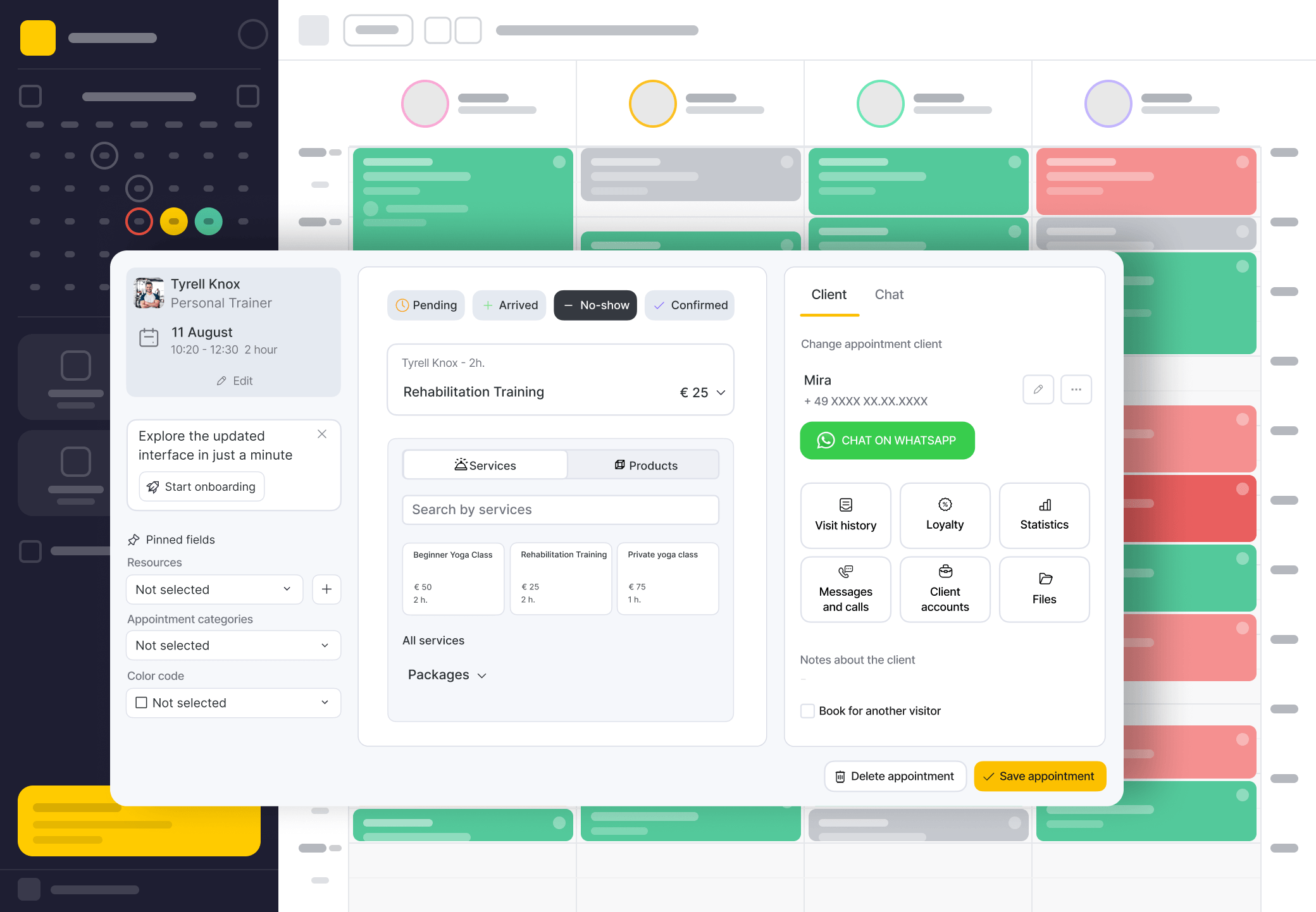
| Waiting List | Yes, clients add themselves – an honest plus for Booksy | Yes: the receptionist saves a request with the service, time and professional and turns it into an appointment in one click – a cancelled slot is filled by the next request in the queue instead of standing empty |
| Calendar sync | One-time .ics file import (up to 5,000 visits, visits are anonymised) | Permanent Google Calendar sync for every team member – the professional sees an up-to-date schedule in a familiar calendar, with no double bookkeeping and no “forgotten” appointments |
| Several professionals on one service | Multi-services “in parallel” – each service is assigned to its own team member | 4HANDS+ Service Packages: a manicure and a pedicure at the same time by two professionals – the client spends half the time in the salon, and chairs turn over faster |
| Equipment | One resource per service: “dependencies cannot be set” – you cannot occupy a chair and a device with one service | Resources are booked together with the appointment in the combinations you need – double-booking a room or a device is excluded, and the receptionist does not have to keep conflicts in their head |
| Group bookings online | No – only the business can create a group, manually | Group Events: clients book themselves, the receptionist sees occupancy in real time – courses and classes fill up without ring-arounds |
| Settling a group | “it is not possible to settle the entire group booking at once” – each booking is settled separately | Booking, payment and sales to participants – from a single event window: the receptionist does not switch between cards |
| No-show protection for groups | “it is also not possible to enable no-show protection for group bookings” | Online payment at booking is available for Group Events too – a place in the group is confirmed with money |
The last three rows come from one and the same Booksy article: clients cannot book into a group online, you cannot settle the whole group at once, and no-show protection does not switch on for group bookings. If you run courses, classes or paired treatments, that is not a detail – that is a way of working.
3. Client retention: stamps versus a Loyalty Program
Remember one quote from Booksy’s documentation – it explains the scale of their entire Marketing section:
“Loyalty card type – for now, only stamps are available.”
That is their loyalty cards article: the card type – stamps only, one program per business, rewards issued manually, and the client must have the Booksy app. A “10th coffee free” scheme is fine for a coffee shop; for a salon with different services, an average bill and returning clients it is not a loyalty program – it is a piece of cardboard.
| Feature | Booksy | Altegio |
|---|---|---|
| Loyalty types | Stamps | Fixed and tiered cashback, discount programs, automatic tiers |
| Number of programs | One | Several, by segment |
| Reward accrual | Manual: “rewards are not issued automatically” | Automatic, by rules |
| Referral program | Not documented | Yes, the reward is applied at checkout |
| Gift Cards: online sale | An order via the profile, paid on site: “Booksy does not handle payments when cards are bought online” | Sold online 24/7 with payment |
| Bulk campaigns | SMS (100/month in the subscription, then 0.10 zł), email and push free | SMS, WhatsApp and push by client-base segments; no email channel – an honest minus |
| Discounts for slow hours | Flash Sale, Happy Hours, Last Minute + a Premium Hours markup – their strong side | An automatic discount for online booking, a promo block in the widget; no slot-based discounts |
Note that we put bulk email and slot promos in Altegio’s minus column – and Gift Cards in Booksy’s. Their own article explains why: the “online sale” of a gift card for your services is an order the client pays for at the visit – Booksy does not process the payment for cards bought online. Before the holidays, when gift cards are bought at the last minute and paid by card on the spot, the difference between “ordered” and “bought” is revenue.
4. Money: no-shows, online payments, checkout
Booksy’s no-show protection is well thought out: prepayments, late-cancellation and no-show fees charged to the client’s card on file, and a list of “trusted clients” exempt from prepayments. For a market where no-shows are pain number one, this is an important loop, and in Altegio the same class of tasks is handled by the Payment policy. It works in two modes:
- Deposit mode. The client pays an amount at online booking; at the visit it counts towards the payment, and on a no-show it stays with you. Works with any connected payment provider
- Card guarantee mode. The client only links a card and pays nothing in advance, and a late-cancellation or no-show fee is charged to the card if the rules are broken. Works via Adyen
The mechanics are similar; they differ in details worth checking against your own processes:
| Booksy | Altegio | |
|---|---|---|
| Who is exempt from the policy | A list of “trusted clients” | Scope: all clients, new clients only or regular clients only |
| Clients with debts | Not documented | The default policy can be enforced for them |
| Where it is switched on | Rules by service group | By service, category and team member, with a minimum appointment amount threshold |
| No-show charge | Automatically at the end of the day, or manually | The receptionist decides in the appointment window: charge the fee, waive it, or keep the deposit on the client’s balance |
Next – the cost of the payments themselves, which pricing pages do not tell you about:
- Booksy’s acquiring fee: 1.89% + 0.49 zł for mobile payments and prepayments; Tap to Pay – 1.49%; network gift cards – 3%
- The Booksy Pay fee is not published in the documentation: “detailed information on this can be found in the app” – their article
- Refunds to clients are charged as well
Altegio adds no fee of its own to payments. With Adyen, the rate for EU consumer cards is 0.99% + ~0.90 zł, and that covers about 90% of transactions; the payment methods include BLIK and Polish online banking. On a 200 zł visit the fee comes to about 2.88 zł versus 4.27 zł for Booksy’s mobile payments. An honest caveat: on bills below ~46 zł the difference disappears because of the fixed part, and corporate cards and cards issued outside the EU cost more.
On reporting, the philosophies differ. Booksy has 51 reports built around bookings, sales and commissions. Altegio runs an operational financial loop: multiple cash registers, a daily report with encashment, cash flow, P&L with month-to-month comparison, and client accounts with deposits.
5. Inventory and payroll: what Booksy does not have at all
Payroll. There is no salary calculation in Booksy’s documentation – only commissions: a percentage or a fixed amount per service. Shift rates, base salaries, bonuses, penalties, separate schemes for assistants and receptionists – this class of tasks does not exist in the product. In Altegio: criteria-based calculation schemes, a percentage of services and of products sold, and a Payroll section in the team member’s app: every professional sees their own accruals – one less source of conflict, and one less evening the owner spends in Excel.
Inventory. Booksy has a basic inventory module, but writing off consumables is a manual operation at visit payment (“Usage”). In Altegio – bills of materials with automatic write-off: close a visit with colouring, and the dye and developer are written off automatically, with the cost price of the procedure calculated. For a business with expensive consumables this is control over real margin, not a rough guess at the end of the month.
To be fair: Booksy has Zakupy – purchasing professional products from suppliers right inside the app, with automatic goods receipt to stock. A handy mechanism with no counterpart in Altegio.
6. Team and chain: from one professional to a franchise
To the question “I have several addresses”, Booksy’s help center answers verbatim:
“Create separate accounts for each location, and then contact us at [email protected].”
A separate account for every location plus an email to support so that the logins get linked manually. With this architecture, a shared client base, a chain-wide service catalog and cross-location analytics do not exist by construction. One more detail from the same section: to delete a team member’s profile if you pay by bank transfer, you need to sign a paper annex to the contract and send it back.
In Altegio a chain means a shared client base and a shared service catalog, a loyalty program configured once for all locations, chain-level inventory and consolidated cross-location analytics. A new location is added from the interface.
To Booksy’s credit: they have behavioural protection against client-base theft – the owner gets an alert if an employee views many clients’ contact details within a short time. In Altegio the same task is solved with access rights: a professional can manage appointments and check out visits without seeing clients’ phone numbers at all.
7. Your data and the platform
Check how data leaves the system – before you move into it.
With Booksy it is an email request: “processing the request may take up to 5 business days.” Booksy’s API is a partner API: there is not a single article about it in their help centre, the documentation is closed (docs.booksy.com refuses access), and the key is issued through Booksy. In Altegio the client base exports to Excel from the interface, and the Open API with webhooks is available to any registered user – from telephony and messengers to Power BI and AI agents. The same Elena from DoLaser names integrations as the reason she is not considering a move away: her Power BI export works out of the box.
Talk to your own business
The next step is an AI assistant that works with your data directly. Altegio Pro MCP connects Claude, ChatGPT, Gemini or Cursor to your Altegio account: you sign in with your own login, no keys or tokens, and the assistant sees only what your role allows. Then you just ask: what was revenue this week compared with last week, which team members have free slots tomorrow, which clients have not come back in a while. The assistant answers from live data and takes action – it moves appointments or sets up a new location in one sentence. For people who should only look, there is a read-only version of Pro MCP: the same data, but no permission to change anything.
Two more helpers work alongside it. Knowledge MCP answers questions about setting up Altegio from the knowledge base and links to the articles. Analytics Agent answers questions about revenue, clients and team utilization right inside Altegio.
And if your assistant supports voice, you can simply talk to your business. ChatGPT is the strongest here today: it answers in a natural voice and carries out spoken requests through the same MCP connection. Ask on your way to work how many appointments there are today and where the free slots are – and hear the answer without opening the calendar.
Booksy has no official connection for AI assistants in its documentation: searching their help centre for “MCP”, “ChatGPT”, “AI” and “asystent” (Polish for “assistant”) returns no articles.
A separate note on Booksy Med – the medical module with patient documentation. It is a product of a partner company, Znajdź Gabinet sp. z o.o.: a separate subscription of +50 zł/month billed through a third-party processor, available only to the “Physiotherapy” category and only on a computer or tablet. For Polish physiotherapists with their e-zdrowie (P1) requirements it is a working solution – but it is a second product with its own billing, not a feature of the system. In Altegio the medical record is built in and available to medical business types without a separate subscription.
Where Booksy is objectively stronger – and what to do about it
We promised honesty, so no squinting. Six points where Booksy is ahead – with context for each.
1. A marketplace with real demand – and a client habit. Millions of Polish clients search for services right inside Booksy, and for a new business with no base it is the fastest cold start. On top of the demand comes habit: some guests will book only through the app they know, and that is a fact to work with, not argue with – which is why the “Booksy as storefront + Altegio as system” scenario is so common. Then the arithmetic begins for every new client: 45% of the first visit plus VAT (110.70 zł on a 200 zł visit in their own example), cancellation and visibility rules set by the platform, and competitors right next to your profile. Altegio’s strategy is to remove the intermediary between those same traffic sources and you: Book Now in Reserve with Google and Instagram, booking from your website and messengers, your own app. The client comes from the same Google – but books directly with you and stays yours. The owners we interviewed agree on one thing: the marketplace is good as a starting push and expensive as a permanent model.
2. Tap to Pay and Klarna instalments. Accepting cards with a phone, no terminal, at 1.49% is convenient for mobile professionals, and paying in instalments via Klarna costs the business nothing. Altegio has no phone card acceptance and no BNPL instalments; online payments, including BLIK, run through Adyen and other payment integrations.
3. Waiting List self-booking. Booksy clients join the queue themselves in the app and get a notification when a slot opens up. In Altegio the Waiting List is managed by the receptionist: a request turns into an appointment in one click, but there are no automatic queue notifications.
4. Slot promos out of the box. Flash Sale, Happy Hours, Last Minute and the Premium Hours markup – ready-made mechanics for managing occupancy hour by hour. Altegio has an automatic discount for online booking and a promo block in the widget, but no discounts tied to specific slots.
5. Free bulk email. Booksy’s email and push campaigns are included in the subscription with no limit. In Altegio, bulk campaigns run through SMS, WhatsApp and push by client-base segments – there is no email channel.
6. Zakupy. B2B purchasing of professional products from suppliers inside the system, with automatic goods receipt to stock.
Pricing: what you actually pay for
| Parameter | Booksy | Altegio |
|---|---|---|
| Subscription | 145 zł net/month for the first team member + 35 zł for each additional one (from the 10th – free) | From €8 per team member per month |
| Fee for new marketplace clients | Boost: 45% of the first visit price + VAT (min. 25 zł, max. 250 zł net) | None |
| SMS | 100/month in the subscription, then 0.10 zł net | Via an SMS provider at its rates |
| Medical module | Booksy Med: +50 zł net/month (a separate product, physiotherapy only) | The medical record is included for medical business types |
| Acquiring fee | 1.89% + 0.49 zł; Tap to Pay 1.49%; network gift cards 3% | Altegio adds no fee of its own; with Adyen – 0.99% + ~0.90 zł for EU consumer cards |
| Trial period | 7 days | 7 days |
Booksy’s prices per their article “How much does Booksy cost?” and biz.booksy.com/pl-pl/cennik as of 31 July 2026. Adyen rates per the alteg.io/en/adyen page. Exact Altegio prices by market are on the pricing page.
The point of this table is simple. The Booksy subscription looks comparable – until the business grows. Calculate the full cost of a year on your own numbers: subscription + team members + Boost for every new client + SMS beyond the first hundred. An example: a business with three team members pays 215 zł net a month for the subscription. If ten new clients a month come from the marketplace with an average bill of 150 zł, Boost adds another 675 zł net – three times the subscription itself. Altegio’s price is tied only to team size: your occupancy grows – the plan does not change.
Moving from Booksy to Altegio: the four questions everyone asks
We went through the requests of owners who switched from Booksy to Altegio, and here are the answers to what they ask first – in order of frequency.
“Will my client base and visit history transfer?” Yes. You request a data export from Booksy (per their procedure – an email request answered within up to 5 business days), then Altegio’s onboarding specialists import the clients together with their visit history and set up services, online booking, notifications and the loyalty program around your processes. Data transfer is free.
“What happens to appointments already on the books?” There is no automatic import of future appointments from Booksy – they are entered into the Altegio calendar during setup, together with the onboarding team. That is why the switch is planned for a specific day: from that morning on you work in the new system, and booking does not stop.
“Can I keep Booksy running for a while?” You can, and most owners do exactly that: Booksy remains the storefront, Altegio becomes the system. There is no automatic sync between the two systems – appointments coming from Booksy are entered into the Altegio calendar by the receptionist. One more argument for gradually moving your regulars to your own booking channels.
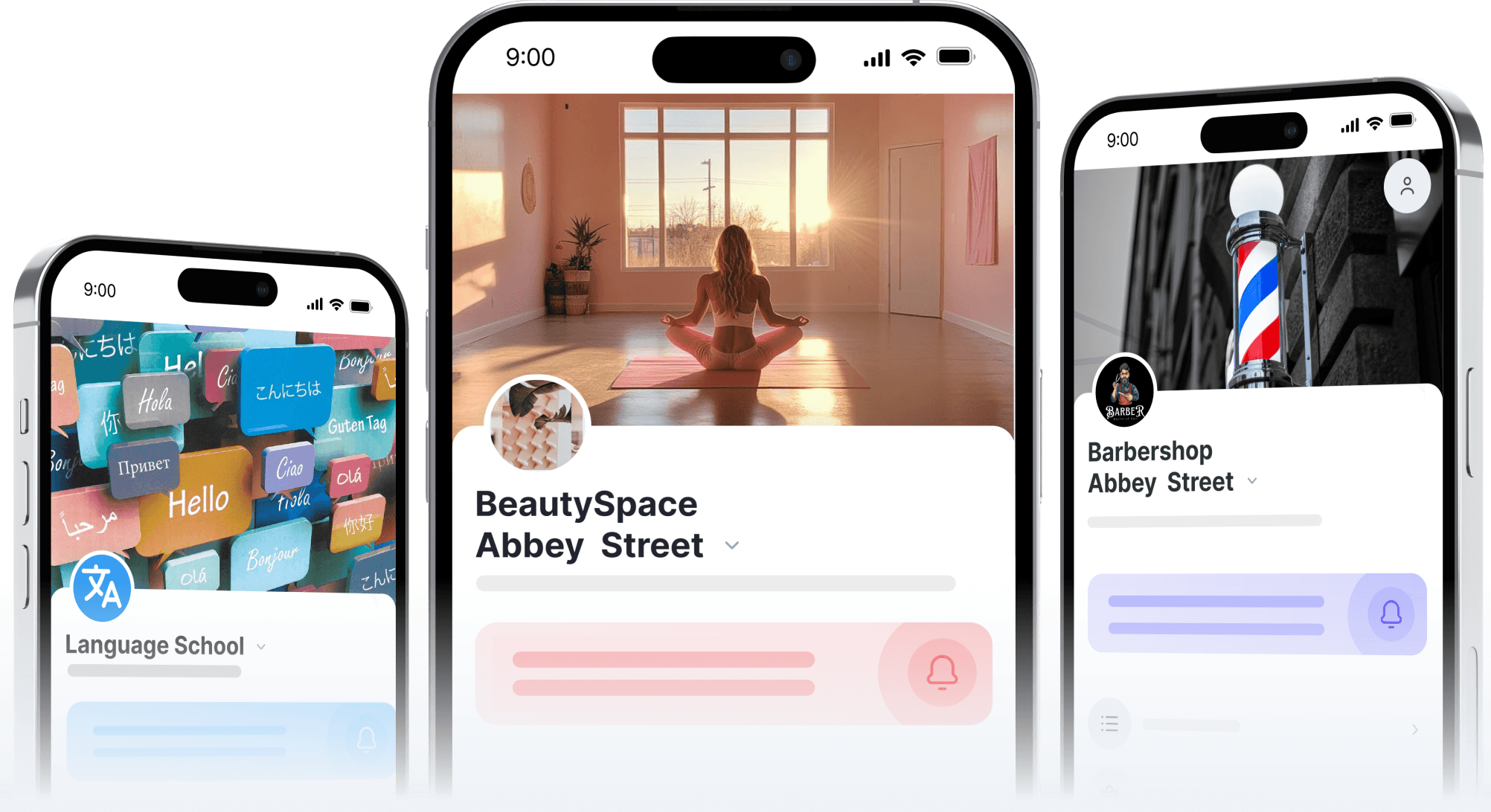
“Will everything be in Polish?” The system interface, the online booking widget and client notifications work in Polish. The knowledge base and support are in English. We say this before you subscribe, not after: if Polish-language support is essential for your team, factor it into the decision.
The first 7 days are a free trial, no card required.
Frequently asked questions
Is Booksy free?
No. The Booksy Biz subscription in Poland is 145 zł net/month for the first team member plus 35 zł for each additional one. Paid separately: SMS beyond 100 per month, the Boost fee for new marketplace clients (45% of the first visit price plus VAT), acquiring, and the Booksy Med module.
How much does a client from the Booksy marketplace cost?
Per their documentation: 45% net of the price of the first completed visit, minimum 25 zł, maximum 250 zł net. The rate is calculated on the full price of the visit, and 23% VAT is added on top: in Booksy’s own example, the fee on a 200 zł visit is 110.70 zł. If your business can reclaim VAT, the real cost is 90 zł, or 45% of the bill.
What is the fundamental difference between Altegio and Booksy?
Booksy is a marketplace with booking tools: it brings clients and charges a fee for them, while cancellation and profile-visibility rules are set by the platform. Altegio is a business management system without a marketplace: booking from your own channels, loyalty, checkout and P&L, inventory with bills of materials, payroll, a chain of locations – and a client base that belongs to you. Across our 105-item matrix: 36 in Altegio’s favour, 20 for Booksy, 38 parity.
Can I transfer my data from Booksy to Altegio?
Yes. You request a data export from Booksy (per their procedure – a request answered within up to 5 business days), then Altegio’s onboarding team does the transfer: clients, visit history, services. The transfer is free.
Does Altegio have a marketplace like Booksy’s?
No. Instead of an intermediary marketplace, Altegio provides direct connectors to the main sources of traffic: the Book Now button in Reserve with Google and Instagram, booking via Facebook, your website, messengers and a branded app. Clients come from the same channels where they would be looking for you anyway, but book directly – and no fee is charged for them.
Does Altegio have no-show protection with a card on file?
Yes. The Payment policy works in two modes: a deposit at online booking (with any connected payment provider) or a card guarantee – the client links a card and pays nothing in advance, and a late-cancellation or no-show fee is charged only if the rules are broken. Card guarantee mode works via Adyen. The policy can be switched on for specific services, team members and client types – for example, for new clients only.
Can I connect ChatGPT or another AI assistant to Altegio?
Yes. Altegio Pro MCP connects to Claude, ChatGPT, Gemini, Cursor and other MCP-enabled assistants in three steps: install the app, paste the connection address into your assistant and sign in with your Altegio login. The assistant answers questions about revenue, clients and schedules and takes action within your role’s permissions; there is a read-only version. In ChatGPT you can talk to it by voice. Booksy’s documentation has no official connection for AI assistants.
Does Booksy share data with the tax authorities?
Yes – and that is not a violation but a requirement the EU DAC7 directive places on platforms. Since 1 July 2024, Booksy reports to the Polish National Revenue Administration (KAS): the report covers visits paid through Booksy and visits with a receipt issued through their fiscal module – as quarterly totals, without client names (their DAC7 section). Visit history cannot be deleted: “Booksy does not allow deleting data on historical visits”. Altegio is not a marketplace, there is no automatic DAC7 reporting in it, and lawful requests from public authorities are handled under the privacy policy. The business declares its own income in any case.
Will I lose clients if I leave Booksy?
Regular clients book wherever you point them: the Instagram link, the website button, Google Maps, the branded app. You do not have to switch the Booksy storefront off – many businesses run both systems until their own channels gain weight. The Boost fee applies only to new marketplace clients, so the higher the share of your own channels, the cheaper every appointment becomes.
Can I use Booksy and Altegio at the same time?
Yes, it is a common scenario: Booksy as the storefront for new clients, Altegio as the management system – calendar, finances, inventory, payroll, client base. There is no automatic sync between the systems: appointments from Booksy are entered into the Altegio calendar manually.
Is Altegio available in Polish?
The interface, the online booking widget and client notifications – in Polish. The knowledge base and support – in English.
Does Altegio work for chains and franchises?
Yes: a shared client base, a shared service catalog, a chain-wide loyalty program, inventory and consolidated cross-location analytics – without separate accounts for every location. In Booksy, a chain is assembled from separate accounts linked by support via an email to [email protected].
P.S. If you have read this far, you already know the answer. The question is not “which system is better” – the question is what you need: a storefront that brings clients for almost half of their first bill, or a system where the client becomes yours for good. Many start with the first and grow into the second. Try Altegio free for 7 days – and compare your own schedule a week later, not the tables.