
Let’s be upfront about one thing
By the end of this article we’re going to ask you to connect Adyen to your Altegio account. Because that’s profitable for your business. Now you know.
But here’s the deal: everything before that is yours to use today, whether you connect it or not. The numbers, the four worked examples, the new product features available in your account. Take them, run them against your own calendar, and get more high-value appointments and bigger revenue.
Ready? Let’s start with the empty chair.
The more expensive the slot, the more an empty chair costs
A €40 appointment that falls through is annoying. A €380 aesthetic procedure, a €600 ceramic coating or a €450 track slot that falls through is a hole in the month.
The maths is simple. The more a slot costs, the more it hurts when it stays empty. The room is prepared. The specialist is booked. The product is opened. And the client you turned away because the slot was taken? Not coming back.
What it costs: our own numbers for August 2026
We didn’t want to guess, so we looked at our own data. August 2026, appointments with a clear outcome (the client came or didn’t). Here’s what no-shows took:
| Vertical | Share of no-shows among clear outcomes | Turnover lost to no-shows |
|---|---|---|
| Beauty | 7.63% | €6,619,435 |
| Medicine | 12.67% | €3,079,887 |
| Sport | 5.91% | €92,113 |
| Education | 10.06% | €69,989 |
| Retail | 20.22% | €55,311 |
| Total, five verticals | €9,916,735 |
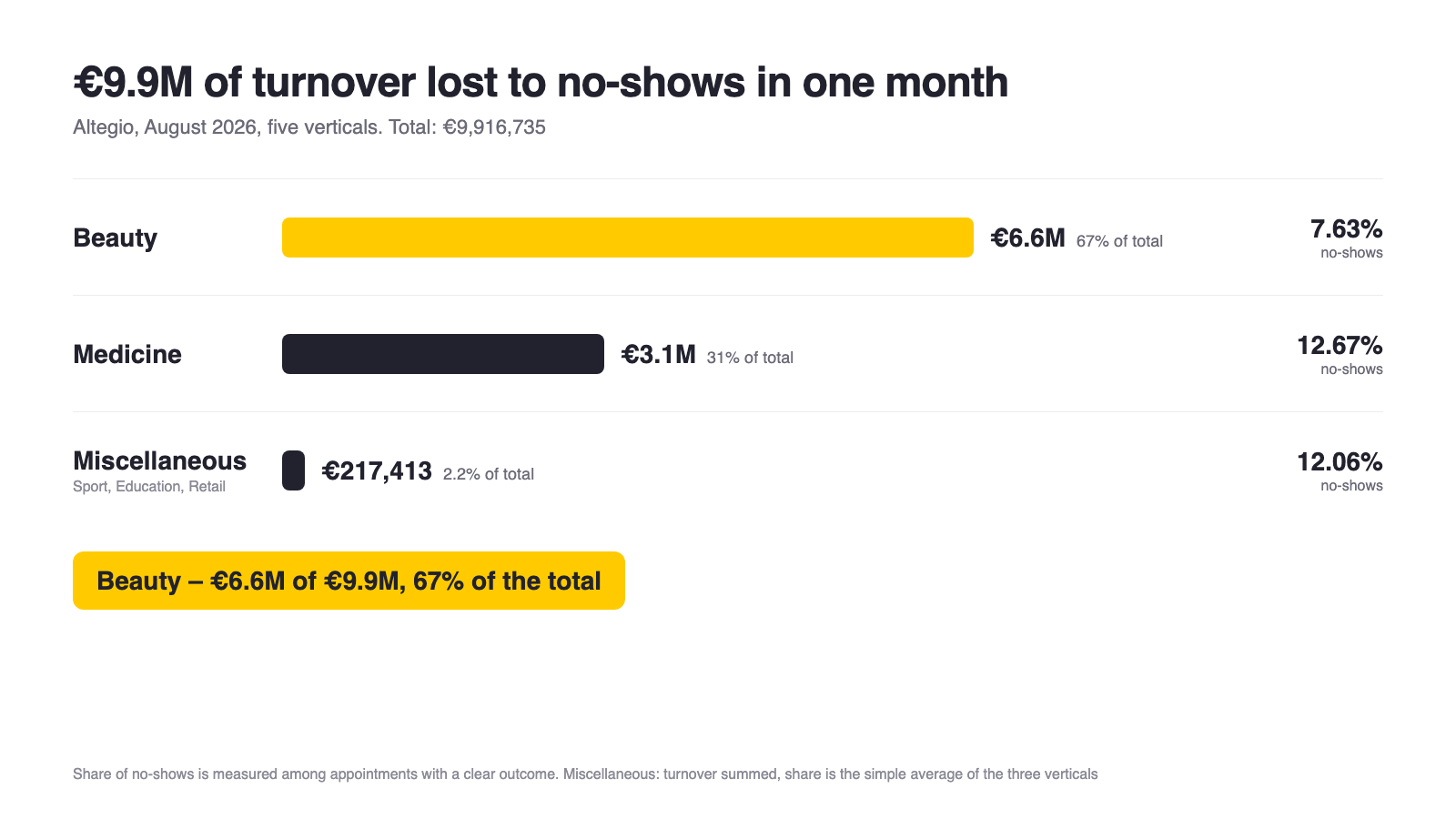
Almost €10 million of booked turnover in a single month that never turned into revenue, because businesses were left with empty slots due to non-coming clients.
Most of those appointments had nothing behind them. No deposit, no card. Prepayment has always been available in Altegio, but only a minority of businesses asked for it.
And look at medicine: 12.67%. More than one appointment in eight, gone.
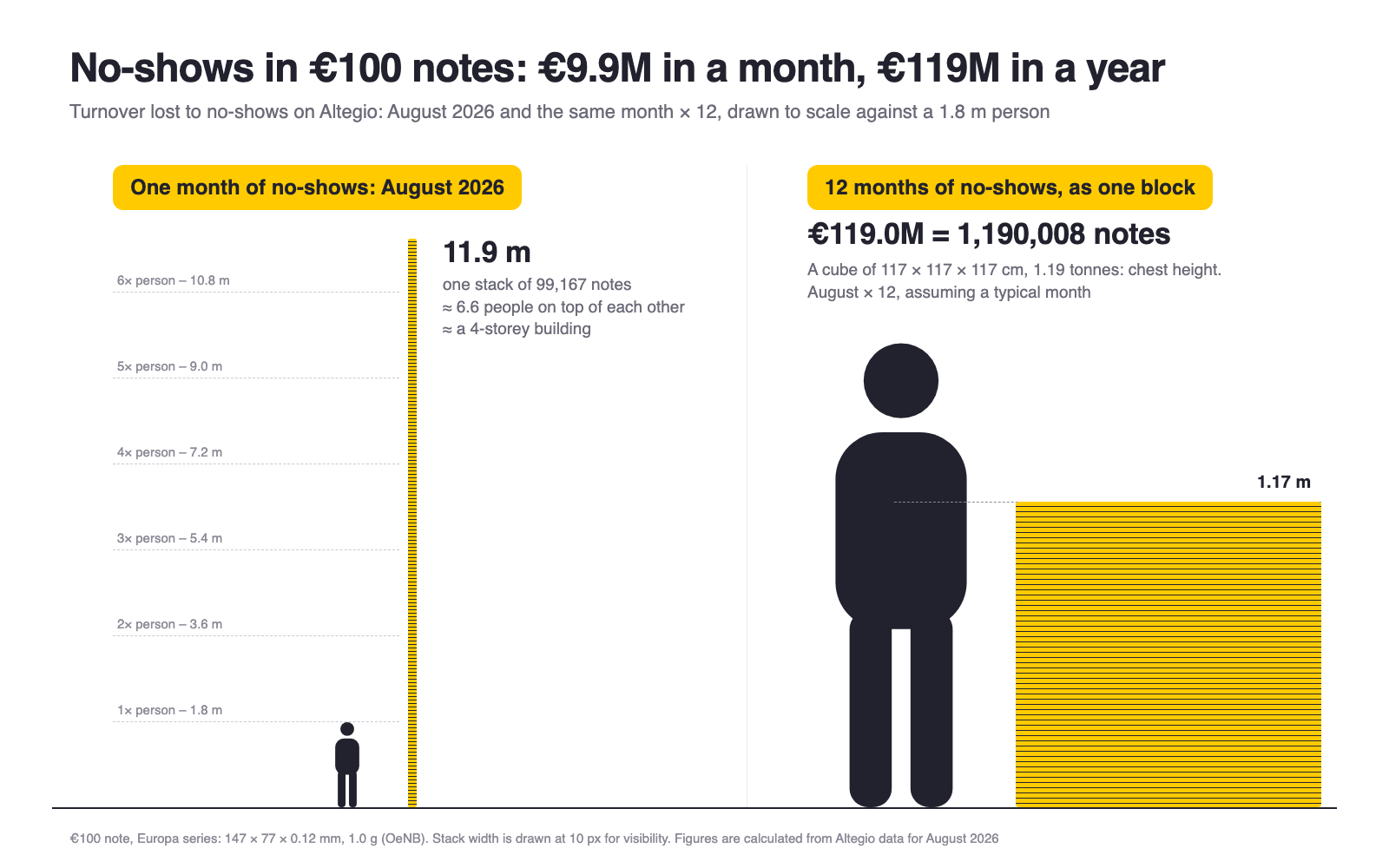
Hard to picture €10 million? Try this. In €100 notes it’s a stack of 99,167 notes, almost 12 metres tall – a four-storey building – weighing about 99 kg. Twelve months of it, if August is a typical month, is €119 million: about 1.19 million notes that fit into a cube of 1.17 m and weigh 1.2 tonnes.
Now, honestly: no tool gets all of that back, and a policy isn’t meant to. But the biggest losses sit in the most expensive slots, and those are exactly the slots a deposit or a card guarantee protects best.
That’s what payment policies are for. And connecting Adyen, our payment partner in Europe, unlocks the most advanced version of them.
What a payment policy is – and what it isn’t
You know the classic online prepayment that businesses on Altegio have used for years. A payment policy is that idea, grown up: far more flexible, far more controllable.
It also replaces it. The old online prepayment module is being retired: payment policies take over, the prepayment toggles on services and team members go away, and optional prepayment stops existing as a concept. Either the policy applies to a booking and the client pays a deposit or links a card, or it doesn’t apply and nothing is asked.
You set the rules once for your location, and Altegio applies them to every new online appointment that matches. Two ways to protect a slot:
- Deposit – the client pays part of the visit at booking. If they show up, the deposit becomes the first payment for the visit. If they cancel late or don’t show up, it stays with you.
- Card guarantee (available with Adyen) – the client books without paying anything, but links a card. If they cancel late or don’t show up, the fee you set is charged from that card.
Now, we know what you’re thinking.
“Will this take money from my clients in a way I didn’t agree to?”.
No. And here are the three reasons.
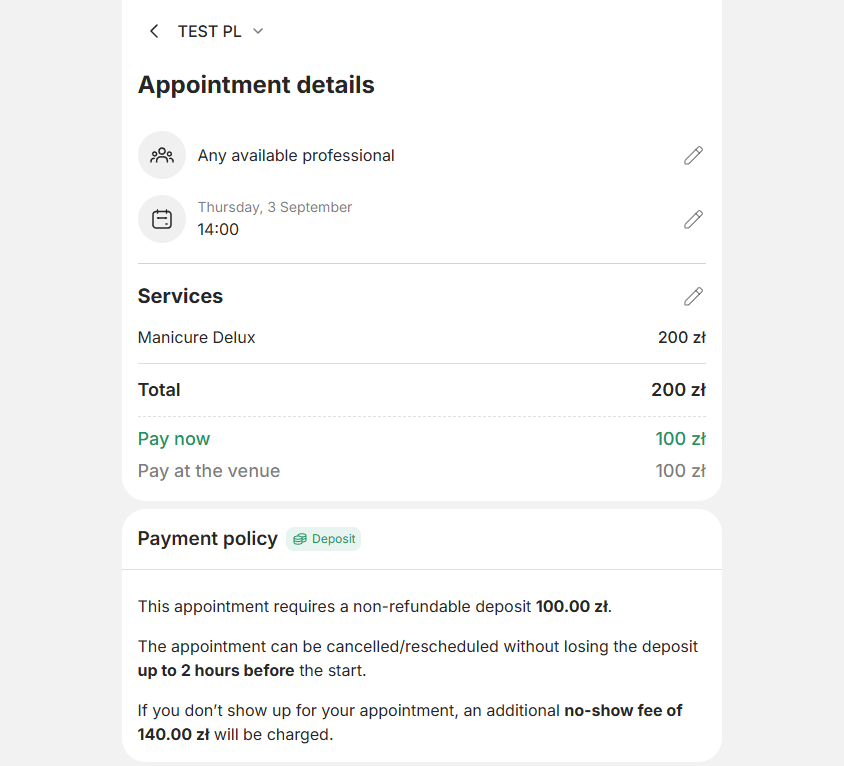
- The client agrees first. Before confirming, the client sees the exact amounts – the deposit, the late cancellation fee, the no-show fee – and the free cancellation window. Consent is two explicit checkboxes – to the fees and to storing the card data – never pre-ticked.
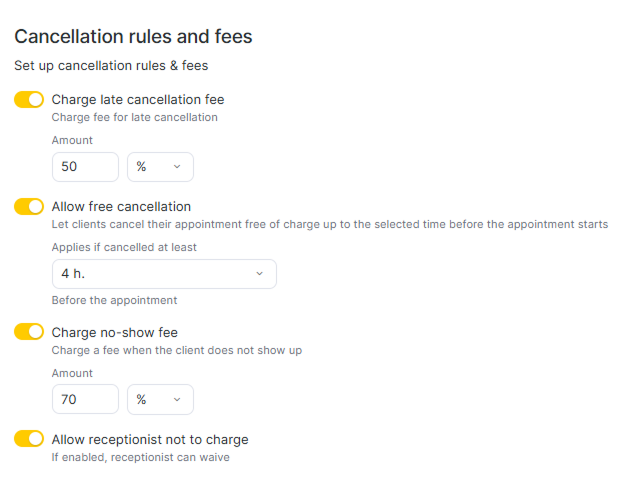
- Money moves only in two situations: a no-show, or a cancellation (or reschedule) after the free window closes. The card cannot be charged for anything else, and the terms are locked at the moment of booking, so changing your settings tomorrow doesn’t change yesterday’s booking.
- You decide the amounts, and your team keeps the final word. The fee percentages and windows are yours. When a client cancels late online, the rule you set applies on its own. In every other case your receptionist decides in the visit window: charge the fee, waive it (if you allow waiving), or keep the deposit on the client’s balance for the next visit. If nobody decides on a no-show by the end of the visit day, your own rule applies automatically.
Here’s what your client actually sees while booking:
Four slots worth protecting
Let’s make it concrete. Four businesses, four expensive slots, four policies. Round numbers, illustrations, not a promise of results. You set your own fees, windows and percentages.
| Business | Slot to protect | Policy | What you keep if the client does not come | Cost of collecting it via Adyen* |
|---|---|---|---|---|
| Beauty – colouring, balayage | €240, 3 hours of the top colourist | Card guarantee, free cancellation up to 24 h, late fee 50%, no-show fee 70% | €168 (late cancellation: €120) | €1.86 |
| Aesthetic medicine – lip filler | €380, prepared room and product | Deposit 30% at booking (€114) + no-show fee 70%, with Adyen | €266: the €114 deposit plus €152 charged from the card (late cancellation: the €114 deposit) | about €3 in total |
| Sport and entertainment – a private track slot for up to 10 people, listed as one service | €450, the whole track for an hour | Deposit 30% (€135), free cancellation up to 72 h | €135, or up to €225 with a 50% no-show fee (with Adyen) | €1.54 for the deposit |
| Auto detailing – ceramic coating | €600, one bay for 6 hours | Card guarantee, free cancellation up to 48 h, late fee 40%, no-show fee 50% | €300 (late cancellation: €240) | €3.17 |
*0.99% + €0.20 per transaction on EEA consumer cards. Cost = amount × 0.0099 + €0.20.
Four things to notice:
- Aesthetic medicine is where the hybrid mode shines. A deposit protects part of the slot, and when the connected payment system is Adyen the no-show fee can be higher than the deposit: the difference is charged from the linked card. You take a small amount upfront and still cover the real loss.
- Big slots need the long window. Free cancellation can be set from 1 to 72 hours, so a company booking the whole track has time to reschedule and you have time to refill the slot.
- One thing to know about groups. In this release the policy applies per individual appointment, so a track slot is protected when it’s listed as one service booked by one client. Group events with separate participants aren’t covered yet; that may come in a future release, depending on how many businesses ask for it. Service packages (4HANDS+), where several specialists work on one client in one appointment, will be covered. Competitors aren’t further ahead here: some let a group prepay as one reservation or let classes be paid in advance, but we have not seen any of them offer a card guarantee for a whole group.
- Test drives. A dealership or a premium car rental loses an hour of a manager and a demo car per missed test drive. Payment policies skip services priced at zero, so a free test drive isn’t covered. Businesses that want protection list a premium test drive as a paid slot, for example €90 for 90 minutes, and protect it with a card guarantee.
What it adds up to in a month
Let’s say you run a studio. 400 online appointments a month, average check €95. You set the policy to apply from a minimum visit amount of €150. That covers about 100 of those appointments, averaging €220 – €22,000 of revenue.
Now take the beauty figure from our own data: 7.63% falling through. About 8 of those 100 appointments are at risk. Roughly €1,680 a month.
With a card guarantee and a 70% no-show fee, charging all of them brings in about €1,175. Even if your team waives half, about €590. The cost of collecting it through Adyen: about €13. Over a year, €1,175 a month adds up to about €14,100.
Run a clinic? The picture is heavier: medicine’s rate is 12.67%, and each slot costs more.
Before you trust any of this, replace 400, €95 and 7.63% with your own numbers. They’re all in your Altegio reports. That’s the part you can do today, for free, without connecting anything.
Why Adyen unlocks the full version
Here’s the thing about the two modes.
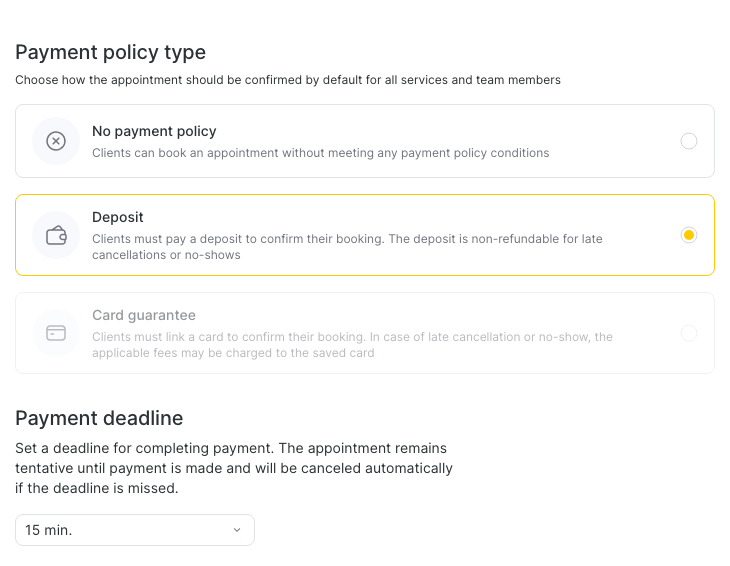
Deposits work with the payment system you already use in Altegio – Stripe, VivaWallet, LiqPay, Qton and others. Card guarantee is different. Holding a card and charging it later, without the client being present, needs a provider that supports off-session charging. In Altegio that provider is Adyen.
That’s why the mode stays switched off until Adyen is connected:
So what does connecting Adyen actually add?
| Without Adyen | With Adyen | |
|---|---|---|
| Card guarantee (book with no money upfront) | – | Yes |
| No-show fee higher than the deposit | The fee equals the deposit | The difference is charged from the linked card |
| Late cancellation and no-show fees charged from the card | – | Yes, off-session, with automatic retries if a charge fails |
| Card acquiring fees | Rates of your current provider | 0.99% + €0.20 on EEA consumer cards |
| Payment methods | Depends on the provider | Apple Pay, Google Pay, and local methods such as BLIK, Bizum, Girocard and Cartes Bancaires |
Card guarantee is the mode that removes friction from booking. The client pays nothing upfront, so booking stays as easy as before, and the protection only kicks in if they don’t keep their word.
The numbers on the payment side
“Yes, but what does Adyen cost me?” Fair question. Adyen’s rates for Altegio clients in Europe:
- 0.99% + €0.20 on EEA consumer cards – the mass segment, about 90% of transactions.
- 2.50% + €0.20 on EEA commercial cards.
- 2.90% + €0.20 on international consumer cards.
- 3.90% + €0.20 on international commercial cards.
The same 0.99% applies in EUR, CZK, PLN, DKK, RON and HUF, with the fixed fee adjusted per currency. Payouts go to your existing bank account every week, with no separate merchant account. Full details are on the Altegio and Adyen page.
One honest caveat: the 0.99% is for personal EEA cards. Commercial and international cards cost more, as the list shows, so your overall cost depends on your client mix. For the typical beauty, health, sport or auto client paying with a personal EEA card, the mass rate is what applies.
Adyen is a natural choice, not a leap of faith
“And who is Adyen, anyway?” Also fair.
By volume, Stripe is the larger of the two: about €1.6 trillion in 2025 (its reported $1.9 trillion at the ECB rate of 31 December 2025). Adyen processed €1.39 trillion in 2025 and €804 billion in the first half of 2026 alone, up 24% on a year earlier. Net revenue for that half-year was €1.3 billion (up 19%) at an EBITDA margin of 49%, or 50% without one-time transaction costs. It’s a European company, listed on Euronext Amsterdam since 2018, holding a banking licence and certified as a PCI DSS Level 1 service provider, with results published for anyone to read.
Sources: Stripe 2025 annual letter, 24 February 2026; Adyen full-year 2025 results; Adyen H1 2026 results, 13 August 2026. Stripe’s figure converted at the ECB reference rate of 31 December 2025 (€1 = $1.1750).
For a business in Europe this is an ordinary, sensible step: the provider whose rates for Altegio clients start at 0.99% + €0.20 is also the one that unlocks the most advanced mode.
Who is responsible for what
Payment policies involve real money, so let’s be precise about who holds what:
- Your business is the merchant of record. You’re responsible for the service, the size of your fees and your cancellation windows. Altegio provides the mechanics and makes sure the terms are disclosed to the client. The decision to charge or waive a fee, and the risk of a refund or a chargeback, stay with you.
- Adyen handles the card data. The card is tokenised by Adyen N.V. Altegio never sees the full card number, the CVV or the expiry date, and it doesn’t take payments on your behalf – the money goes from Adyen to your bank account.
- Fees must be proportionate. European consumer law lets clients challenge a penalty that is disproportionate to the loss the business suffered. Set your percentages with the real cost of an empty slot in mind, not as a punishment.
The bottom line: Altegio doesn’t hold your clients’ card data and doesn’t touch your payments. Both are handled by a licensed European bank that does this at a scale few companies can match.
How to set it up
You’ll probably not set this up yourself. But it helps to know how little there is to it:
- Connect Adyen. Only the Location Owner can do it, under Integrations → Payment systems. It’s a separate onboarding with business verification and a payout account, which usually takes a few days. Start it early.
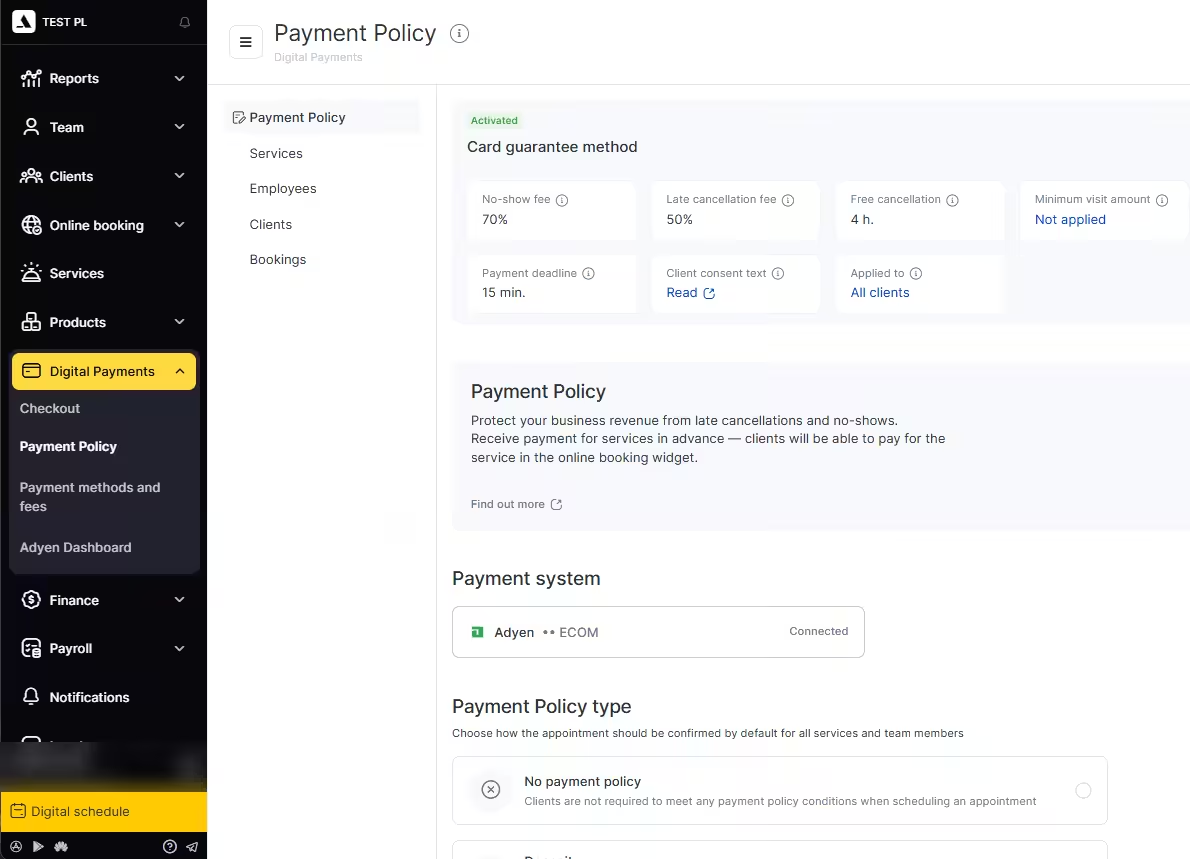
- Open Payment Policy in Administration mode → Digital Payments → Payment Policy, and choose the mode: deposit or card guarantee.
- Set the amounts: the deposit or the fees, as a percentage or a fixed sum, the free cancellation window and the deadline for paying or linking a card (15 minutes by default).
- Say where it applies. This is the part that makes payment policies practical.
Policies apply to online bookings on their own. For an appointment your team books by phone, the receptionist sends the client a payment link from the visit window; if the client doesn’t pay the deposit or link a card before the deadline, the appointment is removed from the calendar.
Rules for your priciest services only
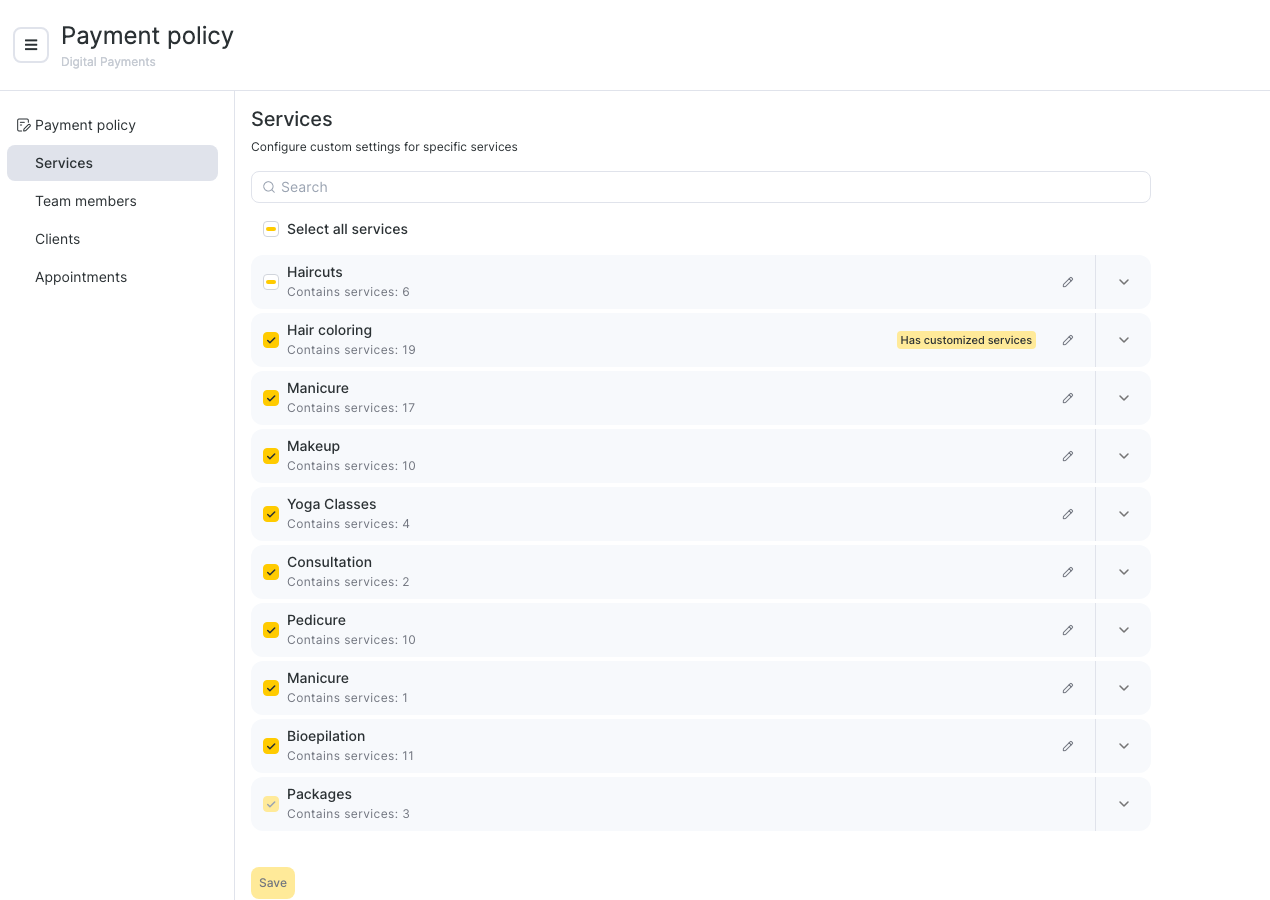
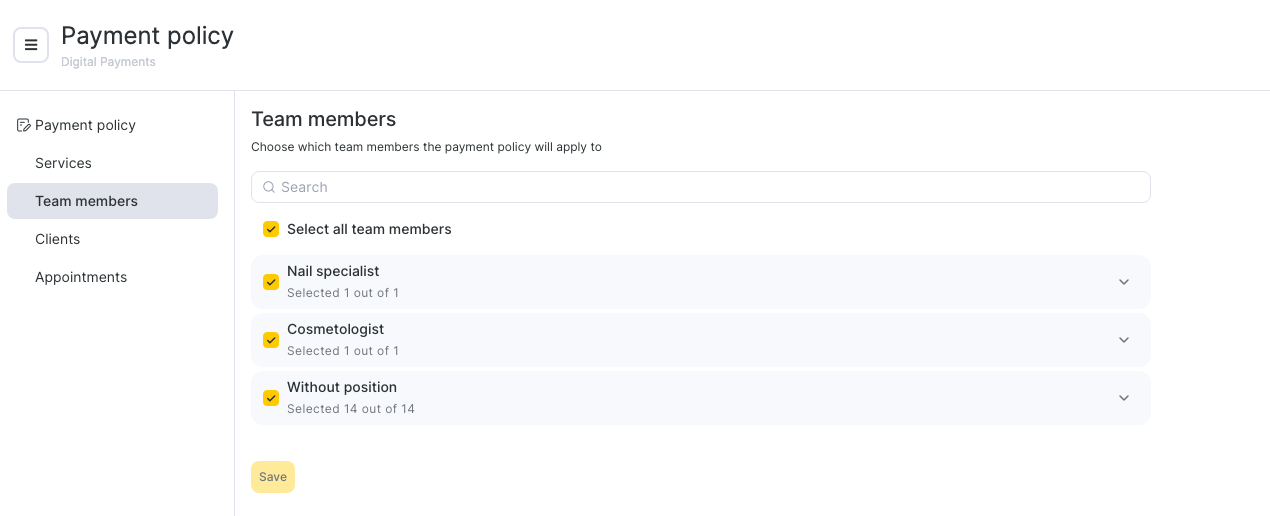
You don’t have to apply one rule to everything. A policy can be limited by:
- Services – whole categories or single services, with custom values for chosen ones. Colouring and packages can carry a higher fee than a haircut.
- Team members – for instance, only your senior specialists.
- Clients – all, new only, or existing only. New clients only is the cautious way to start.
- Appointments – a minimum visit amount, so that a €30 appointment books as before and a €300 one is protected.
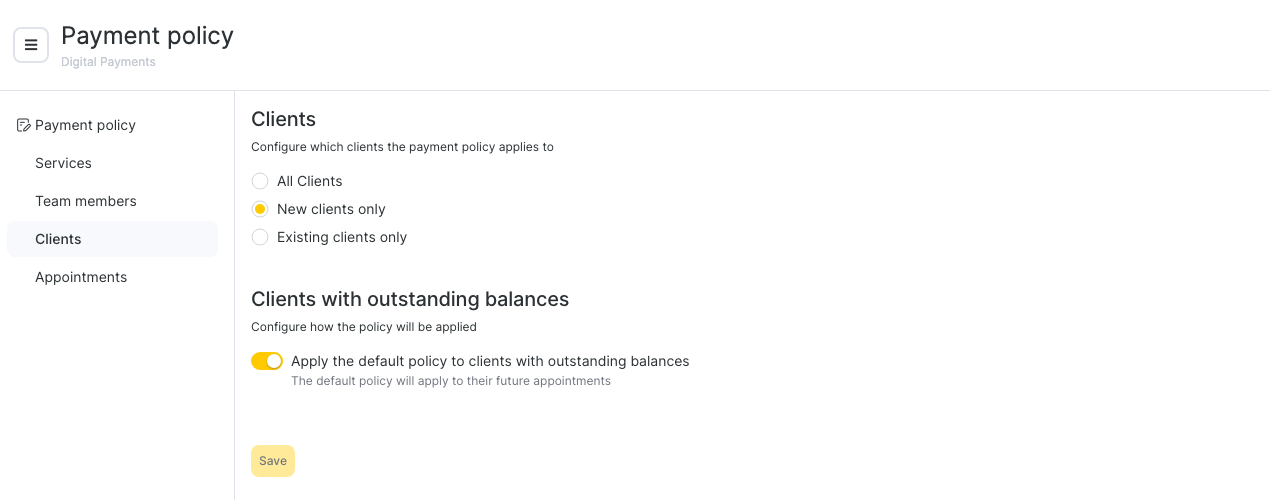
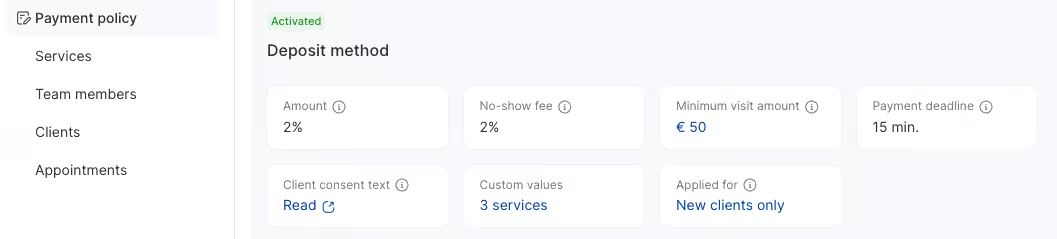
A policy applies only to new appointments, and active memberships override it. Services with a price of zero are not covered. Group events are not covered in this release (a future one may add them if there is demand), while 4HANDS+ service packages will be.
What the team and the owner see
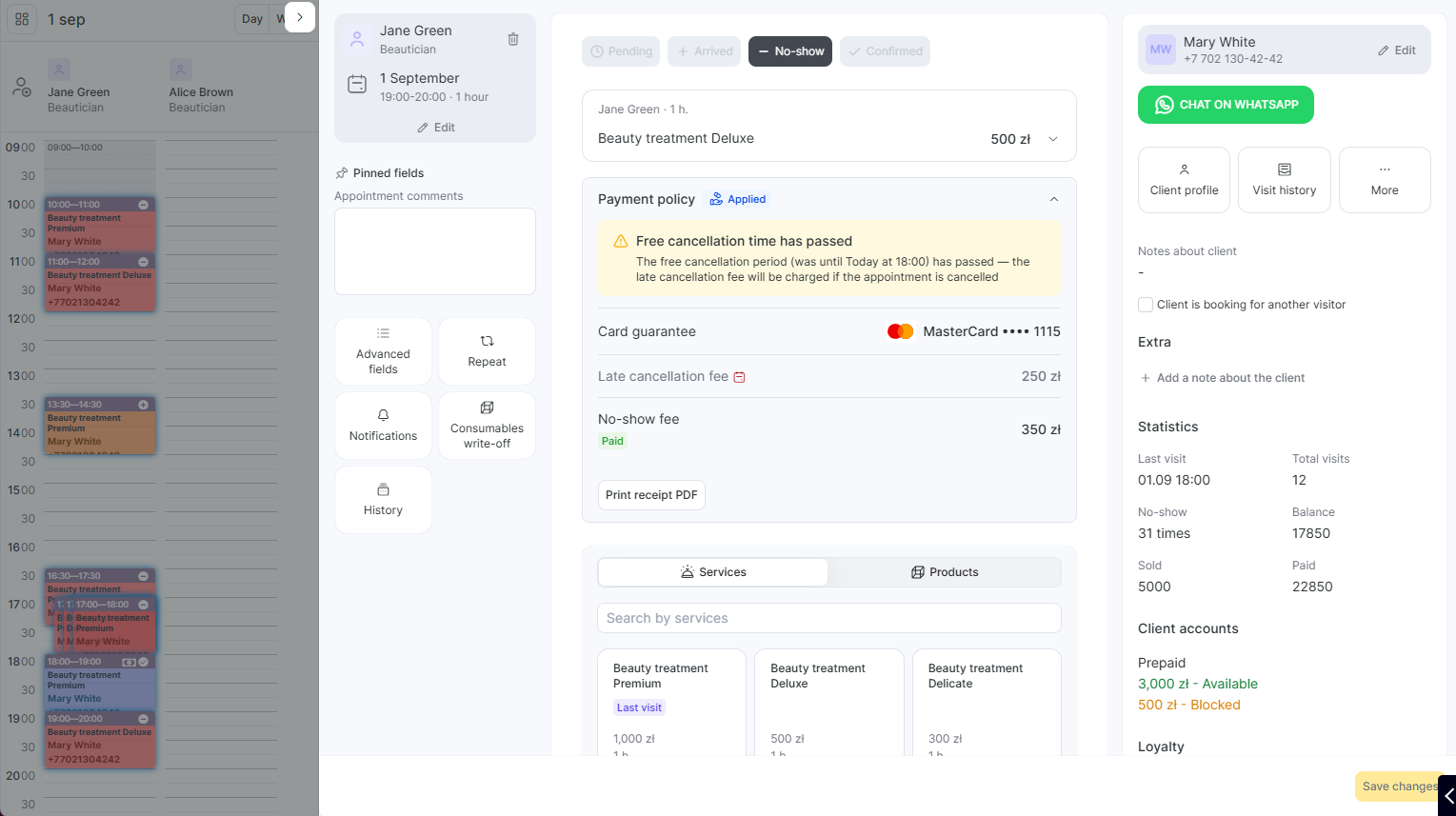
When a no-show or late cancellation happens, the receptionist sees the case in the visit window, with the card, the fees and the payment status in one place:
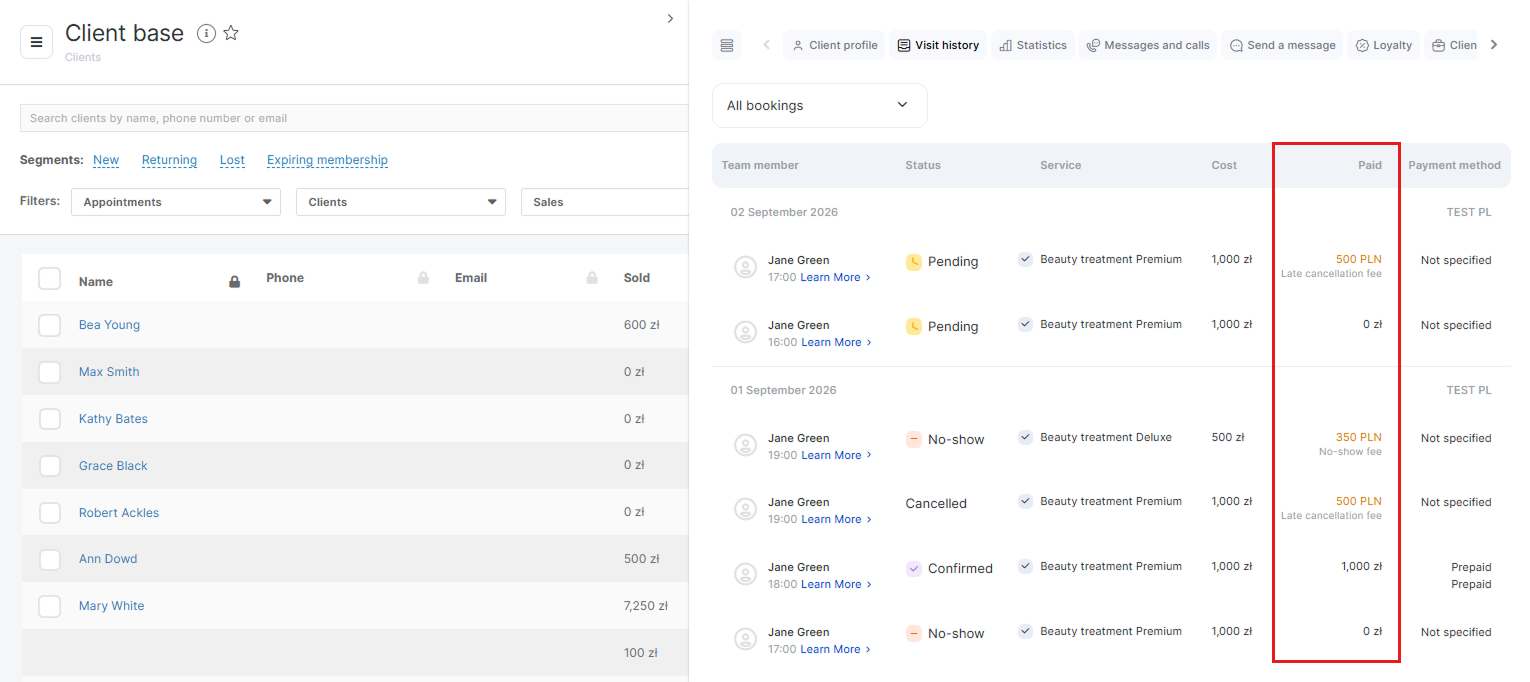
And the client’s visit history shows, appointment by appointment, what was collected as a fee:
“My clients won’t accept this”
We hear this one a lot. So look around.
Your clients are already used to it from hotels, restaurants, airlines and clinics. What matters is how the rule is presented: clear amounts before booking, a fair free cancellation window and a receptionist who can make an exception for a loyal client. All three are built into the payment policy.
Your competitors are protecting their most expensive slots. Your clients accept it there. They’ll accept it from you.
What sets Altegio apart
- No marketplace between you and your clients. Altegio is software, not a marketplace: no commission on new clients and no booking fees. Marketplaces charge new-client commission of up to 20%, and some sell no-show protection on top, with their own transaction fee.
- Both modes, not just one. Some platforms give you only a deposit. Altegio gives you the deposit for any supported payment system and card guarantee with Adyen, and lets you combine them.
- Rules by service, team member, client and amount. Protect the €600 slot, leave the €30 one alone.
- Control stays with your team. Charge, waive or keep the deposit on the client’s balance, with permissions for who is allowed to waive.
- Minimum acquiring rates for fees and for payments. 0.99% + €0.20 on EEA consumer cards applies to every card payment you take through Adyen in Altegio, not only to no-show fees.
And one more reason to run your business through one system
Altegio has also launched an MCP connection: you can connect Claude, ChatGPT or Cursor to your Altegio account and ask questions in plain language – which clients haven’t visited in 90 days, how revenue changed this month and which services drove it. The assistant can also move an appointment or adjust working hours, and you review every change before it’s saved. Access follows your own permissions.
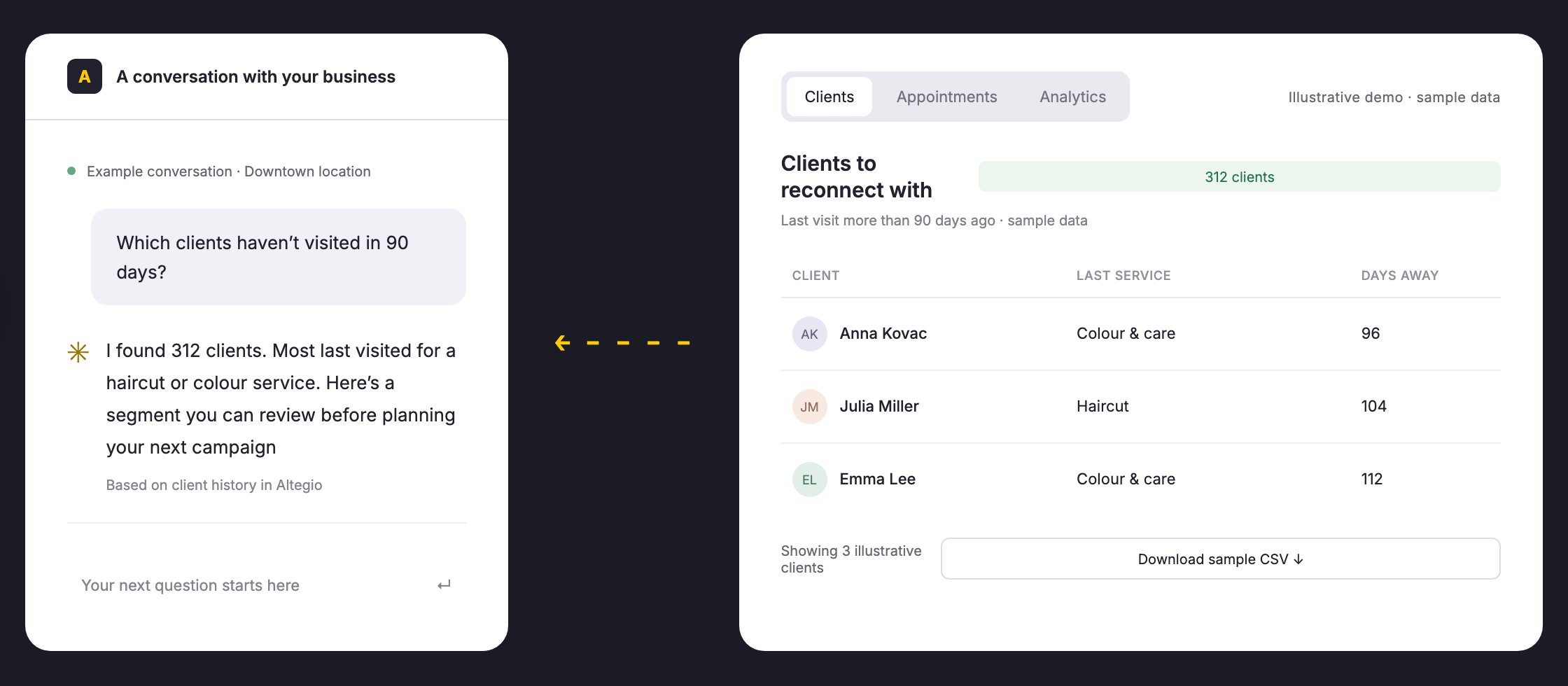
Payment policies protect the money on the calendar. An assistant that reads the same data helps you see where the rest of it leaks.
Where to start
We told you at the top what we’d ask. Here it is, in three steps, the Adyen part in the middle:
- Look at your ten most expensive services and how many of them ended in a no-show or a late cancellation last quarter.
- Connect Adyen, so that card guarantee is ready when you need it. The onboarding takes a few days, which is exactly why you start it before you need it.
- Turn on a policy for those services only, for new clients, and review the results after a month.
Step 1 costs you nothing and you can do it this afternoon. Step 3 works with the payment system you already have. Step 2 is what turns “deposit only” into the full version.
Good to know
- Payment Policy is rolling out gradually across Europe. If you don’t see it under Digital Payments yet, it’ll appear shortly.
- Adyen availability depends on your country and business category. It’s available to registered companies, not to individual entrepreneurs, and only the Location Owner can connect it. If you don’t see it, write to support.
- The full setup guide is in the payment policy article in our help centre.
- The payment policy legal page for your clients is available at alteg.io/en/info/payment-policy.