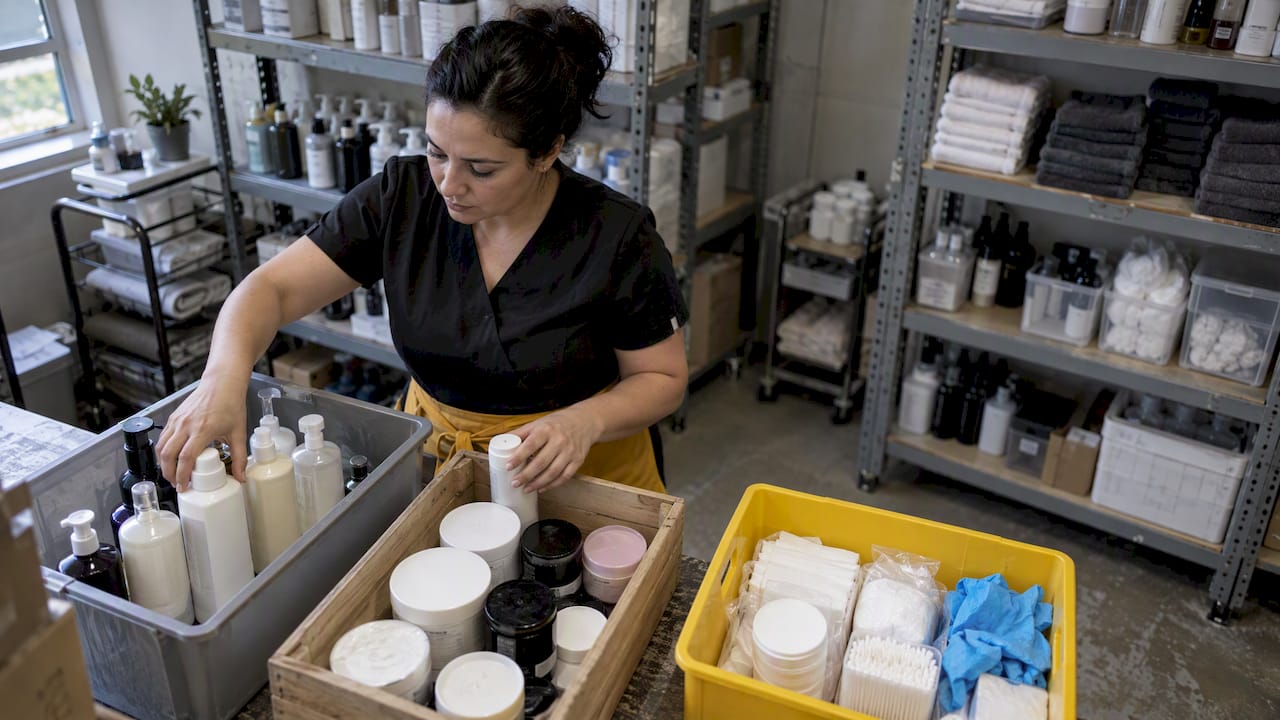
The fastest way to cut stock loss in a spa is to separate back-bar products from retail stock, count on a fixed schedule and let your booking system write off what each treatment actually uses. This week, do two things: run a full physical count of everything on your shelves and in the back room, then set par levels for your top 10 products. Everything else in spa inventory control builds on those two moves, and the 90-day plan below shows the order to do it in.
TL;DR:
- Separate back-bar, retail and consumables from the moment stock arrives, or your margin figures will mix up training problems and theft.
- Give inventory one owner, a full monthly count and weekly spot checks on your top 10 products.
- Track a handful of numbers: sell-through, stock-to-sales ratio, par compliance and shrinkage.
- If you sell cosmetics to clients, EU rules expect you to check batch numbers and expiry dates and to know who supplied each product.
- Software helps most once categories and par levels are clean: link products to services, scan barcodes and reorder from data rather than memory.
Why back-bar, retail and consumables need separate tracking
Many spas keep everything in one stockroom and one spreadsheet. That’s the first mistake, and it’s an expensive one.
Back-bar stock is professional-use product: the oil you use in a massage, the peel you apply during a facial, the wax you melt for hair removal. It never reaches the till. Retail stock is the bottles and jars clients buy and take home. Consumables sit in a third bucket: cotton pads, disposable towels, gloves and the other supplies that get used up whichever service is on the schedule.
When these three categories share a shelf and a ledger line, your margin numbers mislead you. A spa that seems to be “losing” retail stock might have a therapist using retail-labelled product during a treatment, which is a training problem, not a theft problem. You can’t tell the difference unless the categories are separated from the moment stock arrives.
A few habits fix this fast:
- Give each category its own physical storage area, even if that just means a labelled shelf.
- Use separate product categories or codes so reports split cleanly.
- Value back-bar stock at cost, and retail stock at cost against sale price, since they answer different questions.
Once the categories are distinct, the sources of shrinkage stop hiding behind each other and you can see where the money is going.
Six practical steps to control spa inventory day to day
Inventory control isn’t a one-off project. It’s a routine, and routines need owners, a rhythm and rules. Here’s the sequence that works.
- Assign an inventory owner with named helpers for each room or department, so counts have one accountable person rather than “whoever’s free”.
- Set a counting rhythm: a full formal count every month, with weekly spot checks on your highest-value or fastest-moving items.
- Set par levels and reorder points for every product, and revisit them each season rather than leaving fixed numbers to go stale as demand shifts.
- Build a bill of materials for every paid service, listing the products and quantities a treatment uses, so stock is written off when the visit is completed rather than whenever someone remembers.
- Label and shelve everything on arrival, recording the supplier, batch number and expiry date before the box is unpacked.
- Secure back-bar and retail stock with simple physical measures, since a locked cupboard stops more opportunistic loss than any report.
Don’t let slow movers sit. Bundle them with a popular treatment, offer them to your team at a discount, or ask your supplier about returns or exchanges before they become a write-off.
Pro Tip: Count your top 10 products weekly even if your full count is monthly. A handful of products usually make up most of your inventory spend, and catching a discrepancy early is far cheaper than finding it a month later.
Key metrics and reports every spa should track
You don’t need forty reports. You need four or five numbers checked at the right frequency, and the discipline to act on them.
Sell-through rate shows what share of the stock you received in a period has actually sold. Divide units sold by units received and multiply by 100: if you received 40 bottles of a €18 cleanser and sold 10 in a month, sell-through is 25%. Review it monthly per product line. A low sell-through rate on a line you keep reordering is a signal to stop, not a reason to double the next order.
Stock-to-sales ratio compares the value of stock on hand with sales over the same period, and it’s your early warning for overstocking. €6,000 of retail stock against €2,000 of monthly retail sales gives a ratio of 3, so you hold about three months of stock. Par compliance simply asks whether your shelves match the par levels you set. Check both weekly.
Shrinkage (stock that disappears without a recorded sale or service write-off) and supplier fill rate (how reliably suppliers deliver complete, on-time orders) are worth a monthly review each.
- Check sell-through when a product feels like it’s “always on the shelf”.
- Check the stock-to-sales ratio monthly to catch overbuying across a whole category.
- Investigate shrinkage as soon as a physical count disagrees with the system.
What inventory software must do for your spa
Software doesn’t fix bad habits, but the right features make good habits far easier to keep. Here’s the checklist that matters, whichever system you choose.
- Barcode scanning on receipt, at sale and during counts, so stock movements are recorded in seconds rather than estimated at the end of the week.
- Several storage areas, so back-bar, retail and consumables are separate inside the system, not just on paper.
- Bills of materials that link each service to the products and quantities it uses.
- Minimum and target stock levels per product, with a list of what has fallen below them.
- Sales linked to appointments, so retail sold during a visit leaves stock and shows up in revenue without a second entry.
- A full operations log showing who received, sold, moved or wrote off stock and when, which turns “I don’t know what happened” into an answerable question.
- A record of batch numbers and expiry dates, whether that’s a field in the system or a receiving log kept alongside it.
Bills of materials matter because they make back-bar overuse visible. Say a facial’s bill of materials lists 15 ml of serum and you perform 20 facials a month: the system writes off 300 ml. If your count shows 500 ml gone, the 200 ml gap works out to an extra 10 ml per facial, and you’ve found a training issue before it becomes a habit. Batch records matter because without them, a recall means pulling every unit of a product rather than only the affected batch.
The most common pitfall is setting reorder points once and never touching them again. A product that sells steadily in winter can sit untouched in summer, and a fixed reorder point either ties up cash in stock nobody wants or causes a stockout on something that’s suddenly popular. The second is ignoring supplier lead times, which quietly turns “reorder at 10 units” into “run out before the delivery arrives”.

Compliance, batch control and expiry rules that affect spas
The EU Cosmetics Regulation, Regulation (EC) No 1223/2009, defines a distributor as anyone in the supply chain, other than the manufacturer or importer, who makes a cosmetic product available on the market, and it treats a professional using a product as an end user. In a spa, that usually makes you a distributor for the retail shelf and an end user for back-bar products.
As a distributor, before you sell a cosmetic product you must check that the required labelling is present, including the batch number or another reference that identifies the product, that the language requirements are met, and that the date of minimum durability, where one is required, has not passed (Article 6). If you have reason to believe a product doesn’t comply, you must not sell it, and where it presents a risk to health you must inform the responsible person and the competent national authority. If an authority asks, you must be able to name who supplied each product to you, and this obligation runs for three years after the batch was made available to you (Article 7).
In practice, this breaks down into a few concrete habits:
- Record the supplier, batch number and expiry date for every product as it arrives, before it goes on a shelf.
- Pick stock using FEFO (first-expired, first-out) rather than FIFO (first-in, first-out) for anything with a shelf life, since the item that arrived first isn’t always the one that expires first.
- Keep supplier delivery records at batch level for at least three years, so a recall stays narrow instead of pulling every unit of a product off every shelf.
- Set a minimum remaining shelf life for stock going to the retail shelf or the treatment room, so nothing close to expiry reaches a client.
The risk of skipping this isn’t abstract. Without batch-level records, a single contamination issue forces you to quarantine or discard your entire stock of a product rather than the affected units. National enforcement differs between EU countries, so check with your national authority if you’re unsure what applies to you.
Implementation checklist: timeline, team roles and training
A 90-day rollout turns all of this from theory into habit.
- Weeks 1 to 2: run a full physical count, separate stock by category, and record batch and expiry data for everything on hand.
- Weeks 3 to 6: standardise barcode labels, storage areas and par levels across every product line.
- Weeks 7 to 12: build service bills of materials into your booking system, set minimum stock levels so your reorder list comes from data rather than memory, and train every team member on the new workflow.
Roles need to be explicit from day one. The spa director owns the overall policy and supplier relationships. The inventory lead runs the counts, maintains par levels and places orders. Supplier contacts and lead times are logged against each product line so they are known rather than guessed.
Training should cover bills of materials (so therapists understand why portions matter), scanning on receipt and at sale, and basic security. Build it into onboarding from a new hire’s first week, and include part-time and cover team members, who are the easiest to miss when processes change.
Pro Tip: Run your first month on paper alongside your software rollout. If the two don’t match, you’ll find the gaps in your process before they cost you stock.
Altegio in practice: supporting spa inventory control
Altegio is booking and business management software for appointment-based businesses, from beauty and wellness to clinics, auto services and fitness. Your client base stays yours under Altegio’s Zero-Competition Policy: there is no marketplace listing rival businesses next to yours, clients book through your own links, and client data is never resold. Its inventory control covers the steps above inside the same system as appointments and payments.
- Separate inventories: Altegio starts with two inventories, Consumables and Products, and you can add more, for example a display shelf or a back-bar store (Products > Inventories).
- Transfers: moving stock from the back room to the display shelf is a relocation between inventories, so balances stay correct in both places.
- Bills of materials: link a bill of materials to a service for each team member who performs it, and consumables are written off automatically once the visit is completed. If a treatment used more or less than planned, you can correct the amounts in the visit window.
- Barcodes: a standard barcode scanner works like a keyboard, so no integration is needed. Scan to fill in a product card, add a product to a sale or build a file for a stock audit.
- Stock audit: under Products > Stock Audit you enter actual quantities, or upload a file of scanned barcodes, and Altegio creates write-offs for any shortfall automatically.
- Reorder signals: each product can have a critical stock level and an optimal stock level. The Product orders report lists stock on hand, both levels and the deficit, filtered by inventory, category or supplier. Deliveries are recorded as product arrivals with the supplier and purchase cost.
- Retail at checkout: when a client buys a product during a visit, it’s deducted from stock and the sale appears in revenue alongside services.
For the numbers in this guide, the inventory reports cover most of what you need: Inventory balance (with critical-stock and zero-balance filters and Excel export), Turnover analysis for slow movers, Consumables usage and Write-off analysis for overuse, Product sales analysis for retail, and an inventory operations report that shows when and by whom stock was written off. The Sales by Services report adds consumables cost, payroll and profit per service. See statistics and analytics for the wider reporting, and the Altegio inventory management guide for a step-by-step walkthrough of the module.
In a 90-day rollout, the software does most of its work in weeks 7 to 12, once your categories and par levels are already clean.
Where most spas actually lose money on inventory
In our view, the most common root cause of inventory chaos isn’t theft or bad luck: it’s mixing back-bar and retail accounting into one pile. Once that happens, every report is built on a false premise, and managers end up chasing shrinkage that’s really a training issue, or restocking retail lines that are actually back-bar overuse in disguise.
The highest-impact quick win costs nothing but discipline: set and enforce par levels on your top 10 products, then measure sell-through over 30 days. Adjust, don’t overhaul. Small, measured corrections usually beat a dramatic system change.
Ready to put this into practice? Start here
Everything in this guide works better when appointments, stock and reports sit in one place instead of three. A completed visit writes off the right products, bills of materials stop the guesswork about how much serum a facial should use, and barcode scanning with separate inventories makes counts faster.
- Run the full count and set par levels on your top 10 products this week.
- Split stock into back-bar, retail and consumables before the next delivery arrives.
- Pair the 90-day checklist above with a trial on your own stock data.
You can try Altegio with a 7-day free trial and load your own products and bills of materials. The price depends on the number of team members and the billing period, so check pricing before you plan the rollout. Then check how the numbers have moved after 30 days.
FAQ
What should spa inventory software include?
At minimum: separate storage areas, bills of materials linked to services, barcode scanning, stock counts, minimum stock levels with a reorder list, and reports on balances, usage and write-offs. If the same system also handles appointments and payments, retail sales and service write-offs reach your stock without double entry. Altegio covers these inside one platform.
Can stock be deducted automatically after a treatment?
Yes, if the service has a bill of materials. In Altegio, you link a bill of materials to a service for each team member who performs it, and the consumables are written off once the visit is completed. You can adjust the amounts in the visit window if a treatment used more or less than planned.
What are four different ways to manage inventory?
Common approaches include periodic physical counts, perpetual tracking through software that records every movement, just-in-time ordering based on supplier lead times, and par-level systems that flag products to reorder. Many spas combine several: a monthly formal count alongside software-based par tracking.
How often should a spa count inventory?
A full formal count once a month, with weekly spot checks on your highest-value and fastest-moving products, is a practical rhythm for most spas. It catches discrepancies early without daily counting.
Do EU rules require a spa to track batch numbers?
If you sell cosmetic products, Regulation (EC) No 1223/2009 requires you, as a distributor, to check that the batch number is on the label and that the date of minimum durability hasn’t passed before you sell, and to be able to name your supplier for three years. Recording batch numbers when stock arrives makes both easy.
Read next
- Altegio inventory management: storages, operations, BOM, barcodes and reports
- End of day reconciliation: 6 checks to keep salon records audit ready
- Salon chart of accounts: a template for VAT, card fees and tips
- Cross-selling and upselling in a salon: how to raise the average check
This article is general information, not legal or tax advice. Rules and their enforcement differ between EU countries.