
Card not present fees can run higher than in-person rates, but not always where people expect. In the EU, interchange on a consumer card issued in the European Economic Area (EEA) is capped at the same level whether the card is tapped at the desk or typed into a booking page; the gap opens up on keyed-in phone payments, on business cards, on cards issued outside the EEA, and in the scheme and acquirer charges around the headline rate. Recurring charges and monthly minimums can matter just as much as the per-transaction percentage, so the full picture needs more than one number.
TL;DR:
- EU rules cap interchange on EEA-issued consumer cards at 0.2% (debit) and 0.3% (credit), in person and online alike, but scheme and acquirer charges remain uncapped.
- Cards issued outside the EEA cost more online: Visa and Mastercard’s commitments to the European Commission cap their interchange at 1.15% (debit) and 1.5% (credit) for online payments, against 0.2% and 0.3% in person. Business cards have no EU cap at all.
- Example: with Adyen in Altegio, a €100 online payment costs €1.19 in fees on an EEA consumer card and €3.10 on a consumer card issued outside the EEA.
- If your payment provider requests a Strong Customer Authentication exemption and the issuer accepts it, checkout is smoother, but fraud liability usually stays with you.
- Check that your contract and statements break fees down by card category, as EU rules require unless you opted for a blended rate, and compare effective costs, including monthly and dispute fees, rather than headline percentages alone.
Table of Contents
- 1. What counts as a card not present transaction
- 2. How different CNP scenarios change your cost or fraud profile
- 3. How card not present fees are built: interchange, scheme and acquirer charges
- 4. Card present vs card not present: a worked cost comparison
- 5. How a card not present transaction actually gets processed
- 6. Fraud, chargebacks and the cost of strong customer authentication
- 7. Practical steps to reduce card not present fees and risk
- 8. How integrated booking and payments cut card not present exposure
- 9. What merchants should actually prioritise next
- 10. A simpler way to manage card not present risk
- FAQ
- Read next
1. What counts as a card not present transaction
A card not present (CNP) transaction is any payment where the card isn’t physically presented or electronically read at the point of sale. No chip insertion, no tap, no swipe. The merchant takes the card number and other details through another channel and submits them for authorisation without the card in hand.
This covers more of daily business than most owners realise:
- Ecommerce purchases where a customer enters card details on a website or app.
- Phone orders (mail order/telephone order, or MOTO) where staff key in the number.
- Mail-order payments taken from a written form or fax.
- Payment links sent by text or email for a client to pay remotely.
- Stored-card billing, where a saved card is charged automatically for a repeat or subscription service.
Edge cases trip people up. A keyed-in card at a physical till, say when the chip fails, still counts as CNP. Refunds and pre-authorisations tied to an original CNP sale typically inherit the same treatment. Saved-card flows, where a client books once and pays automatically next time, are CNP even though the original card was present weeks earlier.
2. How different CNP scenarios change your cost or fraud profile
Not every CNP transaction carries the same risk, and acquirers price accordingly.
- A low-value mobile checkout, like a €15 online deposit, typically attracts a standard CNP rate because fraud exposure per transaction is small. In the EU it may also fall under the low-value exemption from Strong Customer Authentication, which covers remote payments of up to €30 within cumulative limits.
- A high-ticket mail order, say a €900 bespoke item paid by post, may draw closer fraud checks from your provider because the potential loss is larger.
- Subscriptions and stored cards shift liability: the merchant holds responsibility for keeping card data current and secure, which can mean extra tokenisation or compliance costs.
- Phone orders with manually keyed numbers usually cost more to process than automated web checkouts, since manual entry removes some of the data that normally lowers risk scoring.
3. How card not present fees are built: interchange, scheme and acquirer charges
Three separate layers sit inside every CNP fee, and conflating them is the easiest way to misread a statement.
Interchange goes to the cardholder’s bank and is the most heavily regulated component. Under the EU Interchange Fee Regulation (Regulation (EU) 2015/751), which applies across the EEA, interchange on consumer cards is capped at 0.2% of the transaction value for debit and 0.3% for credit, and EU countries may set lower caps for domestic payments. The caps apply to in-person and online payments alike, so for most small businesses the acquirer’s margin and other charges make up the bigger share of the total fee. Those caps don’t touch scheme or acquirer margins, which is exactly why a capped interchange rate doesn’t guarantee a cheap overall fee.
Two kinds of cards sit outside these caps. Commercial (business) cards are excluded from the Regulation’s interchange caps altogether. Consumer cards issued outside the EEA, such as a visitor’s card from another continent, are covered instead by commitments Visa and Mastercard gave the European Commission in 2019: interchange of up to 0.2% (debit) and 0.3% (credit) when the card is present, but up to 1.15% (debit) and 1.5% (credit) for online payments.
Scheme and processing fees are charged separately by Visa or Mastercard for running the network, and can include optional value-added services such as fraud scoring tools, so ask your provider which ones you are paying for.
Acquirer and service fees are where most of the variation between providers lives:
- A percentage fee plus a fixed per-transaction charge, layered on top of interchange and scheme costs.
- Monthly gateway or terminal fees, charged regardless of transaction volume.
- Chargeback handling fees, charged per dispute win or lose.
- PCI compliance and tokenisation costs, sometimes bundled, sometimes billed separately.
Ask for the breakdown EU rules already require. Under Article 9 of the Interchange Fee Regulation, your acquirer has to price card categories and brands with different interchange levels separately, and set out the merchant service charge, interchange and scheme fees for each of them in your contract, unless you ask in writing for a single blended rate. After each card payment, your provider must also show the merchant service charge and the interchange fee separately (Article 12); with your consent, this can be grouped by card category and sent periodically, at least once a month. Reading that breakdown before signing or renewing a processing contract shows which card types really drive your bill.
4. Card present vs card not present: a worked cost comparison
Card-present (CP) transactions are often cheaper because chip and PIN or contactless verification lowers fraud risk, and acquirers price that in. For consumer cards issued in the EEA, though, the interchange cap is the same whether the card is present or not, so the gap comes mostly from how the payment is taken, what kind of card it is and where it was issued.
- Acquirers often charge more for keyed-in phone payments than for card-present or online checkout payments, because manual entry carries more risk.
- Online payments with consumer cards issued outside the EEA carry up to 1.15% (debit) or 1.5% (credit) interchange, against 0.2% and 0.3% when the same card is used in person.
- Commercial cards have no EU interchange cap, so they usually cost more to accept wherever the payment is taken.
- The practical effect is thinner margins on online or phone sales unless pricing accounts for the gap.
Here is what the interchange caps mean for a €100 payment. These are upper limits, not quotes, and they show only the first of the three layers.
| Card used for a €100 payment | Maximum interchange in person | Maximum interchange online |
|---|---|---|
| Consumer debit card issued in the EEA | €0.20 | €0.20 |
| Consumer credit card issued in the EEA | €0.30 | €0.30 |
| Visa or Mastercard consumer debit card issued outside the EEA | €0.20 | €1.15 |
| Visa or Mastercard consumer credit card issued outside the EEA | €0.30 | €1.50 |
| Commercial (business) card | No EU cap | No EU cap |
Scheme fees and the acquirer’s margin come on top, and the full price follows the same pattern. With Adyen in Altegio, for example, a €100 online payment costs €1.19 in fees on a consumer card issued in the EU/EEA, €2.70 on an EEA business card and €3.10 on a consumer card issued outside the EEA (rates published by Altegio at the time of writing; see section 8).
You also can’t simply pass these costs on to clients. PSD2, the EU’s Payment Services Directive (Directive (EU) 2015/2366), bans surcharges on cards whose interchange is capped under the Interchange Fee Regulation, which covers EEA-issued consumer cards (Article 62(4)). For other cards, each EU country may prohibit or limit surcharges, so the rules depend on where your business is based.
5. How a card not present transaction actually gets processed
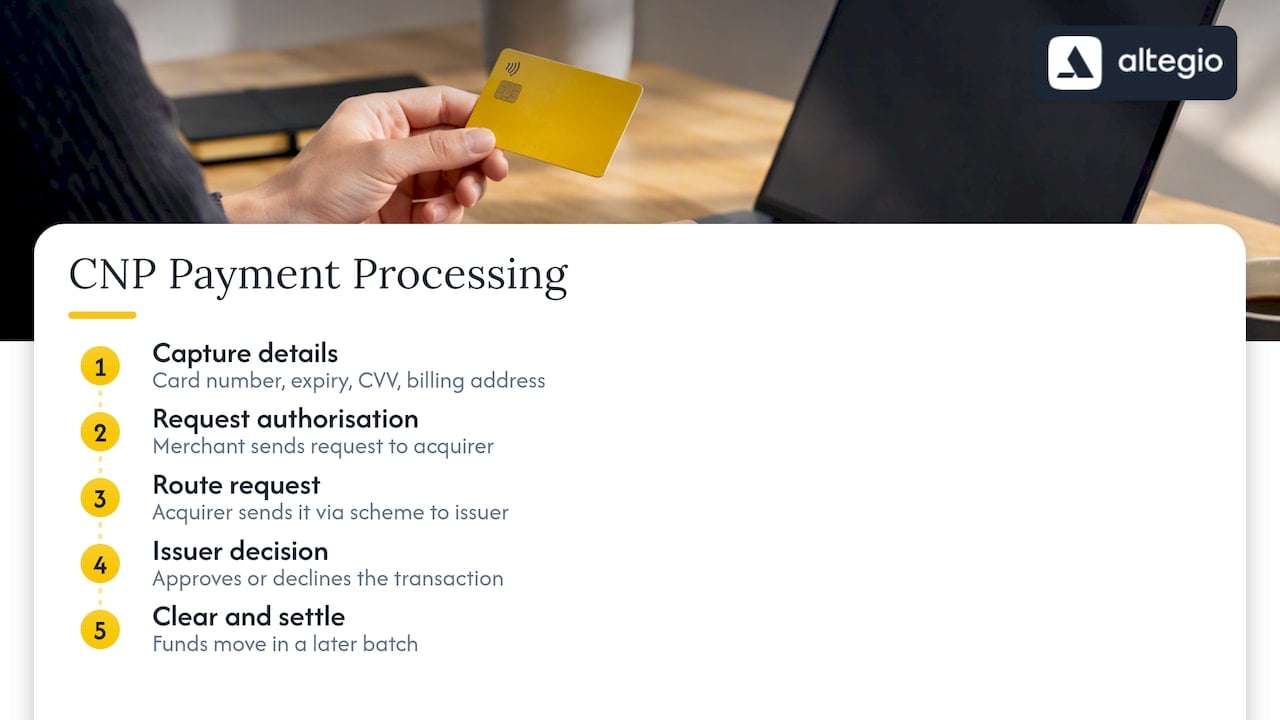
Every CNP payment follows the same basic path. The merchant captures card number, expiry, CVV and billing address, then sends an authorisation request to the acquirer, who routes it through the scheme to the issuing bank. The issuer approves or declines, and funds move during a later clearing and settlement batch.
Data quality affects both risk and cost at each step. Submitting the CVV and matching address data through AVS checks gives the acquirer stronger grounds to approve the transaction and lowers the merchant’s exposure if a dispute follows. Keyed entry, where staff type in a number read aloud over the phone, skips some of these checks and tends to attract higher fees because the data trail is weaker.
Strong Customer Authentication (SCA), required under PSD2 when a payer initiates an electronic payment and delivered through 3D Secure for card payments, sits at the authorisation step for most online card payments, asking the cardholder to confirm their identity before the issuer approves the transaction. The detailed rules (Commission Delegated Regulation (EU) 2018/389) allow exemptions, for example for remote payments of up to €30 within cumulative limits, or for transactions that real-time risk analysis rates as low-risk. Your payment provider can request such an exemption, which removes the extra step; if the issuer accepts it, fraud liability usually stays with you (via your acquirer) instead of shifting to the card issuer.
6. Fraud, chargebacks and the cost of strong customer authentication
In the EU/EEA, card fraud was the second-largest payment fraud category by value in 2024 (€1.3 billion, after €2.5 billion for credit transfers), and about 83% of card fraud happened in remote, card-not-present payments, according to the 2025 EBA and ECB report on payment fraud. Remote payments made up only about 28% of the value of card payments, and their fraud rate was 13 times higher in value terms than for in-person card payments (0.091% against 0.007%).
SCA-authenticated transactions generally show lower fraud rates than non-authenticated ones, especially for card payments, according to the same report. It also found that fraud rates on remote card payments exempted from SCA were generally above the overall card fraud rate, which suggests fraudsters aim at transactions likely to fall into common exemptions. If your payment provider requests an exemption and the issuer accepts it, fraud liability usually stays with you (via your acquirer) instead of shifting to the card issuer, so it’s a deliberate trade-off between smoother checkout and who absorbs the loss if something goes wrong, not simply a UX setting. PSD2 points the same way: a cardholder whose bank didn’t require SCA doesn’t bear the loss unless they acted fraudulently, and where the merchant or its payment provider doesn’t accept SCA, it has to refund the cardholder’s bank (Article 74(2)).
Saved cards follow their own logic. When a client links a card so you can charge it later, for a no-show fee for example, SCA applies when the client gives that permission, and the later charge you initiate relies on it; the EBA and ECB report describes these merchant-initiated transactions as one of the most common reasons remote card payments go through without SCA.
Common CNP fraud patterns worth watching for:
- Stolen card details used for a one-off high-value purchase.
- Friendly fraud, where a genuine customer disputes a legitimate charge.
- Card testing, where small transactions check whether stolen numbers still work.
- Account takeover on stored-card or subscription profiles.
Keep dispute evidence on file, track chargeback rates against scheme thresholds, and review disputed transactions regularly to catch patterns before they become a compliance problem.
7. Practical steps to reduce card not present fees and risk
A few concrete moves make a measurable difference to both cost and exposure.
- Check your contract and statements for the per-category fee breakdown EU rules require, and compare effective cost, not just the headline percentage.
- Know your card mix. If many clients pay with business cards or cards issued outside the EEA, your effective rate will sit above the headline consumer-card rate.
- Watch the fixed fee on small payments. At 0.99% + €0.20, a €20 deposit costs about €0.40 in fees, or 2% of the payment, while a €100 payment costs €1.19, or 1.19%.
- Use tokenisation for stored cards, which keeps raw card numbers out of your systems. PCI DSS still applies when processing is outsourced, but the PCI Security Standards Council notes that many requirements may not apply directly to your own environment.
- Apply 3D Secure on higher-risk transactions rather than exempting everything, accepting a touch more checkout friction in exchange for liability protection.
- Take deposits or pre-authorisations at booking for appointment-based sales, which discourages no-shows and gives stronger evidence if a dispute arises.
- Review chargeback data monthly, flag repeat disputants and fix the processes causing the disputes rather than just contesting each case.
Pro Tip: Ask your acquirer for last quarter’s chargeback-to-sales ratio in writing. If you don’t know the number, you can’t manage it.
8. How integrated booking and payments cut card not present exposure
Running payments through the same system as booking changes the risk profile. A deposit taken at the moment of booking, followed by an automated reminder before the appointment, cuts no-shows and gives you a clear record of what the client agreed to if a charge is later questioned.
Within Altegio, payment policies, deposits taken at online booking and automated appointment reminders work alongside the schedule, so a client can book online and pay a deposit in the same booking flow, through the payment provider you connect. Altegio doesn’t charge its own commission on payments; only the provider’s processing fee applies.
For eligible businesses in EU countries, that provider can be Adyen, connected directly in Altegio, with 3D Secure included. According to Altegio, about 90% of transactions are made with consumer cards issued in the EU/EEA, and these get the lowest rate:
| Card type | Fee with Adyen in Altegio | On a €100 payment |
|---|---|---|
| Consumer card issued in the EU/EEA | 0.99% + €0.20 | €1.19 |
| Commercial card issued in the EU/EEA | 2.50% + €0.20 | €2.70 |
| Consumer card issued outside the EEA | 2.90% + €0.20 | €3.10 |
| Commercial card issued outside the EEA | 3.90% + €0.20 | €4.10 |
Small differences in rate add up. Illustration only: a business that takes €10,000 a month in online card payments, as 200 payments of €50 on EEA consumer cards, pays 200 × €0.695 = €139 a month at 0.99% + €0.20. Every extra 0.5 percentage point on the rate would add €50 a month, or €600 a year. As Altegio’s pricing page puts it, on an average turnover, what you save on processing can cover the cost of your Altegio subscription.
Adyen also unlocks Card guarantee mode: instead of paying a deposit, the client links a card at online booking, and the configured fee is charged only if the client doesn’t show up or cancels too late. Card guarantee works only with Adyen and is available in EU countries; connecting Adyen includes a business verification step. See how online booking and payment policies and no-show protection work in Altegio, and our guide to reducing no-shows for the tactics in more detail.
9. What merchants should actually prioritise next
Most merchants chase the headline percentage and miss the bundle of monthly fees and chargeback charges sitting underneath it. Transparency is the lever that matters most: a fee breakdown that separates interchange, scheme and acquirer costs by card category is worth more than another quote on the blended rate.
The second priority is getting the SCA trade-off right rather than defaulting to exemptions everywhere, since that default quietly shifts fraud liability onto the business. An integrated booking and payment workflow helps with both, by giving you cleaner data at the point of sale and fewer manual, keyed-entry transactions to fund.
10. A simpler way to manage card not present risk
Appointment-driven businesses carry a specific flavour of CNP exposure: clients who book remotely, pay a deposit online, and sometimes don’t show up. Reducing that exposure usually comes down to catching it at booking, not after the fact.
- Deposits taken during online booking reduce no-shows and late cancellations, and the terms the client agreed to at booking give you a clear record if a charge is questioned.
- Keeping scheduling, payments and client records in one system cuts manual re-entry and the admin errors that come with it.
If you want to see how this fits your business, our pricing page sets out subscription options, which depend on the number of team members and the billing period. Altegio doesn’t charge its own commission on payments; card processing fees are charged by the payment provider you connect.
FAQ
What is considered a card not present transaction?
A card not present transaction is any payment where the card isn’t physically swiped, tapped or inserted at checkout. Ecommerce purchases, phone orders, mail orders and stored-card billing all fall into this category.
What fees do businesses pay for card transactions?
Card transaction fees combine interchange, scheme charges and acquirer margins, and the mix depends on the type of card and how the payment is taken. In the EU, the Interchange Fee Regulation (EU) 2015/751 caps interchange on consumer cards at 0.2% for debit and 0.3% for credit within the EEA, for in-person and online payments alike, though scheme and acquirer fees sit on top and aren’t capped the same way. Business cards and cards issued outside the EEA follow different rules.
What does it mean when a charge is pending on a credit card?
A pending charge means the merchant has requested authorisation and the issuing bank has provisionally approved it, but the transaction hasn’t yet moved through clearing and settlement. The final charge is confirmed once settlement completes, usually within a few days.
Does Altegio charge extra fees on payments processed through its platform?
No. Altegio’s subscription covers the software, and Altegio doesn’t charge its own commission on payments. Card processing is handled by the payment provider you connect, for example Adyen or Stripe, and that provider’s processing fees apply under its own pricing. For eligible businesses in EU countries, card payments through Adyen in Altegio start at 0.99% + €0.20 on consumer cards issued in the EU/EEA. Subscription pricing depends on the number of team members and the billing period; see the Altegio pricing page.
Why are card-not-present fees usually higher than card-present fees?
Card-not-present payments can cost more mainly because fraud risk is greater without a physical card check, so acquirers charge more for keyed-in payments and add risk-based fees. Cards issued outside the EEA add a further layer: under the commitments Visa and Mastercard gave the European Commission, their interchange is capped at 1.15% (debit) and 1.5% (credit) for online payments, against 0.2% and 0.3% in person.
Can businesses add a surcharge for card payments in the EU?
Not on consumer cards issued in the EEA: PSD2 bans surcharges on cards whose interchange is capped under the Interchange Fee Regulation. For other cards, such as business cards, each EU country may prohibit or limit surcharges, so check the rules where your business is based.
General information, not financial or legal advice. Payment rules, surcharge rules and national interchange caps differ between EU countries, and providers’ fees change over time; check your contract and fees with your payment provider.
Read next
- Protect your most expensive slots: payment policies, card guarantee and Adyen
- Accept payments during the booking flow – deposits and full prepayment
- Reminders and deposits: how to reduce no-shows