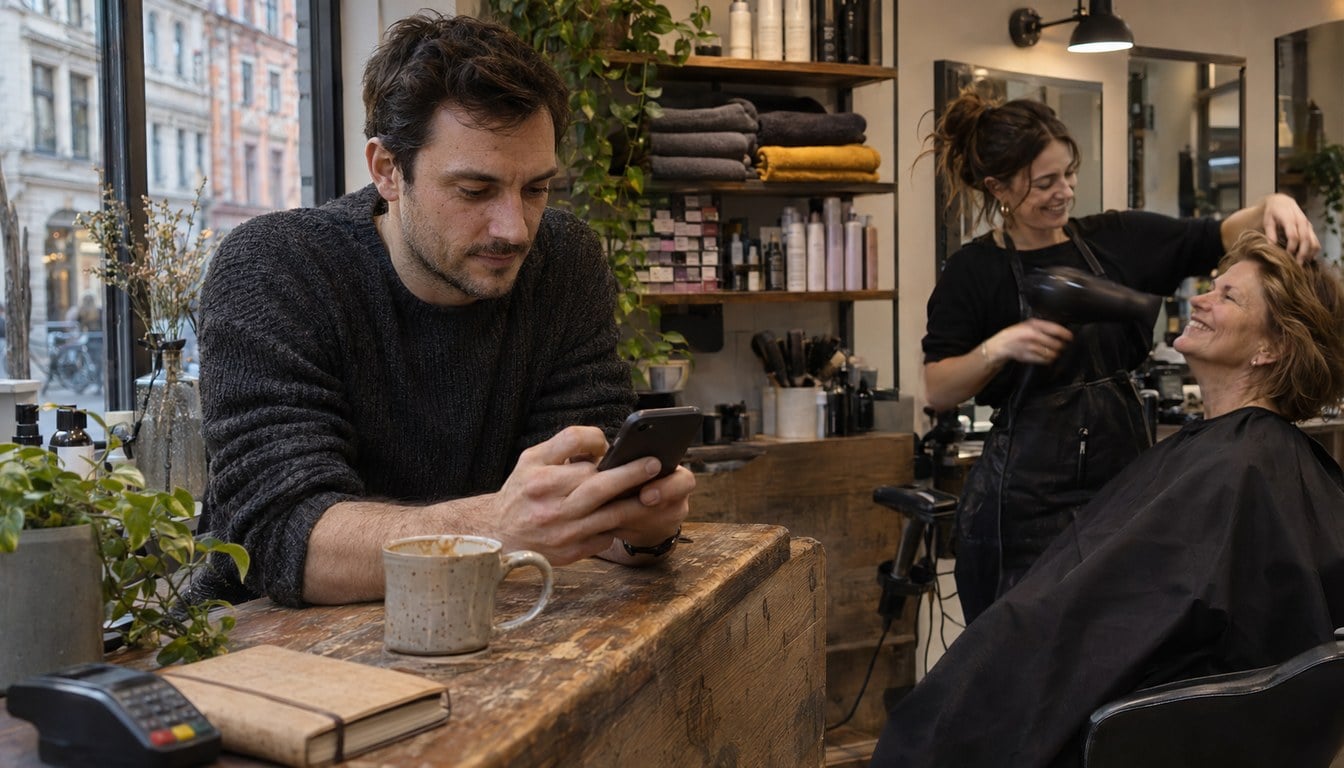
“Unfortunately, a lot of business owners think they won’t find a client outside Booksy. That is the biggest pain point,” says the co-owner of a hair salon in Wrocław we spoke with. He has tested that belief himself. The salon used to run on Versum, and after Booksy acquired Versum it had about three months to find another system. They did not move to Booksy. His wife was afraid they would have no work. “And it turned out everything was the same” – the calendar did not empty.
This article is for owners of hair salons, barbershops, cosmetology clinics and nail studios in Poland who want to know where else clients come from and what a client from a marketplace really costs. It is based on 49 interviews with owners of service businesses in Poland, Czechia and Hungary that we conducted between July and October 2026 (14 of them in Poland), plus public market data.
The short version
- Clients look for you on Google, on Instagram and through friends. These channels belong to you and charge no commission per visit. Paid advertising there is an investment in your own brand, not rent paid for someone else’s storefront.
- A marketplace client is expensive. Booksy Boost takes 45% net of the first visit price plus VAT, which is about 55% of the bill. And the catalog that brought the client in will show them other businesses next time they book.
- Clients increasingly ask AI assistants. When a client asks an assistant to book her usual hairdresser, she has no use for a catalog of promoted profiles. The advantage will go to businesses that connect their calendar to AI assistants.
Where salon clients actually come from
Booksy is a brand almost everyone in Poland knows. According to the company itself, the app has more than 10 million users in Poland, and more than 64 million visits were booked through it in 2025. That is real strength, and we won’t pretend otherwise.
But when we ask owners where their clients come from, the picture is different from what platform ads suggest. The owner of a barbershop chain we spoke with puts it plainly: his clients come from Google and Instagram, and many businesses stay on Booksy out of habit. The owner of a barbershop with a 15-person team was even shorter: hardly anyone comes specifically from Booksy. The owner of an aesthetic cosmetology clinic with 21 years in business adds that her strongest channel is word of mouth from the neighbourhood.
Here are four client sources with no marketplace and no commission per visit.
1. A Google Business Profile with a “Book online” button
When someone searches for “fryzjer Mokotów” (a hairdresser in Warsaw’s Mokotów district) or “manicure hybrydowy blisko mnie” (gel manicure near me), the first thing they see is a map and business listings. Poles type the word “fryzjer” (hairdresser) into Google about 246,000 times a month, “barber” about 90,000 times and “kosmetyczka” (beautician) about 33,000 times (Semrush estimates, November 2026). According to Google, clients are 2.7 times more likely to consider a business with a complete profile reputable.
A Google Business Profile is free. Fill in the categories, opening hours, price list and photos of real work. Reply to reviews, including the critical ones – we cover how in The Salon Reputation Operating System: reviews and local SEO.
The most important step is the booking button. According to a Booksy report, almost one in five appointments is booked after the salon has already closed, so the button has to work without a receptionist. In Altegio you connect it for free in the integrations section (Reserve with Google). The client sees a “Book online” button in Google Maps and in Search, picks Altegio from the list of booking providers and lands straight on your online booking page, with your price list and available times. This is how one of the salon chains we spoke with takes booking from Google: in its listing, Altegio appears above the marketplace in the list of providers (as of 11 November 2026). A step-by-step guide is here: Reserve with Google and Reserve with Meta.
Don’t forget reviews. In the BrightLocal survey (USA, 2026), 97% of consumers read reviews of local businesses, and 68% only choose businesses rated 4 stars or higher. Reviews collected on a marketplace, however, stay on the marketplace. The clinic owner mentioned above has gathered about 4,700 reviews there and will not take them with her if she switches systems. Google reviews work for you whatever system you use.
2. Instagram, Facebook and TikTok: your profile as a storefront with a booking button
Facebook reaches 18.1 million adults in Poland, TikTok 13.3 million and Instagram 11.2 million (advertising reach, DataReportal, October 2026). What matters for the beauty industry is who is there: women make up 67% of the ad audience on TikTok and 58% on Instagram. According to IAB Polska (January 2026), 60% of social media users have bought a product or service on the recommendation of someone close to them online.
A business profile on social media is a storefront today: a client looks through your work before she even asks about a time. What works best is what a stock photo can’t fake: before-and-after results, short videos of a treatment, the faces of your team and answers to the questions you hear in the chair.
The second condition is a short path to booking. A “Book” button on Instagram and Facebook and an online booking link in your bio take people straight to your calendar. The same chain has more than 50,000 Instagram followers, and the main booking button on its profile opens its own online booking widget, not a catalog.
3. Referrals and regular clients: the cheapest source
A client who comes back and a client who brings a friend cost you no commission. And this is still the main channel: for 52% of Poles, family and friends are the most important source of salon recommendations (Booksy survey, November 2025). On top of that, acquiring a new client costs 5 to 25 times more than keeping an existing one (Harvard Business Review).
Simple mechanics help here:
- A reminder about the next visit. Set an interval for each service, for example 4 weeks after a men’s haircut or 3 weeks after a gel manicure, and the system sends the invitation itself.
- A referral program. The referred person gets a discount on the first visit, and the person who referred them gets cashback in bonuses, credited automatically after payment.
- A Loyalty Program under your own brand. Bonus and discount cards, memberships, gift cards. More on the models: Salon Loyalty Programs: 7 Models That Work in 2026.
Where your regular clients book matters. If they book through a marketplace app, they see other salons there every time. If they book through your link, your Google Business Profile or your app, they see only you.
4. Paid advertising: an investment in your own brand, not rent for someone else’s
The salon co-owner from Wrocław quoted at the start has a simple rule: instead of paying a commission to a platform, he would rather spend that money on his own Meta Ads and Google Ads campaigns “and be visible online”. Why? Whoever clicks his ad doesn’t land on a Booksy page that requires logging in, but goes straight to his price list. He says he likes to “shorten the path as much as possible”: anyone who wants an appointment should be able to book it right away, without filling in forms or logging in.
What does it cost? A click on a Google ad for a local phrase such as “fryzjer warszawa” or “manicure warszawa” costs about 1–2.5 zł on average (Semrush estimates, November 2026). If one in twenty clicks ends in a booking, a new client costs about 20–50 zł. This is an example, not a guarantee: the result depends on the city, the service and the quality of your booking page. You can also add a Book button to your Google Ads: Google Ads now has a Book button that opens your Altegio online booking.
To judge whether advertising pays off, compare it with the commission you would pay for the same client through Booksy Boost. The commission is 45% net of the first visit price (minimum 25 zł, maximum 250 zł), plus 23% VAT:
| First visit price | Boost commission incl. VAT | Your maximum cost to acquire a client through ads |
|---|---|---|
| 80 zł (e.g. men’s haircut) | 44.28 zł | up to ~44 zł |
| 150 zł (e.g. gel manicure) | 83.03 zł | up to ~83 zł |
| 250 zł (e.g. facial) | 138.38 zł | up to ~138 zł |
| 400 zł (e.g. hair colouring) | 221.40 zł | up to ~221 zł |
Calculated at the standard Booksy Boost rate for Poland (checked in November 2026). If you are a VAT payer and deduct the tax, the real cost of the commission is 45% of the price.
If a campaign brings in a client for less than this limit, you win from the first visit. But even at a similar cost, the difference is fundamental: advertising leaves you with an audience of followers, data for remarketing and a client who knows your brand, not a catalog.
To calculate this, you need to see which ad led to a booking. In Altegio you can send events from the online booking form to Google Analytics 4 and Meta Pixel, so the appointment shows up in your reports as a conversion. Setup is described here: Google Tag Manager now runs inside Altegio online booking.
What a marketplace client really costs
A commission for a “new” client
Booksy Boost is a one-off commission for a new client brought in by the marketplace: 45% net of the services in their first completed visit, with a minimum of 25 zł and a maximum of 250 zł net. It is calculated on the gross price the client pays, and 23% VAT is added on top of the commission. Then there is the subscription: 145 zł net per month plus 35 zł net for each additional user (Booksy price list, November 2026).
In Booksy’s own example, a 200 zł visit means a commission of 110.70 zł. If you don’t deduct VAT, more than half of the first bill stays with the platform. The owner of a massage studio we spoke with estimates her Boost spend at 1,000–2,000 zł a month.
The second problem is who counts as a “new” client. Under Booksy’s rules, it is a person who is not in your Booksy client base and who stated when booking that they had not used your services before. There is no rule along the lines of “they were here six months ago, so I don’t pay”. You report incorrect charges yourself within 7 days after the end of the billing period, and you have to mark a no-show by 22:00 the same day – otherwise the commission is charged.
A barbershop owner told us that a friend of many years who installed the app for the first time and booked through it was counted as a client brought in by the marketplace. The owner of a chain of six salons put it even more bluntly: her team runs Instagram ads aimed at their own clients, those clients book through Booksy, and the salon pays for them a second time.
Booksy does offer commission-free links and QR codes for clients you bring in yourself. But even then, the client lands in an app where they see other salons next to your profile.
A conflict of interest built into the model
The Boost commission is money for a client’s first visit to a new place. A regular client who has been coming to you for hair colouring for three years no longer brings the marketplace a commission. The same client who discovers another salon with Boost in the app does.
We are not claiming anyone is deliberately working against you. But the business model aligns incentives so that the marketplace benefits when your loyal clients become someone else’s first-time clients. You can see it in how the catalog works:
- Whoever pays ranks higher. Booksy’s terms state directly that profiles of partners who have purchased the additional service are displayed higher, and the default sorting is “Polecane” (Recommended). Since September 2026, search position is also determined by a “Boost promotion score” calculated from the history of Boost visits.
- In practice: we checked on 11 November 2026. All of the first 320 results for “fryzjer Warszawa” (hairdresser Warsaw) on booksy.com (web version, location not shared) carried the “Promowany” (Promoted) label.
- Your competitors are on your profile. On a salon’s page, Booksy shows a “Sprawdzone miejsca w okolicy” (Verified places nearby) block with other salons, including on profiles without Boost.
- Loyalty to the platform, not to you. Since July 2026, Booksy Club gives clients points for appointments booked at any salon in the app, and salons offering cashback for paying with Booksy Pay get a separate filter in search.
Booksy also reports that about 75% of clients come back after the first visit if everything went well. So the client you paid a commission for will most likely stay with you for longer. The only question is whether they will keep coming back through your channel or through a catalog that shows them others every time they book.
Our interviewee from Wrocław put the difference this way: when a client wants to book with him, “they see my price list, not, a moment later, a little icon of a salon that bought something, boosting (…), and is displayed next to me as a recommended salon because it has a free slot. Or a discount.”
Whose client base is it?
Under Booksy’s terms, the platform and the salon are separate controllers of client data. You can’t export your base yourself: the account owner sends a request by email, and Booksy prepares the file within up to 5 working days. Switching off Boost comes with a one-month notice period.
In a system without a marketplace, your client base and visit history stay with you. In Altegio you export your client base to Excel yourself, right from the interface, and you pay no commission on appointments – only a subscription, priced by team size and licence period.
“With Booksy I don’t need to build a brand or run social media”
This is one of the most common arguments for a marketplace, and there is some truth in it. A Booksy profile accepts appointments without a single Instagram post, and clients already have the app on their phones. But look at what happens to your brand in this model:
- Visibility on Booksy has to be bought too. For the word “fryzjer” (hairdresser), Booksy shows more than 3,200 profiles in Warsaw alone (as of 11 November 2026), and those who pay rank higher. Your brand still costs money. Only instead of building your own, you rent a spot in someone else’s storefront and pay for it with a commission on every new client.
- Without a brand, all you have left is price. In the catalog, a client compares ratings, prices and free slots, and next to your profile there is a salon with a discount or an opening today. If she doesn’t know you, she picks the offer. When she knows you, she picks the person.
- You create content anyway, just not for yourself. Photos of your work, service descriptions and reviews on your Booksy profile are the same work Instagram or a Google Business Profile requires. On Booksy they stay on the platform. On Google and social media they keep working for you even if you switch systems.
- Recommendations travel without you. For 52% of Poles, family and friends are the main source of salon recommendations. A Google and social media presence means that someone who heard about you from a friend finds you right away, not in a catalog where your competitors are waiting next to you.
- AI assistants recommend brands, not catalog positions. As we explain below, AI builds its recommendations from Google reviews, websites and social media activity. A business that can’t be seen outside a marketplace is hard for an assistant to recommend.
You don’t need an agency to start. A complete Google Business Profile with a booking button and two or three posts a week showing your work are enough. Happy clients do the rest, as long as they have somewhere to recommend you.
To be fair: when a marketplace makes sense
A marketplace is not bad in itself. It makes sense when:
- you are just starting out and don’t have your own client base;
- you have no time or budget for marketing. The massage studio owner told us plainly that without a marketplace all she has left is marketing, and she doesn’t know how to do it. That is a fair argument;
- your clients are used to one app. Several of the owners we spoke with point out that every generation in Poland knows Booksy and that some clients are reluctant to enter their phone number somewhere new.
So the conclusion is not “delete Booksy tomorrow”. It is: don’t hand your regular clients over to a marketplace, and build channels that belong to you. A detailed point-by-point comparison of the two systems is in Altegio vs Booksy: An Honest Comparison for Service Businesses.
For those looking ahead: an AI assistant instead of a catalog
This part is for people who like to be a step ahead of the market. Booking marketplaces were built for a time when clients browsed lists of salons in an app themselves. That way of searching is starting to change.
In the USA, the share of people who use AI to find local businesses grew from 6% to 45% in one year (BrightLocal, February 2026). In Poland, 36% of adults already use generative AI, and among 18–24-year-olds the figure is 81% (CBOS, May 2026). ChatGPT alone has more than 1.2 billion weekly users.
The biggest players are building this openly:
- Google. AI Mode in Search has been available in Polish since October 2025. In the USA, since November 2025 Google has been testing booking at beauty salons in it: the AI shows available times and books an appointment without leaving the conversation. In May 2026 Google also announced that its AI will call businesses on the user’s behalf, including in beauty.
- Apple. The new Siri, built in collaboration with Google on Gemini models, understands the user’s personal context and takes actions in apps (announced in June 2026). Meanwhile, Apple Business lets a company add a booking action to its place card in Apple Maps.
- OpenAI. ChatGPT already runs apps from Booking.com, Expedia and OpenTable, and since autumn 2026 the first beauty platforms as well.
- A shared standard. MCP, the standard for connecting AI assistants to external systems, is supported by OpenAI, Google, Microsoft and Anthropic. One such “connector” to a calendar works across many assistants at once.
In Poland, booking through AI agents doesn’t work yet: Google hasn’t enabled it in Polish AI Mode, and the new Siri doesn’t support Polish and isn’t yet available on iPhones in the EU. This is a horizon for the next few years, not today’s reality.
To be fair, marketplaces see this trend too. Booksy and Fresha were among the first to connect to AI assistants – the Booksy app in ChatGPT is available in the USA for now. But the role of the catalog is changing. When a client tells an assistant “book me with my hairdresser on Thursday after 5 pm”, she doesn’t need a list of salons nearby. She needs the calendar of one specific person. So the question is: does the assistant talk to your calendar directly, or through an intermediary whose model is built on commission from new clients?
One of the salon owners we spoke with in Hungary already sees this: a client types a question into Google, and the first answer comes from an AI overview that recommends a specific professional based on reviews and social media activity. His advice: invest in Instagram and TikTok, because that is where AI learns about a business.
What does this change for you? When an assistant books a client, there is no catalog page with promoted profiles next to yours. The assistant needs two things:
- To know you are good. Google reviews, an up-to-date website and an active social media profile are the material AI uses to build a recommendation. These are the same channels we covered above.
- To see your available times. Booking through Google already works today. The next step is a calendar the assistant can talk to directly.
With Altegio you can take that second step today. Altegio.me MCP lets clients book by chat: the assistant finds a free time, then books, reschedules or cancels the appointment in a single conversation. It works through the MCP standard mentioned above – a bit like a plug-in that lets the assistant “see” your calendar. On the business side, you can also connect AI receptionists from Altegio partners that answer clients on WhatsApp, Instagram and your website and create and reschedule appointments themselves. Details are on the Altegio MCP page.
It is still early days. But the direction is clear. Among the AI questions we get from Altegio clients, the most common request is: let the assistant talk to the client and book the appointment on its own.
A 30-day plan: your own client sources without a revolution
Week 1. Google. Complete your Google Business Profile, add photos of your work and a price list, connect the “Book online” button. Ask five regular clients for a Google review.
Week 2. Social media. Add a booking button on Instagram and Facebook and an online booking link in your bio. Plan three posts a week: a before-and-after, a short treatment video, an introduction of a team member.
Week 3. Regular clients. Send your regular clients an SMS or messenger message with your booking link. Turn on next-visit reminders and the referral program.
Week 4. First campaign. Launch a small Meta Ads or Google Ads campaign with the cost-per-client limit from the table above. Turn on conversion tracking from the booking form, and after a month compare the cost per client with the commission you would have paid a marketplace.
One note from practice. Running two calendars in parallel risks two clients being booked into the same time slot – two of the owners we spoke with postponed switching systems for exactly that reason. If you are switching, set a cut-over date, tell your clients and move your client base before that date.
Frequently asked questions
Can you run a salon without Booksy?
Yes. The owners we spoke with get their clients mainly through Google, Instagram and referrals. After Booksy acquired Versum, the Wrocław salon from the start of this article chose a different system and kept its calendar full. The condition: build your own channels before you give up the marketplace.
How much does a client from Booksy Boost cost?
The standard rate is 45% net of the services in the first completed visit, with a minimum of 25 zł and a maximum of 250 zł net, plus 23% VAT. The commission is calculated on the gross price, so for a 200 zł visit it comes to 110.70 zł. It applies to a client who is not in your Booksy client base and who stated when booking that it was their first visit to you. The subscription comes on top.
How do I add a “Book online” button to my Google Business Profile?
You need a booking system that is a Reserve with Google partner. In Altegio you connect it for free in the integrations section. The client clicks “Book online” in Google Maps or Search, picks Altegio from the list and goes straight to your business’s booking page.
Can I use Booksy and another system at the same time?
You can, but two calendars without synchronisation risk two clients being booked into the same slot. It is safer to run one calendar and set a cut-over date. Some businesses keep the marketplace as one acquisition channel and have regular clients book through their own link.
Isn’t a Booksy profile enough, without building a brand?
It can be enough to get started. But visibility on Booksy costs money too: profiles that pay for promotion rank higher, and every new client from the marketplace means a commission. Your own brand, meaning a Google Business Profile, reviews and an active social media presence, makes clients choose you rather than a cheaper offer next to you. And it stays with you whatever system you use.
Do clients really book through AI assistants?
It is only just starting, but it is growing fast. In the USA, 45% of people already use AI to find local businesses, and Google is testing booking at beauty salons directly in AI Mode there. In Poland, booking through AI agents doesn’t work yet, but 36% of adults already use generative AI. With Altegio, clients can book an appointment by chat through Altegio.me MCP.
Will Altegio bring me clients?
No, and that is deliberate. Altegio is not a marketplace, doesn’t show your clients your competitors and charges no commission on appointments. It gives you the tools for your own channels: online booking with your brand, a booking button on Google, Instagram and Facebook, reminders, a referral program and a Loyalty Program.
Build client sources that belong to you
Try Altegio free for 7 days: connect booking on Google and Instagram, move your client base and see how many clients book through your own channels. An Altegio expert will help you with the initial setup free of charge.
Read next:
- Altegio vs Booksy: An Honest Comparison for Service Businesses
- How clients choose a barbershop: what they search for in Google
- The Salon Reputation Operating System: reviews and local SEO
- Salon Loyalty Programs: 7 Models That Work in 2026