
The price on a salon software pricing page is rarely the number on your bank statement. Plans are often quoted without VAT, SMS reminders and some add-ons are billed on top, setup or data migration may carry a one-off fee, and every card payment costs a percentage of the transaction. Before you sign, add everything up for a year, divide by twelve and test the platform on your real appointments during the trial. The six reports are described in revenue reports every salon should run.
TL;DR:
- Headline prices often leave out VAT, SMS credits, add-ons and one-off setup, so the real monthly bill can end up at double the advertised plan or more.
- Pricing per team member, flat tiers and commission models each change the bill differently as you grow, so model them against your own numbers.
- Card processing fees grow with your turnover: compare rates on your real card volume, not on the headline percentage.
- Use the trial for real appointments, a real report export and a sample invoice from the vendor, not a demo account.
How salon software pricing models work
Vendors charge in three main ways, and each one shifts the cost differently as your business changes.
- Per team member. You pay according to how many team members work in the calendar. The bill is predictable and grows with your team, so check whether you can change the team size during the term and what hiring does to the price.
- Flat or tiered. One price for a bundle of features, whatever the team size. Watch the tier limits: the feature you need next is often in the next tier up.
- Commission or “free”. No subscription, but a cut of the appointments that come through the provider’s client directory or app. It feels free while you’re quiet and gets more expensive as your client flow grows.
Whichever model you look at, the advertised price is rarely complete. Subscriptions are often quoted net of VAT, while payment processing, SMS credits and one-off setup tend to appear as separate lines.
Pro Tip: Ask every vendor for a sample invoice, not just the pricing page. If they can’t show you one, expect surprises on the real bill.
From a €39 headline to a real monthly bill
Here is a hypothetical example with round numbers. A small salon sees a plan advertised at €39 a month, excluding VAT, and adds the items the plan doesn’t cover.
| Item | Per month |
|---|---|
| Headline subscription (net) | €39.00 |
| SMS reminders: 200 messages at €0.05 | €10.00 |
| One-off setup and migration fee of €240, spread over 12 months | €20.00 |
| Total before VAT | €69.00 |
| VAT at 21% (example rate) | €14.49 |
| Total with VAT | €83.49 |
In the first year, the €39 plan really costs €69 a month before VAT, and €83.49 if your business can’t reclaim the VAT – more than double the headline. And that’s before a single card payment. VAT rates differ between EU countries, so use your own rate, and ask your accountant whether you can reclaim it.
How much does salon software cost by team size?
Prices range from free entry tiers to custom quotes for large chains. Where you land depends on your team size, the number of locations and how many extras you need.
- Solo professionals and chair renters: entry tiers are the cheapest, but check for caps on clients, appointments or reports, and whether the low price relies on a commission.
- Small teams of 2 to 5: most of the difference between vendors comes from what’s included. SMS, loyalty, payroll and inventory may be in the plan or sold as add-ons.
- Multi-location businesses and chains: fees per location, chain-level reporting and data migration add up quickly, and large chains often get custom quotes instead of published prices.
Commission-based platforms deserve a calculation, not a guess. Multiply the commission per appointment by the number of appointments it applies to each month, then compare the result with a flat subscription for your team size. If the commission applies to repeat appointments too, the gap widens as your client base grows, while a flat subscription stays the same however busy you get.
How do you calculate the true cost of salon software?
Comparing two vendors on subscription price alone is like comparing two cars on the sticker price and ignoring fuel and insurance. You need one number that covers everything you’ll pay across a year, divided by twelve.
Start by listing every component:
- Base subscription for your team size and billing period (monthly or prepaid for several months).
- VAT at your country’s rate, if you can’t reclaim it.
- Card processing fees, modelled on your real monthly card turnover and number of payments.
- SMS or messenger credits.
- One-off setup, data migration and training, spread over twelve months.
- Hardware such as tablets, card readers or receipt printers.
- Add-ons: loyalty programme, branded app, payroll, paid integrations.
Card fees deserve their own line because they grow with your turnover. Suppose you take €5,000 a month by card across 100 payments, an average of €50 each. At 1.75% + €0.25 per transaction you pay €87.50 + €25.00 = €112.50 a month. At 0.99% + €0.20, the rate for EEA consumer cards with Adyen via Altegio, the same month costs €49.50 + €20.00 = €69.50. That’s €43 a month, or €516 a year, from the processing rate alone. Commercial cards and cards issued outside the EEA cost more, so model your own card mix.
Pro Tip: When a vendor pitches an add-on, work out its break-even. If it costs €20 a month and you keep €25 from an average visit after costs, it has to bring back one extra visit a month to pay for itself. If it doesn’t, you’re paying for a feature you don’t use.
Which features and terms change the price most?
Two businesses on the “same” plan can pay very different amounts, because what counts as included varies between vendors. Online booking is normally part of the base plan; SMS credits, loyalty programmes, payroll, inventory and branded apps are the features to check first.
Before you sign, check:
- Whether you can export your full client database if you leave, and in what format.
- The cancellation notice period, and whether unused months are refunded.
- How multi-location pricing works: a fee per location or one fee for several.
- Which support is included and which is a paid tier.
- Whether setup, data migration and team training are included or quoted separately.
During a demo, ask directly: “What will my invoice look like in month three, with VAT, SMS, card fees and add-ons included?” If the answer takes a week to arrive, that tells you something too.
Pro Tip: Platforms that bundle SMS, loyalty and inventory into one subscription can have a higher headline price than bare-bones tools, but they may replace several separate subscriptions. Compare the bundle with everything you pay for today, not with the cheapest single-purpose app.
What should you test during a free trial?
Free trials are short, so don’t spend them on admin. Test the things that cost you money if they go wrong: real online appointments for your actual services, payments, a report export and how quickly support replies when something breaks.
Budget separately for the costs a trial won’t reveal: data migration if it isn’t included, a branded app, hardware and the hours your team needs to learn the system. A staged onboarding plan with clear steps keeps a quoted setup fee from growing.
- Check whether payments can be tested during the trial, not just the calendar.
- Get any onboarding or migration quote in writing before work starts.
- Set a success criterion before you begin, for example “no double appointments for a full week”.
Why headline prices rarely tell the full story
Owners get sold on the subscription number, and vendors know it. The real cost gap between platforms is rarely in the base price. It’s in whether payroll, inventory, marketing and reporting are built in or bought as separate tools, each with its own subscription and login.
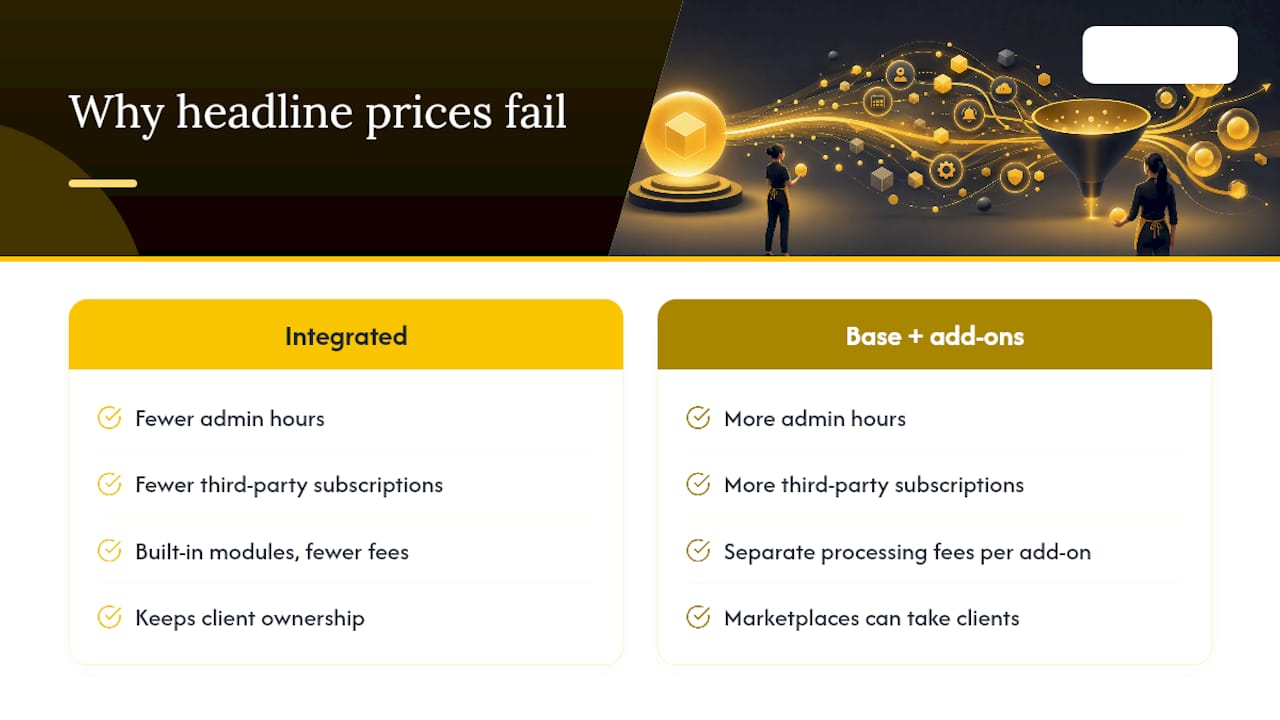
A platform with finances and inventory built in can replace several subscriptions and the hours spent moving data between them. Ownership of the client relationship matters too: a platform that sends your clients through a shared directory, where they also see other businesses, can cost you repeat visits that never show up on an invoice.
The right question isn’t “what’s the cheapest plan?” but “what does each feature save me, and does that saving beat what I pay for it?”.
How Altegio pricing works
Altegio is booking and business management software for appointment-based businesses: beauty and wellness, clinics, auto services, fitness and more. Altegio works on a Zero-Competition Policy: it doesn’t compete with your business for its audience, there is no marketplace showing your clients other businesses, and your client base is never resold. Here is what its pricing page sets out:
- The price depends on the number of team members and the billing period: 1, 3, 6 or 12 months, with bonus months currently added to the longer terms. The page shows the price for your country, so check it there rather than relying on a figure quoted elsewhere.
- Every plan has the full feature set: schedule, clients, loyalty, notifications, inventory, finances and payroll. Plans differ only in team size and term.
- Prices exclude VAT. The rate for your country is added at checkout, and you get an invoice for your accounting.
- Setup for your business, data migration, team training and support are part of the subscription and aren’t billed separately. Migration can start during the trial.
- Altegio takes no commission on appointments, puts no cap on the number of appointments and doesn’t charge its own commission on payments.
- If your team grows during the term, you raise the team size and pay the difference for the remaining period; you can lower it at the next renewal.
- Chains and franchises with more than 5 Locations can discuss flexible terms.
What you pay for separately:
- SMS, billed by the SMS provider you connect. Email notifications are free, and push notifications through the Altegio.me client app cost nothing.
- A branded mobile app in the App Store, Google Play and Huawei AppGallery, quoted on request.
- Some apps in the Integrations Hub that have their own subscription, billed by the app’s developer.
- Card processing. In EU countries Altegio works with Adyen: 0.99% + €0.20 on EEA consumer cards, 2.50% + €0.20 on EEA commercial cards, 2.90% + €0.20 on non-EEA consumer cards and 3.90% + €0.20 on non-EEA commercial cards, with weekly payouts. The acquiring fee is written off automatically as an expense in Finance, so the cost of card payments shows up in your reports.
There is no free plan. There is a 7-day free trial with every feature and no card required, and nothing is charged when it ends. Use it the way this article suggests: import a slice of real client data, take a few live appointments through online scheduling, pull a report export and check it against your books, and if you sell retail products, compare the stock levels with a real count. For the reasoning behind the flat, commission-free model, read Altegio’s pricing philosophy and ROI.
FAQ
What is the best salon software?
There’s no single best platform. The right choice depends on your team size, the number of locations and whether you want payroll, inventory and loyalty in one system or as separate tools. Compare the total cost over a year, not the headline prices.
How much does salon scheduling software cost?
It ranges from free entry tiers, usually limited or funded by commission, to full management platforms priced by team size, tier or number of locations. Work out the price for your own team, then add VAT, SMS and card fees. Altegio’s price for your team size and billing period is on the pricing page. Clearer pricing and menu structure are covered in our salon service menu guide.
What is the best software to manage all salon operations?
Look for a platform that combines booking, payments, inventory and payroll in one subscription rather than separate apps, because that is where the savings against buying tools one by one usually sit.
What is the best CRM software for a salon?
The strongest options keep client history, rebooking reminders and loyalty in the same system as the calendar, so client data never lives apart from your appointments.
Do salon software providers charge VAT on top of the subscription?
Many show prices excluding VAT and add it at checkout at the rate that applies in your country; Altegio does the same. Whether that VAT is a real cost for you depends on your VAT registration, so ask your accountant.
Does Altegio have a free plan?
No. Altegio has a 7-day free trial with every feature and no card required. After it, you choose a subscription by team size and billing period.
Read next
- Card Not Present Fees: Appointment Businesses Pay Beyond the Rate
- Salon chart of accounts: a template for VAT, card fees and tips
- Why a salon needs a booking system: 5 numbers
- Reminders and deposits: how to reduce no-shows
This article is general information, not tax or legal advice. VAT and other rules differ between EU countries, so check with your accountant before acting.