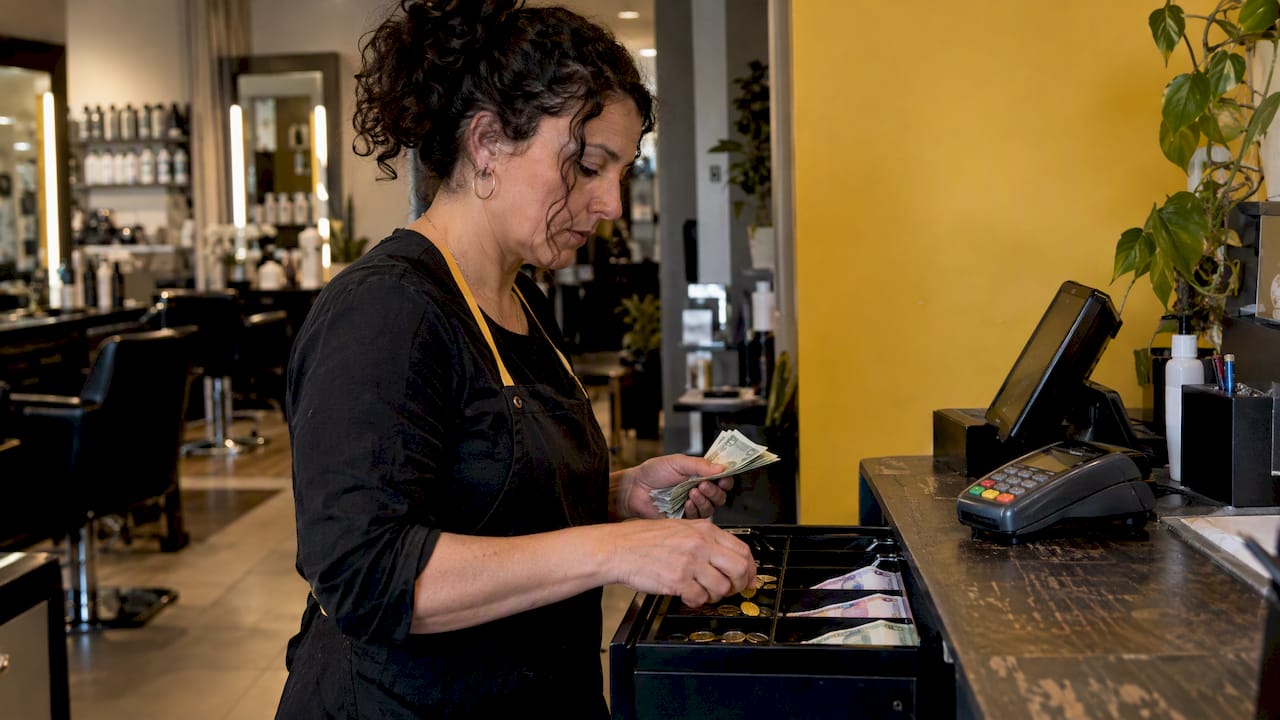
End of day reconciliation is the process of matching what your till recorded against the cash and card payments you actually took, so every pound is accounted for before you close up. Start by printing your X or Z report and counting your cash drawer against that expected total. If you’re VAT-registered and use one of HMRC’s retail schemes, you also need a daily gross takings (DGT) record for every trading day (VAT Notice 727). Even if you’re not, your daily close is the evidence behind the figures you report to HMRC.
TL;DR:
- Remove the float before a blind cash count, record any variance with a witness’s signature, and investigate unexplained differences the same day.
- Match card totals to terminal or gateway reports by settlement date, keeping batch numbers and payout dates together because settlements may arrive later.
- File each day’s Z report, signed collection form, and payment records together; use X reports for mid shift checks and investigate gaps in sequential readings.
- Separate deposits, cash tips, card tips, and retail sales from service revenue, then compare sold or used products with daily stock deductions.
- For VAT-registered retailers, HMRC treats the till record as the basis for VAT when it shows more than the cash in the drawer, unless you can prove otherwise; unexplained discrepancies can lead to further enquiries.
Table of Contents
- Your end-of-day reconciliation checklist
- Counting cash without letting errors hide
- Matching card and digital payments to your POS totals
- Reading X, Z and sequential till readings properly
- Investigating overs, unders and unexplained gaps
- What to keep on file and what HMRC expects
- Which tools actually speed up your daily close
- Quick wins that make daily close faster and safer
- Linking reconciliation to your stock levels
- Turning daily reconciliation into cash flow visibility
- Where beauty and wellness businesses get reconciliation wrong
- Why daily discipline pays off beyond the numbers
- FAQ
- Read next
Your end-of-day reconciliation checklist
Build this into a routine and it stops feeling like a chore. Here’s the order that works, every single day:
- Print your X or Z report and lock the till before anyone touches the drawer.
- Note the terminal batch reference and gateway reference for card and digital payments.
- Remove the float, then blind-count the remaining cash so the counter doesn’t see the expected figure first.
- Record any overs or unders, and have a second person witness and sign the count.
- Compare your POS total against the terminal or gateway batch report for card and digital takings.
- Write everything on a single cash collection form, seal the takings in a tamper-proof bag, and prepare the paying-in slip.
A few things matter more than others in that list:
- The float must come out before you count anything else, or your numbers will never make sense.
- Blind counting only works if the counter genuinely has no sight of the system total.
- Batch and Z report numbers should run in sequence; a missing number is worth explaining, not skipping.
Pro Tip: Keep one canonical cash collection form across every till and every shift. Comparing a Tuesday morning count with a Friday evening one only works when they’re structured the same way.
If a variance doesn’t make sense straight away, don’t guess. Flag it for investigation the same day while memories and CCTV footage are still fresh, rather than waiting until the weekly reconcile.
Counting cash without letting errors hide
Cash is where most reconciliation errors creep in, usually because the float gets mixed into the count or the cashier sees the expected total before counting. Pull the float first and set it aside; it isn’t part of today’s takings and including it will throw off every figure that follows.
Blind counting is the safeguard here. The person counting records what’s physically in the drawer before checking it against the POS figure, which stops conscious or unconscious rounding toward the number they expect to see.
- Count the drawer twice if the first count looks off; a second pass catches most simple errors.
- Have a witness present for the count and get their signature on the form, not just the cashier’s.
- Work out the variance as (cash counted in the drawer − opening float) − expected cash takings from your POS. A result close to zero means a clean count.
Pro Tip: A small variance that swings in different directions day to day is usually just handling noise. A shortage that repeats in the same direction is the one worth investigating.
Store the completed cash collection form with the day’s till readings. That paper trail is what you’ll reach for if HMRC ever asks you to explain a discrepancy.
Matching card and digital payments to your POS totals
Card and digital takings follow a different reconciliation path to cash, because you’re matching two electronic records rather than counting physical notes. Barclaycard recommends reconciling your takings at the end of each trading day, using your card machine’s End of Day process or your payment gateway’s reporting.
Pull the terminal batch report and the gateway settlement reference every day and keep both. Settlement timing can vary, so match by settlement date rather than expecting same-day totals to tie out perfectly.
- Keep the batch number and payout date together so a delayed settlement can still be traced back to the original sale.
- Exclude card and digital payments from your physical cash count entirely; mixing them in is the fastest way to create a false shortage.
- Log refunds, chargebacks and timing differences separately, since these are the usual causes of a card total that won’t match.
Reading X, Z and sequential till readings properly
An X report gives you a snapshot of sales so far without resetting the till, which makes it useful for a mid-shift check. A Z report closes the day, resets the running totals, and is the one that belongs in your end-of-day pack.
- Pull an X report during a busy shift if you want a sanity check before close, without disturbing the day’s running total.
- Check that today’s Z report number follows on from yesterday’s; a missing number is worth explaining.
- File the printed Z report alongside your cash collection form and batch references, not as a separate pile.
Investigating overs, unders and unexplained gaps
Before anything else, check you’re comparing the same till, the same terminal, and the same reporting window. A surprising number of “discrepancies” are actually a mismatch between yesterday’s batch and today’s count.
- Recount the drawer once, blind, before assuming the figure is wrong.
- Check the void and refund log for anything processed after the report printed.
- Review CCTV and staff notes for anything unusual around till access that day.
- If it’s still unresolved, document the variance in full, check whether it matches a pattern in recent records, and decide whether it crosses your threshold for escalation.
A one-off variance that balances out over a few days is normal. A pattern is the signal worth acting on.
What to keep on file and what HMRC expects
HMRC’s Compliance Handbook explains that officers may watch you cash up during an inspection, to check that your procedure captures every sale and that the day’s takings are consistent with your earlier records. HMRC doesn’t prescribe a cash collection form, but it does expect complete, accurate records of your takings, kept for at least 5 years after the 31 January Self Assessment deadline (generally 6 years for VAT records). If your qualifying income is over £50,000, Making Tax Digital for Income Tax has applied since 6 April 2026 (over £30,000 from 6 April 2027), so your daily totals also need to feed your digital records. Keep these together for every trading day:
- The printed X and Z reports.
- The signed cash collection form.
- Terminal batch reports and gateway settlement references.
- Till receipts and the paying-in slip.
For VAT-registered businesses using a retail scheme, HMRC’s guidance says occasional, small discrepancies that balance out over adjacent periods are generally treated as reasonable, but persistent discrepancies can lead to further enquiries or a best-judgement assessment. Where the till record is higher than the cash in the drawer, HMRC’s VRS4150 guidance treats the till record as the basis for VAT unless you can prove otherwise, so a recurring, unexplained shortage is worth resolving quickly rather than letting it build up.
Which tools actually speed up your daily close
The features worth prioritising are the ones that remove manual consolidation, not the ones with the longest feature list. Look for a system where sales, payments and stock already sit together, so you’re not re-keying the same numbers from three separate reports.
- Automatic daily reporting that pulls POS, terminal and payment gateway totals into one view.
- Exportable settlement references and batch numbers, so delayed card payouts are easy to trace later.
- Sequential audit logs that flag gaps automatically, rather than relying on someone spotting them by eye.
- A sign-off workflow built into the system, so the witness step isn’t a paper form that goes missing.
Pro Tip: If your reconciliation routine still involves copying figures between three different screens or apps, that’s the step to fix first, before anything else.
In Altegio, the Daily financial report is generated automatically at the end of each day, with opening and closing cash register balances and the payment method for every transaction, and it can be exported to Excel. That gives you the system-side figure to count against, without re-keying numbers from separate reports. Card batch numbers and settlement references still come from your card provider’s own reporting.
Quick wins that make daily close faster and safer
- Count in pairs: one person counts, one witnesses, and both sign the form.
- Run a mid-shift X report on your busiest days so the Z report at close isn’t your first indication of a problem.
- Record the seal number on your tamper-proof cash bag against the day’s form.
- Use one canonical daily form everywhere, so every location and every shift produces a comparable record.
Linking reconciliation to your stock levels
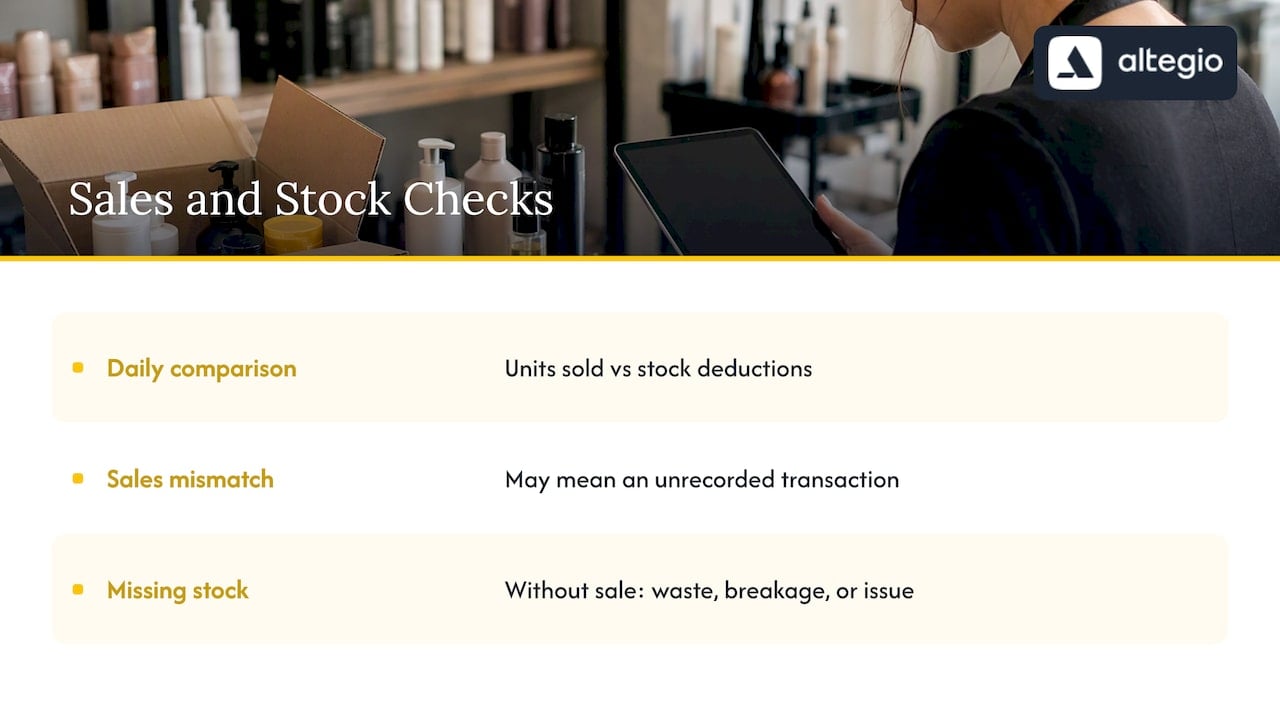
End-of-day reconciliation shouldn’t stop at the till drawer. Every product sold or used during a service is a stock movement, and the day’s sales total is only half the story if your inventory count doesn’t move with it. A salon that sells retail shampoo alongside services needs its daily sales figure to tie back to the units that physically left the shelf.
Building this check into your closing routine catches two different problems at once: a sales total that doesn’t match stock movement often means a transaction wasn’t recorded properly, while stock that’s missing without a matching sale usually points to waste, breakage or an internal issue worth investigating. Neither is obvious from the cash count alone.
In practice, this means your end-of-day process should include a quick comparison between units sold on the day’s reports and the corresponding deduction in your stock system, for both retail products and the consumables used during treatments. Treating stock and takings as one reconciliation is far easier when appointments, sales and inventory sit in the same system. In Altegio, a product sold in the visit window is deducted from stock automatically, and consumables can be written off automatically through bills of materials linked to services. A regular stock-take then shows whether physical stock still matches the system.
Turning daily reconciliation into cash flow visibility
A single day’s reconciliation tells you whether today balanced. Weeks of consistent daily reconciliation tell you something far more useful: the actual pattern of cash coming into your business, broken down by day of the week, by payment type, and by how long card settlements typically take to land in your account.
That pattern is the raw material for cash flow forecasting. Once you understand how card settlement timing affects when funds become available, you can forecast your actual bank balance rather than assuming takings convert to available cash immediately. Once you know which days consistently bring in the most card revenue versus cash, you can plan float requirements, staffing costs and supplier payments around a realistic weekly rhythm instead of a guess.
This is where daily reconciliation stops being a compliance task and starts earning its keep as a planning tool. A business owner who reviews reconciled daily totals weekly, rather than waiting for a monthly bank statement, spots a slowing week early enough to adjust spending, rather than discovering the shortfall after it’s already a problem. Altegio’s Finance section shows each cash register balance and all related operations in real time, and the Financial report and Profit and Loss report let you compare income and expenses across periods, so reviewing reconciled daily totals week by week becomes a habit rather than a project.
Where beauty and wellness businesses get reconciliation wrong
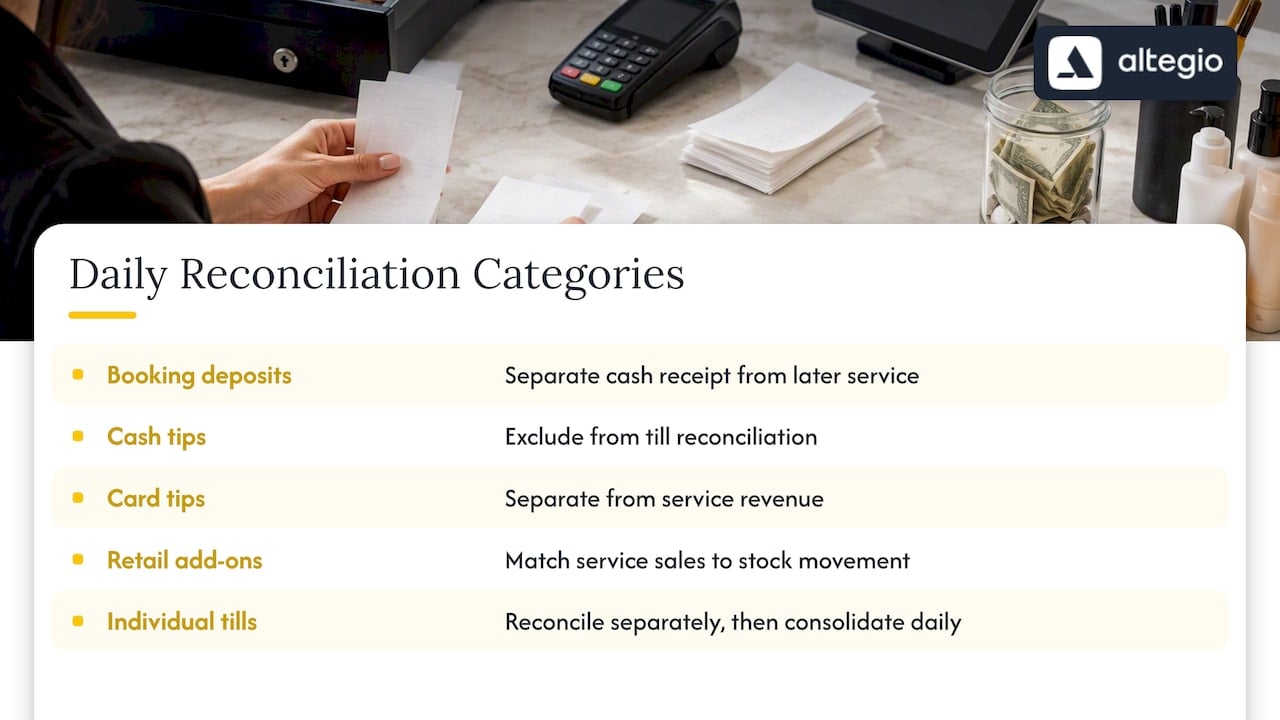
Appointment-based businesses have a few recurring pitfalls that a retail shop doesn’t face in the same way. Deposits taken at booking and redeemed later create a timing gap between when cash is received and when it’s recognised against a service, which confuses a same-day cash count if it isn’t tracked separately.
Tips are another common source of mismatch. Card tips taken through your terminal must be separated from service revenue. Under the Employment (Allocation of Tips) Act 2023, in force since 1 October 2024, tips the business controls or significantly influences, which normally includes card tips, must be passed to workers in full and shared fairly under a written tipping policy, with records kept for 3 years. Cash tips handed directly to a stylist and kept by them don’t pass through the till, but they are still the worker’s taxable income.
Retail add-ons sold during a treatment, think the bottle of product recommended at the end of a facial, get missed from stock reconciliation more often than a standalone retail sale, because the transaction happens alongside a service rather than at a dedicated till. And multi-location or multi-chair operations frequently reconcile each till separately without a consolidated daily view, which makes it far harder to spot a pattern that only shows up across the business as a whole.
The fix in each case is the same: separate these payment types and transaction categories clearly in your daily reporting, rather than lumping everything into one undifferentiated sales figure.
Why daily discipline pays off beyond the numbers
A reconciliation routine you trust means fewer hours lost chasing last week’s shortage and a cleaner answer ready if HMRC ever asks. Standardise the process once, and your attention goes back to running the business rather than firefighting it.
FAQ
What is meant by end of day reconciliation?
End of day reconciliation means matching the sales recorded by your till or POS system against the physical cash and settled card or digital payments actually received. It confirms the day’s takings are accurate before you bank them and close your books.
What is GL and SL reconciliation?
GL reconciliation checks that your general ledger, the main accounting record, matches supporting records like bank statements, while SL reconciliation checks a subsidiary ledger, such as individual customer or supplier balances, against the general ledger total. Both sit above daily till reconciliation as broader accounting checks rather than replacing it.
When should bank reconciliation be done?
Bank reconciliation is typically done at least monthly, once your bank statement is available, though many businesses check more frequently where card settlements need closer tracking. Daily till reconciliation feeds into this process by giving you an accurate daily figure to match against the statement later.
What are the three types of reconciliation?
Definitions vary, but a common grouping covers cash or till reconciliation, bank reconciliation, and account or ledger reconciliation such as matching supplier or customer balances. Each checks a different point in the chain between a sale being made and the money landing correctly in your accounts.
How often should cash be reconciled?
Cash should be reconciled at least once a day, at close of trading: remove the float, count the drawer, compare it with the POS figure, and record and investigate any variance before the takings are banked. Businesses handling high cash volumes sometimes add a mid-shift check as well.
General information, not tax advice; check your set-up with an accountant.
Read next
- Altegio Inventory Management: storages, operations, BOM, barcodes, and one-click reports
- Accept payments during the booking flow – deposits and full prepayment
- Altegio Payroll: rules, criteria, daily runs, settlements, and audit