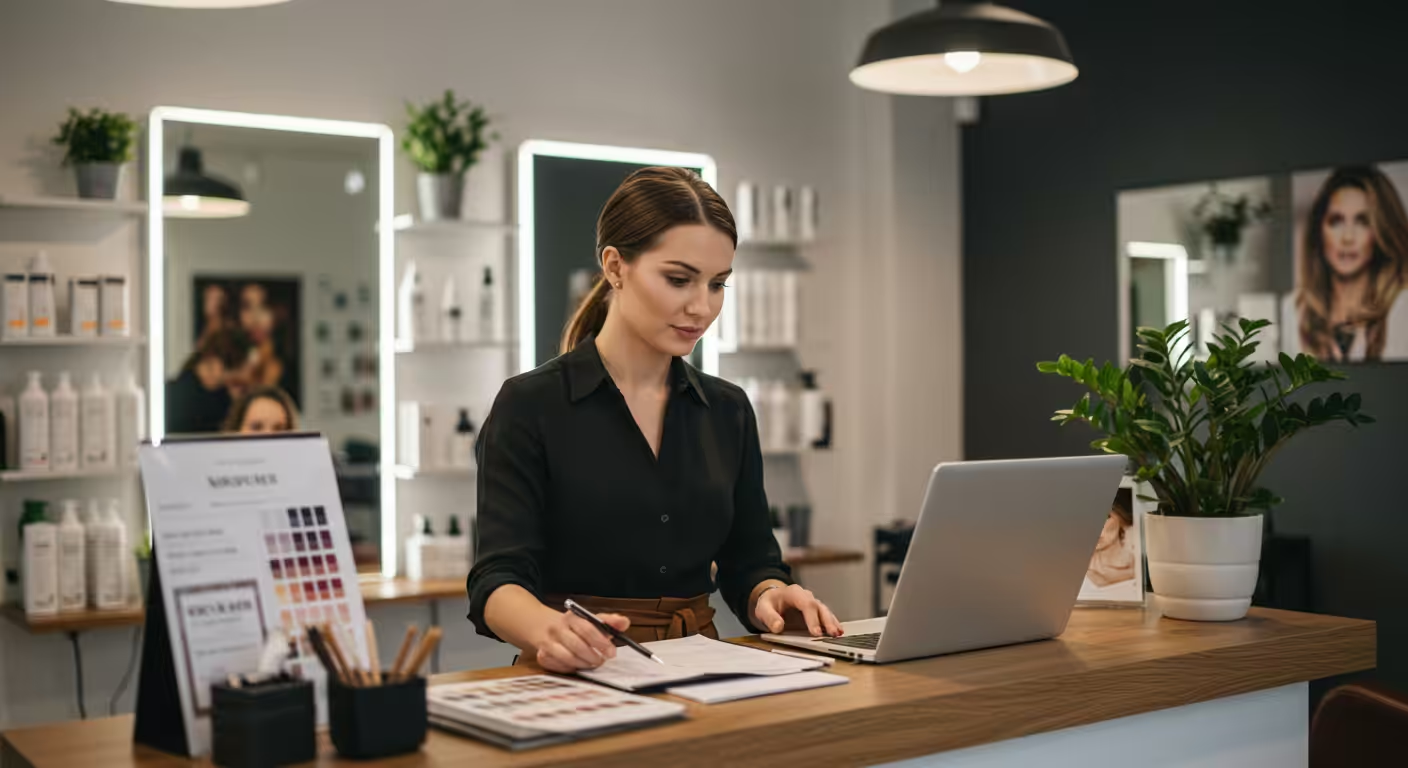
Every salon owner I talk to has the same frustration: “I know I need to market my business, but I’m already working 50 hours a week behind the chair. When am I supposed to become a marketing expert too?”
Here’s the uncomfortable truth. In 2026, being the best stylist in town isn’t enough. The salon down the street with mediocre cuts but a brilliant marketing system will fill chairs faster than the master colorist who’s still relying on word of mouth alone. That’s not fair, but it’s reality.
The good news? You don’t need to become a marketing expert. You need to build a marketing operating system — a set of repeatable, mostly automated processes that attract, convert, and retain clients while you focus on doing great work.
This guide breaks down 20 such systems. No fluff, no “just post on Instagram” platitudes. Every single one is something you can implement this week.
Phase 1: Foundation — Build Your Digital Storefront
1. Define Your Salon’s “Only We” Statement
Most salon websites say the same thing: “We offer cuts, color, and styling in a relaxing environment.” That’s not marketing. That’s wallpaper.
Your “Only We” statement is the one-line answer to: “Why should I book with you instead of the other 12 salons within a 10-minute drive?” It has to be specific. Not “we do great hair” — “we’re the only salon in North Dallas specializing in lived-in blondes using exclusively ammonia-free lighteners.” That filters out the wrong clients and magnetizes the right ones.
Sit down with your team and answer three questions: What do we do better than anyone in our radius? What kind of client do we actually enjoy working with? What service makes us the most money per chair-hour? The intersection of those three answers is your positioning.
2. Audit Your Online Booking Experience Right Now
Open your phone. Try to book an appointment at your salon. Count the clicks, the page loads, the friction points. Every extra second between “I want a haircut” and “I booked it” costs you clients.
A modern booking platform — and yes, I’ll mention that Altegio does this because I’ve seen the data from thousands of salons — should give clients a 3-step flow: pick service, pick time, confirm. No phone tag. No “fill out this 8-field form.” No opening hours that don’t match what Google says. Your booking widget should be embedded on your website, your Instagram bio link, and your Google Business Profile. If you’re running a booking system that can’t do all three, you’re leaving money on the table every single day.
3. Turn Your Google Business Profile Into a Conversion Machine
I see so many salon owners treat their GBP profile like an afterthought — a few photos, a phone number, done. This is a mistake. Your GBP profile is often the first and last thing a potential client sees before deciding whether to book.
Here’s the checklist most people miss: Upload at least 30 high-quality photos (salon interior, team, your best work — and yes, update them quarterly). Post weekly GBP updates with seasonal offers or available appointments. Respond to every single review within 24 hours, using natural language that includes your city name and specialty services. Enable direct booking through Reserve with Google so clients can schedule without leaving Search or Maps. And critically — make sure your booking link goes to an actual calendar with real-time availability, not a “request appointment” form that will get ignored for 6 hours.
4. Build a Review Engine, Not a Review Collection
Most salons wait around hoping happy clients will leave reviews. A few do. Most don’t. The ones who do it well build an engine.
The system: After every appointment, an automated message goes out (SMS or email) with a direct link to leave a review. That’s table stakes. What separates the top 5% is what happens next. If the client leaves a 5-star review, they get a thank-you and a gentle nudge to mention the specific service they received — because “best balayage in Austin” in a review body is a ranking signal Google notices. If they leave anything less than 4 stars, your system tags them for a personal follow-up from the salon manager within 2 hours. Most negative reviews are fixable if you catch them fast. Most positive reviews are squandered if you don’t optimize them.
5. Own Your Service Descriptions as SEO Assets
Here’s a free SEO win almost nobody uses. Your booking platform’s service menu is a search-indexed page. When someone types “keratin treatment Austin” into Google, they should find your service description — not just your homepage.
Go through every service in your booking system and rewrite the descriptions. No generic “Haircut — a haircut” nonsense. Write a paragraph for each: what the service includes, who it’s for, how long it takes, what makes your approach different. Use the exact phrases people search for — “balayage,” “taper fade,” “Russian volume lashes.” Your booking platform should make these descriptions search-engine-friendly by default. If it doesn’t, that’s a platform problem.
Phase 2: Content — Turn Scrollers Into Clients
6. The 3-Content-Type Framework
Stop posting randomly and hoping something sticks. Every piece of content you publish should fall into one of three buckets: Proof (your work, transformations, results — “I want that”), Education (hair care tips, maintenance advice, trend explanations — “I trust them”), and Connection (behind the scenes, team personality, salon culture — “I like them”).
The ratio that works for most salons: 50% Proof, 30% Education, 20% Connection. This keeps your feed portfolio-focused while building trust and approachability. Track which bucket drives the most DMs and bookings, and shift the ratio accordingly.
7. Video First, But Smart Video
Yes, Reels and TikToks dominate the algorithm. But not all video is created equal. The three formats that consistently outperform for salons:
The Transformation Reveal — 15-30 seconds, start on the “before” (grown-out, brassy, whatever the problem is), hold for 3 seconds, then hard cut to the “after” with the stylist stepping aside to reveal. Music matters. Lighting matters more. The Micro-Education — 30-60 seconds explaining one specific thing clients always ask about (“Here’s why your blonde goes brassy in two weeks — and how to fix it”). The Stylist Spotlight — a 45-second intro to one team member, showing their specialty, their personality, and a direct call to action to book with them. These humanize your salon and lower the anxiety barrier for first-time clients.
8. GEO-Tag Everything, Every Time
This is so simple it shouldn’t need saying, but I audit salon accounts weekly and roughly half don’t do it. Every post, every Reel, every Story gets GEO-tagged with your specific neighborhood or city. Not just the city — the neighborhood.
Instagram and TikTok serve content locally first. A transformation reel tagged “#AustinHair” with a location tag in “East Austin” will reach people within 10 miles of your salon. The same reel tagged “#HairInspo” with no location gets served globally to people who will never book with you. Local hashtags — #DallasBalayage, #ChicagoExtensions — are worth more than 10 generic ones combined.
9. The Instagram-to-Booking Pipeline
You post a gorgeous balayage. 8,000 people see it. 200 like it. 15 DM you asking about price and availability. And then what? Those 15 DMs sit unread for 4 hours because you’re behind the chair, and by the time you respond, 12 of them have booked somewhere else.
The fix: your Instagram bio should have one link — your booking page. Not your website homepage plus a separate booking link plus a Linktree. One link, straight to your live calendar. Posts that feature a specific service should have a text overlay or first comment telling people exactly how to book. And if your booking platform integrates a native “Book Now” button on your Instagram profile, you’ve eliminated the single biggest conversion killer: friction.
10. Email Is Not Dead — It’s the Retention Weapon Nobody Uses
I hear “nobody reads email anymore” constantly from salon owners. Meanwhile, our data shows that well-segmented email campaigns to existing salon clients have the highest ROI of any marketing channel — higher than paid ads, higher than social media.
The key is segmentation. Don’t blast everyone with “20% off everything!” That trains clients to wait for discounts. Instead, segment by: Last visit date (clients who haven’t been in 60+ days get a “We miss you, here’s what’s new” email), Service type (color clients get maintenance tips and rebooking reminders at their specific interval), Spend level (high-ticket clients get early access to new services or exclusive event invites). Three segmented emails per month will outperform 30 generic blasts.
Phase 3: Conversion — Turn Interest Into Revenue
11. The Automated Rebooking Machine
The most profitable client is the one who’s already in your chair. And the single most impactful system you can build is an automated rebooking sequence.
Here’s how it works: before the client even leaves the salon, they’re offered their next appointment at the ideal interval for their service — 4 weeks for color, 6 weeks for cuts, 2 weeks for barbering. Your front desk or booking platform handles the scheduling right at checkout. Then, 3 days before that next appointment, an automated reminder goes out. 24 hours before, another one. If they cancel, the system immediately offers that open slot to your waitlist. No gaps, no forgotten rebooks, no revenue leakage.
Platforms like Altegio make this mostly automatic — the rebooking prompt, the reminders, the waitlist management — but the habit has to start with the team. Make “shall we get your next one booked?” as automatic as “how was your service today?”
12. SMS That Actually Works (Without Being Annoying)
SMS marketing has a 98% open rate, which is both a superpower and a trap. Overuse it and clients block you. Use it strategically, and it fills last-minute gaps nothing else can reach.
The SMS rules: Frequency — no more than 2-3 promotional texts per month. Urgency only — text about a same-day cancellation opening or a 24-hour flash sale, not “happy fall, book something.” Personalization — “Hey Sarah, your color appointment is this Thursday at 2pm. See you then!” crushes “REMINDER: You have an appointment.” Opt-out respect — one-click unsubscribe on every message, and actually honor it immediately.
The highest-performing SMS use case for salons is the gap fill. A stylist has a 2-hour opening tomorrow at 11am. Your system texts a curated list of clients who’ve booked that service before, with a time-limited offer. Booked in 90 seconds.
13. The First-Visit-to-Loyal-Client Conversion Path
A new client is expensive to acquire and worth almost nothing on their first visit. Their lifetime value is built over the next 3-6 appointments. So your marketing has to continue after they walk out the door.
The sequence: Day 0 (same day as appointment) — thank-you SMS with a review link. Day 3 — email with at-home care tips for the service they received. Day 10 — a personal note from their stylist checking in on the cut/color, with a tidbit from their client notes (“How’s the new fringe treating you? Still loving it?”). Day 21-28 — rebooking reminder at their service interval. Day 45 (if no rebook) — “We miss you” offer, but make it a value-add (complimentary treatment add-on), not a discount.
This sequence takes maybe 10 minutes to set up in your client management system and runs on autopilot forever. For every client.
14. The Membership Model as Cashflow Stabilizer
Memberships aren’t new, but most salons still don’t use them. A membership model — $80/month for 2 haircuts, $120/month for a monthly blowout plus quarterly color gloss — creates the thing that keeps salon owners up at night: predictable revenue.
Memberships work because they lock in frequency and reduce churn. A membership client visits 40-60% more often than a pay-per-visit client. They’re also 3x more likely to upgrade services and buy retail. The math is straightforward: 100 membership clients paying $100/month is $120,000 in guaranteed annual revenue before you’ve booked a single new client. Your booking platform should handle recurring billing, membership check-ins, and automatic reminders. If it doesn’t, you’re doing admin instead of doing hair.
15. Referral Systems That Actually Pay for Themselves
The standard salon referral program — “refer a friend and get $10 off” — is fine. But it’s not a system. It’s a hope.
A real referral system has three layers: The incentive — make it meaningful. A $10 discount is noise. A complimentary add-on treatment (scalp massage, deep conditioning, brow shape) costs you almost nothing in product but has high perceived value. The trigger — right after a great service, when the client is looking in the mirror feeling great, that’s when your front desk says “We love having you here. If you know anyone who’d be a great fit for our salon, here’s a card with your name on it — they get their first blowout free, and you get a complimentary treatment next visit.” The tracking — your booking platform should track referral sources so you know which clients are your best advocates and can reward them appropriately.
Phase 4: Paid Growth — Accelerate When You’re Ready
16. Know Exactly What a New Client Costs You
Before you spend a dollar on ads, you need to know your numbers. What’s the average revenue from a first visit? What percentage of first-timers rebook within 60 days? What’s the lifetime value of a retained client?
If a new client’s first visit averages $85 and 40% of them rebook at least twice in the next 6 months (adding $340 in revenue), your average acquired client is worth roughly $221 in 6-month revenue. That means you can comfortably spend $30-50 to acquire one and still be profitable. Without these numbers, you’re gambling. Your salon management platform should give you this data in a dashboard, not a spreadsheet.
17. Meta Ads: Target People, Not Interests
The most common Meta Ads mistake I see from salons: targeting “people interested in hair” with a radius of 25 miles. That’s too broad and too competitive. You’re bidding against every national beauty brand with million-dollar budgets.
The smarter play: Lookalike audiences built from your existing client list. Upload your client emails to Meta, and it will find people with similar demographics and behaviors within your radius. These audiences typically convert at 2-3x the rate of interest-based targeting. Retargeting — show ads specifically to people who visited your booking page but didn’t complete a reservation. They were interested enough to click; a gentle nudge with a first-visit offer often closes them. Local radius tightening — for a salon, anyone more than 15 minutes away is unlikely to become a regular. Set your radius accordingly.
18. Google Ads: Bid on “Book Now,” Not “Learn More”
Google Ads for salons should target one thing: booking intent. Someone searching “hair salon near me” might be browsing. Someone searching “balayage specialist Dallas book now” is ready to spend money.
Bid on high-intent, service-specific keywords: “[City] balayage,” “[Neighborhood] hair extensions,” “best colorist [City].” Your ad copy should mirror the searcher’s intent exactly — mention the service, the city, and the action (“Book Your Balayage Consultation — Same-Week Appointments Available”). The landing page for every ad should go directly to that specific service on your booking calendar, not your homepage. Three extra clicks between “I want a balayage” and “I’m on your calendar” will kill your conversion rate.
19. Track Everything — Attribution Matters
“How did you hear about us?” is not a tracking system. It’s a polite question that generates unreliable data. Clients don’t remember, or they say “Instagram” because that’s what they think you want to hear.
Real attribution requires: unique booking links for each marketing channel (one for Instagram, one for your email footer, one for Google Business Profile), UTM parameters on every paid ad, and source tracking built into your booking platform. When a new client books, you should know — automatically, without asking — whether they came from a Google search, a Meta ad, a friend’s referral code, or your GBP profile. Without this, you can’t allocate your marketing budget intelligently. You’re guessing. And guessing is expensive.
20. The Monthly Marketing Review That Saves You Thousands
Set a recurring 30-minute meeting with yourself (or your manager) on the first of every month. Open three reports: new client source breakdown, rebooking rate by stylist, and revenue per marketing channel. Ask three questions: What’s working? (Double down — move budget toward the highest-performing channel.) What’s not? (If a channel hasn’t delivered a positive ROI in 60 days, pause it. Don’t rationalize, don’t “give it more time” — pause it.) What’s missing? (Is there a demographic — bridal clients, men’s grooming, extensions — that you’re not reaching but competitors are?)
This 30-minute review, done consistently, will save you more money than any marketing course or consultant. It forces you to look at data instead of vibes. Most salon owners skip this step for 6 months, then wonder why their marketing budget evaporated.
Building the System That Builds Itself
Here’s what separates the salons that grow from the ones that plateau: they stop treating marketing as a series of disconnected tactics and start treating it as an operating system.
An operating system runs in the background. The automated rebooking reminders, the review requests, the segmented emails, the waitlist gap-fills — once configured, they work whether you’re behind the chair, on vacation, or asleep. Your job is to set the strategy, check the dashboard, and make the creative decisions. The platform handles the execution.
If you’re running a modern salon management platform, most of these 20 systems are already built in — you just need to turn them on and configure them properly. If your current platform can’t do half of what’s in this article, that’s not a marketing problem. That’s a tool problem. Fix the foundation first, then the marketing will follow.