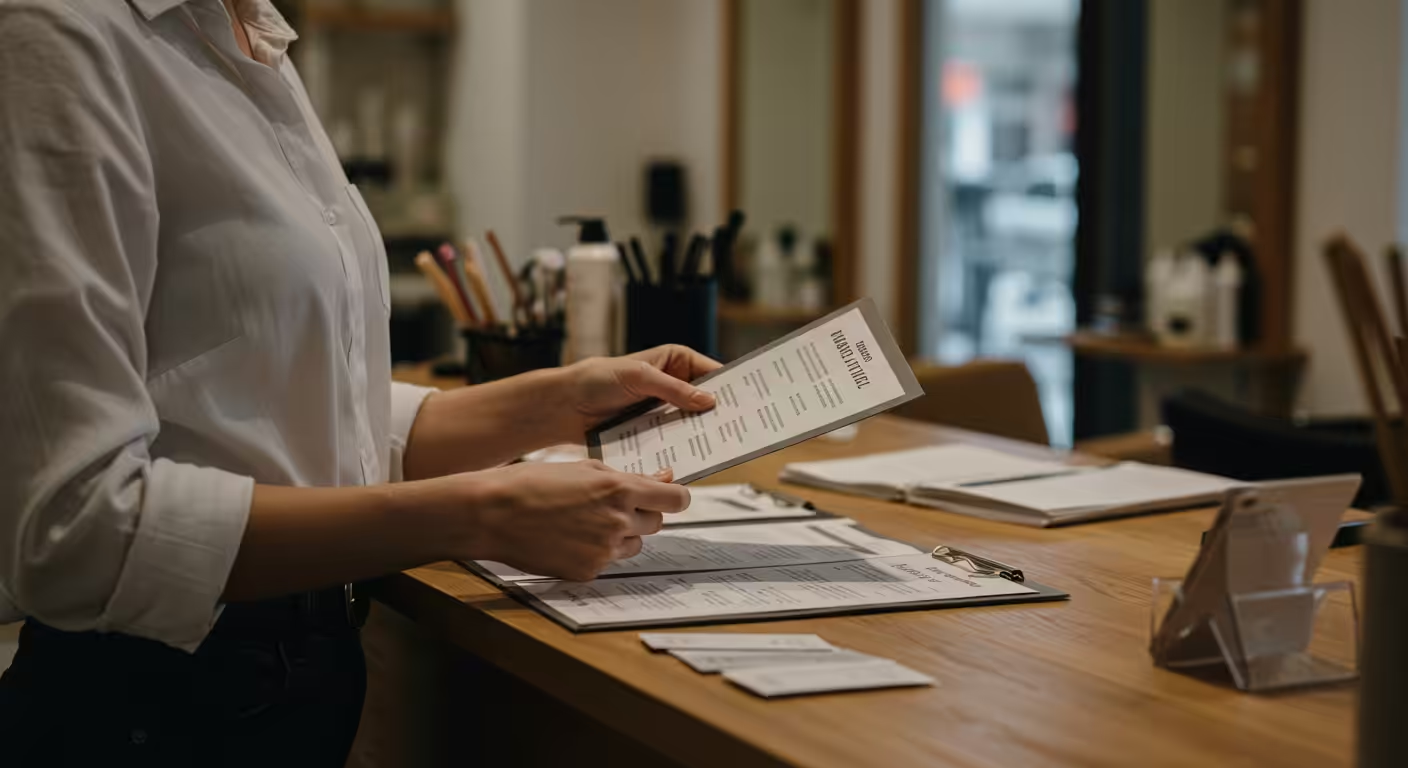
Walk into most independent salons on a Tuesday morning and you will find the owner doing three things at once: answering the phone, mixing color for a client who just walked in, and mentally calculating whether they can afford to order more shampoo this week. This is not business ownership. This is survival mode with a styling cape.
The difference between a salon that runs you and a salon you run is not talent, location, or luck. It is systems. Specifically, the operational systems that handle the repetitive, administrative, and financial machinery of your business so you can return to what you actually signed up for: working with clients and building a team.
This article is not a software review. It is a framework for operational automation — the 18 systems that turn a chaotic, owner-dependent salon into a self-running business. Whether you use Altegio, another platform, or a patchwork of tools, these are the capabilities that matter.
Part 1: The Booking Engine — Your 24/7 Front Desk
1. Always-On Online Booking
If your clients can only book you between 9 AM and 5 PM on a phone call, you are losing roughly 40% of potential appointments. Data consistently shows that over half of salon bookings now happen outside business hours — during lunch breaks, after dinner, on Sunday evenings when someone notices their roots in the bathroom mirror.
A proper online booking system is not a nice-to-have widget on your website. It is your highest-converting sales channel. It needs to show real-time availability, let clients select specific staff members, display accurate service durations, and — critically — allow them to complete the booking in under 60 seconds. Every additional click or form field drops your conversion rate by double digits.
Platforms like Altegio embed this directly into your website and social media profiles. The booking button on your Instagram bio should lead to an available slot, not a “call us” instruction.
2. Automated Appointment Reminders
The single highest-ROI automation in any salon is the reminder sequence. A well-configured system sends an SMS or email 48 hours before the appointment, another 24 hours before, and sometimes a same-day confirmation. Salons that implement multi-touch reminder sequences typically see no-show rates drop from 15–20% to under 5%.
The key is personalization. “Hi Sarah, your balayage appointment with Marco is tomorrow at 2 PM. Reply YES to confirm or click here to reschedule” converts dramatically better than a generic system message. Modern booking platforms let you customize these templates per service type and per staff member.
3. Deposit and No-Show Protection
Automated reminders reduce no-shows. Deposits eliminate their financial impact. For high-ticket services — color corrections, extensions, keratin treatments that block 2–3 hours of chair time — requiring a card on file with a cancellation policy is not aggressive. It is standard professional practice.
Configure your booking system to capture payment details at the time of booking. Set a clear cancellation window (typically 24 hours). Charge automatically for late cancellations and no-shows. The clients who respect your time will not object; the ones who do are the ones who were going to no-show anyway.
4. Smart Waitlist Management
When a prime Saturday slot opens because of a cancellation, the client who gets it should not be the one who happened to call at the right moment. A digital waitlist automatically notifies clients in priority order — by loyalty status, by time on the list, or by service match — and lets them claim the slot with one click.
This alone can add 5–8% to monthly revenue without acquiring a single new client. It is pure capacity utilization, and it requires zero staff time once configured.
Part 2: The Client Operating System
5. Digital Client Profiles
Every client who walks through your door generates data: service history, color formulas, product purchases, preferences, allergies, birthdays, last visit date, average spend, rebooking rate. If this lives in your head or on a stained index card, it is not data — it is memory, and memory fails.
A proper client management system stores every interaction in a searchable, accessible profile. When Sarah books a balayage, her stylist sees her full color history, the formula used last time, her preferred toner shade, and a note that she mentioned wanting to go slightly lighter next visit. This is not a CRM gimmick. It is the operational foundation of premium service.
6. Automated Rebooking Triggers
The most valuable client action is not the first booking — it is the second, third, and twentieth. Yet most salons leave rebooking to chance and a stylist’s memory at checkout.
Configure automated rebooking workflows. If a client has not rebooked within 72 hours of their last appointment, send a personalized follow-up. If their typical gap between color services is 6 weeks and week 5 passes without a booking, trigger a gentle reminder. These automated nudges, configured once, generate consistent recurring revenue without a single phone call.
7. The Lapsed Client Recovery Engine
Every salon has clients who used to come every 4 weeks and then just… stopped. Most of them did not leave because of a bad experience. They got busy, tried someone closer, or simply forgot to rebook.
A lapsed client recovery system automatically identifies clients who have not visited in 60 or 90 days and sends a sequence: a friendly check-in at day 60, a “we miss you” with a small incentive at day 75, and a final reach-out at day 90. The economics are compelling: reactivating a lapsed client costs a fraction of acquiring a new one, and lapsed clients who return often become more loyal than they were before.
8. Client Segmentation and Personalization
Not all clients are the same, and your communication should not treat them as if they are. Segment your client base: high-frequency color clients, occasional blowout bookers, retail buyers, referral sources, VIPs who spend above a certain threshold.
Each segment gets different messaging. VIPs receive early access to new services and priority booking windows. Occasional clients get re-engagement campaigns. Retail buyers get notifications when their favorite products are back in stock. This is not marketing fluff — it is operational precision that drives measurable revenue.
Part 3: The Financial Command Center
9. Integrated Point of Sale
Your booking system and your payment system should be the same system. When a client’s service, retail purchase, and tip all flow through a unified POS connected to the appointment, reconciliation takes seconds instead of hours. Split payments, package redemptions, gift card usage, and loyalty point applications should all happen in one transaction flow.
Disconnected systems create errors, slow down checkout, and make end-of-day reconciliation a nightmare. Integrated POS is not a luxury feature — it is basic operational hygiene.
10. Automated Payroll and Commission Tracking
If you employ a team and you are still calculating commissions in a spreadsheet on Sunday night, you are burning 3–5 hours every week on work that software does in milliseconds. Modern salon platforms track every service, every retail sale, and every tip per staff member in real time, applying tiered commission structures automatically.
This is not just about saving time. It is about accuracy. Manual commission calculation errors — even honest ones — erode team trust. Automated tracking with transparent reporting builds it.
11. Real-Time Revenue Dashboards
You should know, at any moment, exactly how your salon is performing against targets: today’s revenue, this week’s bookings, average ticket value, retail-to-service ratio, new client acquisition cost, rebooking rate. Not in a monthly report you review three weeks late. Right now.
Real-time dashboards turn financial management from a retrospective autopsy into an operational tool. If Tuesday is tracking 30% below target by noon, you can take action Tuesday afternoon — run a flash promotion, reach out to waitlisted clients, adjust staffing — rather than discovering the problem in a month-end report when it is too late.
12. Inventory Intelligence
Most salons carry 20–30% more inventory than they need and still run out of the products they actually use. Manual inventory management is the culprit.
An intelligent inventory system tracks every retail product and backbar supply in real time. It alerts you when stock drops below reorder thresholds, identifies slow-moving products that are tying up cash, and can even suggest optimal reorder quantities based on usage patterns. For salons doing over $20,000 in monthly retail, inventory automation alone typically recovers 3–5% of revenue lost to overstocking, understocking, and shrinkage.
Part 4: The Revenue Engine
13. Automated Marketing Campaigns
Marketing automation is not about blasting promotional emails to your entire list. It is about triggering the right message to the right client at the right moment, without anyone on your team lifting a finger.
Configure birthday rewards (a complimentary treatment or retail discount sent automatically during the client’s birthday month). Set up post-visit thank-you sequences with a review request on day 2 and a product recommendation on day 5. Create re-engagement campaigns for seasonal services — pre-summer color, holiday party styling, wedding season packages.
These campaigns, once built, run perpetually. They are not marketing expenses; they are revenue assets that compound over time.
14. Loyalty and Membership Programs
A well-designed loyalty program is not a punch card. It is a revenue predictability engine. Subscription and membership models — where clients pay a monthly fee for a defined set of services or benefits — transform irregular appointment patterns into guaranteed recurring revenue.
Even a simple points-based loyalty program, where clients earn redeemable points on every dollar spent, increases visit frequency by 15–25% when properly implemented. The key is automation: points must accrue and redeem seamlessly through the booking and POS system, not through a separate tool or manual tracking.
15. Online Retail Integration
Your retail shelf should not be limited to your physical front desk. An integrated e-commerce component lets clients repurchase their favorite products directly from your booking platform or website, with inventory synced in real time.
This is particularly powerful for professional product lines that clients cannot easily find elsewhere. When a client runs out of the shampoo you recommended, they should be able to order it in 30 seconds rather than drive to a store, forget the name, and buy a different brand.
Part 5: The Team Operating System
16. Staff Scheduling and Capacity Optimization
Rostering based on who wants which shifts is operational amateur hour. Staff scheduling should be data-driven: which hours have the highest booking demand, which staff members have the highest utilization rates, which service mix each stylist handles most profitably.
A modern scheduling system overlays staff availability with predicted demand patterns and service durations, flagging overstaffed and understaffed blocks before they become problems. It also handles the complexity of part-time, full-time, booth renters, and commission-based staff in a single view.
17. Performance Analytics Per Staff Member
Every stylist and therapist on your team should have a performance dashboard: revenue generated, rebooking rate, average ticket, retail attachment rate, client satisfaction scores, utilization percentage. This is not about micromanagement. It is about giving each team member the data they need to grow.
Weekly one-on-ones backed by data are fundamentally different conversations from gut-feel check-ins. “Your rebooking rate is 48% — let us look at what the top performers do differently and build a plan to get you to 65%” is coaching. “I feel like your clients are not coming back” is just criticism.
18. Standardized Operational Procedures
Technology automates tasks. But automation only works when the underlying process is consistent. Every recurring operation in your salon — client check-in, consultation documentation, color formulation recording, rebooking conversation, retail recommendation, checkout flow — should have a documented standard operating procedure that every team member follows.
When these SOPs are embedded in your software — mandatory consultation forms before certain services, automated rebooking prompts during checkout, standardized product recommendation workflows — they become habits rather than rules. The software enforces the standard, and the standard drives the results.
Building Your Automation Roadmap
You do not need to implement all 18 systems at once. In fact, trying to is the fastest route to frustration. The right approach is sequential, based on what will produce the highest impact with the lowest friction for your specific salon:
Week 1–2: Foundation. Ensure your online booking is fully configured with accurate services, staff, and durations. Set up automated appointment reminders. Activate deposit capture for high-value services.
Week 3–4: Client Data. Build out digital client profiles with service history and preferences. Configure automated rebooking triggers. Set up the lapsed client recovery sequence.
Month 2: Financial Systems. Integrate POS with booking. Set up automated payroll and commission tracking. Configure real-time dashboards.
Month 3: Growth Systems. Launch automated marketing campaigns. Deploy loyalty program. Enable online retail.
Month 4: Team Systems. Implement data-driven scheduling. Roll out staff performance analytics. Document and embed SOPs.
The salons that dominate their local markets in 2026 and beyond are not necessarily the ones with the most talented stylists or the best locations. They are the ones whose owners stopped treating their business like a job and started treating it like a system — a collection of automated, repeatable, scalable operations that produce consistent results regardless of who is behind the chair on any given day.
Your craft deserves your full attention. Everything else should run itself.