The best cancellation policy is clear about notice, proportionate in its fees and tied to a real financial loss rather than a punishment. Get those three things right and most disputes disappear before they start, including the card disputes that end in a chargeback. The levers you’re actually setting are the notice window, the fee structure, any deposit, your exceptions and how the client agrees to the terms. Once the terms are shown and accepted inside the booking flow, enforcement stops being a fight and becomes a formality.
TL;DR:
- Cancellation fees should reflect your actual loss and depend on the notice given; a 24 to 48-hour window is a common choice for appointment-based work.
- A deposit or a percentage of the service price is easier to justify than a flat penalty if a client challenges the fee.
- EU consumer law requires clear information before the client is bound, and the Unfair Contract Terms Directive lists a disproportionately high compensation sum among the terms that may be unfair.
- In a card dispute, your strongest evidence is that the client saw the exact fee and agreed to it before booking.
- In Altegio, payment policies show the deposit or fees, the free cancellation window and a link to your policy text in the online booking widget, and the client ticks the consent checkboxes before the appointment is booked. Deposit mode works with any supported payment provider; card guarantee works only with Adyen, only in EU countries.
What should go into your cancellation policy?
Every workable policy rests on four moving parts: how much notice you need, what you charge when you don’t get it, whether you take money upfront, and what happens with late arrivals and no-shows. Set these badly and you’ll either lose revenue or spend your week arguing with clients. Set them well, and the policy quietly does its job in the background.
Notice windows should scale with how hard the slot is to fill. A 15-minute blow-dry that’s easy to rebook can live with a 12-hour window. A three-hour colour correction or a bridal trial, booked weeks out and almost impossible to fill at short notice, justifies 48 hours. A 24 to 48-hour window is a common default for appointment-based work.
Fee structures come in three flavours, and each carries a trade-off:
- Flat fee – simple to explain and easy to apply consistently, but it can overcharge for a short appointment and undercharge for a long one.
- Percentage of service price – scales with the actual appointment, which makes it easier to defend as a genuine estimate of loss rather than a penalty.
- Forfeited deposit – clients feel the loss upfront rather than being billed afterwards, which tends to reduce disputes but requires you to collect payment at booking.
No-shows are where policies most often get challenged. Charging the full service price is common, but it’s open to challenge because you avoid some costs when the service isn’t delivered. A fee pegged closer to your genuine loss is far easier to justify if a client pushes back or disputes the charge with their bank.
Late arrivals deserve their own rule, separate from no-shows. A short grace period, say 10 to 15 minutes, followed by a shortened service or treating the visit as a no-show past a set cutoff, keeps things fair without punishing someone stuck in traffic.
Deposits are usually a portion of the service price, rising with the cost of the appointment and how hard the slot is to rebook. A €25 haircut rarely needs a deposit at all. A €350 microblading session or a multi-hour bridal package usually does: a 20% deposit on that €350 session is €70, enough to show commitment without looking like a penalty.
What are the legal limits on cancellation fees in the EU?
There’s no single EU table of permitted cancellation fees. EU directives set a common baseline, and national law and courts fill in the details, so treat what follows as the European starting point rather than the full picture for your country.
The Unfair Contract Terms Directive (93/13/EEC) covers standard terms you write yourself and don’t negotiate with each client, which is exactly what a cancellation policy is. Such a term is unfair if, contrary to good faith, it causes a significant imbalance in the parties’ rights and obligations to the detriment of the consumer, and national law makes unfair terms non-binding on the consumer. The Directive’s indicative list of terms that may be unfair includes two that matter here:
- requiring a consumer who fails to fulfil their obligation to pay a disproportionately high sum in compensation;
- letting the business keep money the consumer paid when the consumer cancels, without the consumer receiving an equivalent amount when the business is the one cancelling.
In practice that means keeping the fee proportionate to your real loss, returning the deposit in full when you cancel or move the appointment yourself, and writing the policy in plain, intelligible language. If a written term is ambiguous, the interpretation most favourable to the consumer prevails.
The Consumer Rights Directive (2011/83/EU) adds information duties. For a distance contract, which an appointment booked and paid online can be, the client must get clear information about the service, the total price and the payment arrangements before they are bound. When an online order places the client under an obligation to pay, the key information has to appear clearly and prominently directly before they place the order, and they must explicitly acknowledge that the order implies an obligation to pay. The Directive also says that if a trader infers consent to an extra payment from a pre-ticked box, the consumer is entitled to get that payment back. Whether a particular fee counts as an extra payment is a question for your lawyer, but the design lesson is simple: let the client tick the box themselves.
Online bookings can also bring the 14-day right of withdrawal for distance contracts into play. For service contracts the period runs from the day the contract is concluded, and the Directive has specific rules for services that start within those 14 days, as well as exceptions. How this applies to a deposit for next week’s appointment depends on how your booking is set up and on national law, so it’s worth a short check with a lawyer.
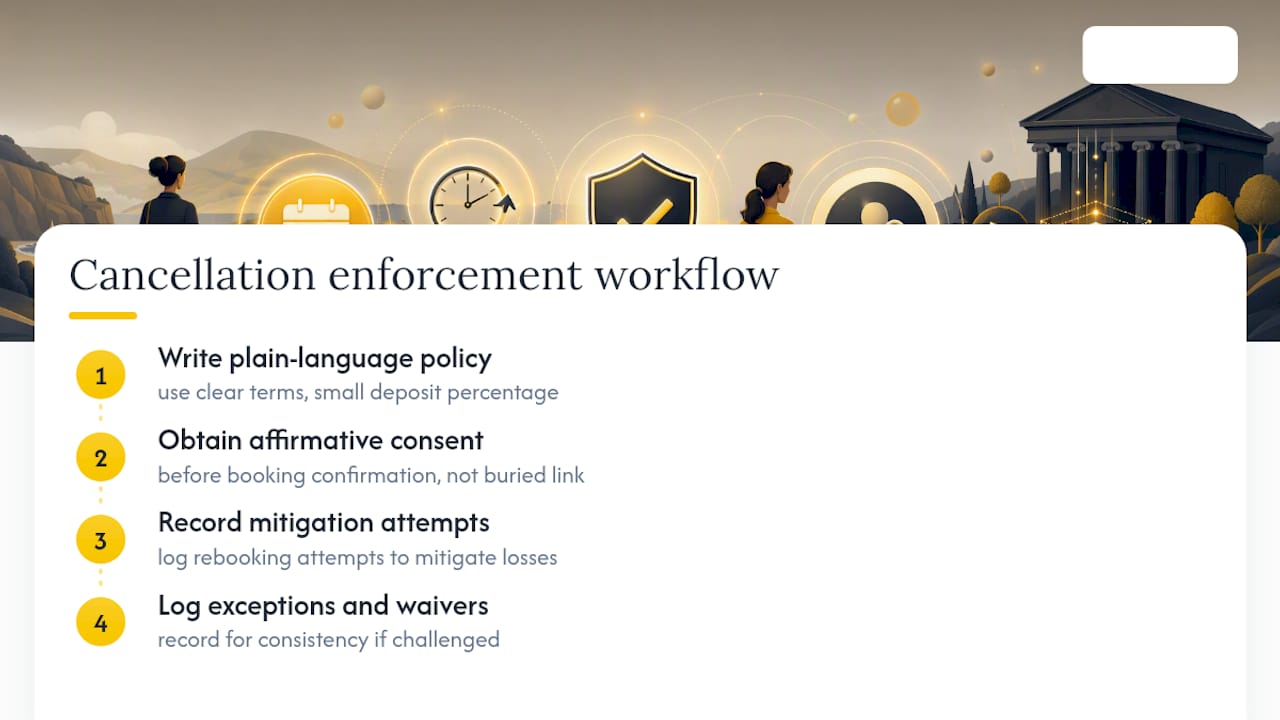
Practically, that means: write the policy in plain language, get affirmative consent before the appointment is confirmed rather than hiding it behind a footer link, keep a note of any attempt to fill a cancelled slot, and log any exceptions or waivers you grant so you can show the policy is applied consistently.
How do chargebacks work, and what evidence helps?
A chargeback starts when the client disputes a card payment with their bank. The bank decides under the card scheme’s dispute rules, and you respond through your payment provider with evidence, within the deadlines the scheme sets. Dispute reasons, evidence requirements and time limits differ between card schemes, so follow your provider’s guidance on each case.
Two EU payment rules shape what happens before a dispute even starts. First, the Payment Services Directive (PSD2, 2015/2366) requires strong customer authentication when a payer initiates an electronic payment, so a client paying a deposit online usually confirms it in their banking app or with a similar check. Your payment provider handles this step. Second, for a payment initiated by the business, such as a no-show fee charged to a linked card, PSD2 gives the client a right to a refund if the authorisation didn’t specify the exact amount and the charge exceeded what they could reasonably have expected. Showing the fee as a concrete amount at booking makes that argument much harder to win.
When a dispute does arrive, the case usually rests on a few records:
- the policy text and the fee the client saw before booking;
- proof the client agreed, such as the ticked checkbox online or a completed payment link for an appointment made by phone;
- the confirmation and any reminders sent before the appointment;
- the appointment record showing when the client cancelled or that they didn’t arrive;
- any attempt to rebook the slot and a short note from the team member involved.
How do you enforce a cancellation policy without losing clients?
Enforcement lives or dies on what happens before the appointment, not after the cancellation. Build the workflow in this order:
- Present the policy at the point of booking. Show the notice window and fee clearly, then require an affirmative action, a checkbox the client ticks themselves, rather than assuming silence means agreement.
- Keep a record of the acceptance. Your booking system should store which terms applied to which appointment, because that record is your strongest evidence if a client later disputes a charge.
- Remind clients before the cutoff where you can. A message that restates the deadline in one line gives clients a genuine chance to cancel free of charge. Check the lead time your reminders allow: if they can’t go out before your window closes, make sure the confirmation carries the policy instead.
- Secure payment before the appointment, either through a deposit taken at booking or a linked card you can charge if the client cancels late or doesn’t show.
- Charge promptly once the cancellation window has closed, rather than letting it sit and inviting an “I forgot” dispute weeks later.
- Keep the evidence together: the accepted terms, the messages sent, any attempt to fill the slot and a short note on what happened.
Phone appointments need the same rigour as online ones. Train team members to read the policy aloud, note the client’s agreement in the appointment record, and avoid negotiating exceptions on the spot, however sympathetic the excuse sounds; that’s what your documented waiver process is for. In Altegio, a payment policy applies automatically only to online bookings, so for an appointment created in the Appointment Calendar the administrator adds the policy and sends the client a payment link with a deadline to pay the deposit or link a card.
Pro Tip: Keep a one-line script for pushback: “Our policy is [X hours] notice or a [Y]% charge, and it’s the same for every client. It’s how we keep appointments fair for everyone.” Consistency, not sympathy, is what protects you in a dispute.
Cancellation policy examples you can copy
You don’t need a lawyer to write a first draft. You need language that’s specific, consistent and repeated at every touchpoint.
Policy summary (booking page and policy text): “Cancellations and reschedules made more than 24 hours before your appointment are free of charge. Later cancellations and no-shows are charged 50% of the service price.” For a €120 colour appointment, that 50% fee is €60, so state the amount in euros wherever you can, not just the percentage.
Acceptance line (phone script or your own terms): “By booking, I agree to the cancellation policy above and authorise [business name] to charge the stated fee for a late cancellation or no-show.” In Altegio’s online booking widget the consent checkboxes appear automatically when a payment policy is active, so you need this line only where you collect agreement yourself.
Reminder message: “Your appointment is on [date] at [time]. You can cancel or reschedule free of charge until [deadline].”
No-show message: “You were marked as a no-show for your [date] appointment. In line with our cancellation policy, a fee of €[amount] has been charged. Contact us within 48 hours if you believe this was recorded in error.”
Keep the tone plain, not legalistic, and state the fee in every message so nobody can say they weren’t told.
How Altegio payment policies handle cancellations and no-shows
A policy nobody sees at the right moment is a hope, not a policy. Payment policies in Altegio put your terms into the online booking flow itself, for any appointment-based business: beauty, wellness, clinics, auto, fitness and more. You set the policy once per Location in Administration mode under Digital Payments > Payment Policy and choose one of three modes: No payment policy, Deposit or Card guarantee.
- Deposit. The client pays upfront, either a percentage of the visit cost or a fixed amount, and the deposit is applied to the bill at checkout. It works with any payment provider supported in your region. If the client doesn’t pay before the payment deadline (15 minutes by default), the unconfirmed appointment is cancelled automatically.
- Card guarantee. The client links a card and pays nothing at booking. A late cancellation fee and a no-show fee, each a percentage or a fixed amount, are charged from that card only if the client cancels late or doesn’t arrive. Card guarantee works only with Adyen, only in EU countries. The card is attached to that one appointment and can be charged only for the fees the client agreed to.
- Free cancellation window. How long before the visit the client can still cancel or reschedule without losing the deposit or paying a fee. In Deposit mode you can set it from 1 to 72 hours.
- Scope. You choose which services, team members and clients (all, new only or existing only) the policy covers and can set a minimum visit amount. Free services and appointments covered by an active membership are excluded.
What the client sees and agrees to. Before the appointment is booked, the widget shows the deposit or the fees as concrete amounts, the free cancellation window and a link to your full cancellation policy text. The client ticks two checkboxes: agreement to the charges under your cancellation policy, and agreement to storing the data needed to process them. Altegio attaches a snapshot of the policy in force to that appointment, so changing your settings later doesn’t change what an existing client agreed to.
Online cancellations and reschedules. While a policy is active, clients can always cancel or reschedule online. Inside the free window nothing is charged, and a reschedule moves the deadline along with the appointment; in Deposit mode a timely cancellation leaves the deposit on the client’s balance for their next visit. After the window closes, the policy applies automatically: in Deposit mode the deposit goes to the business, and under card guarantee the late cancellation fee is charged from the linked card. Without a payment policy, you decide in Online booking > Settings whether clients may cancel or reschedule online and set a cutoff of up to 48 hours before the appointment.
No-shows and waivers. When a client doesn’t arrive, an administrator decides in the visit window whether to charge the fee, waive it or keep the deposit on the client’s balance. Waiving needs the Allow receptionist not to charge setting and the matching permission. If nobody decides by 23:59 on the day of the visit, Altegio applies the no-show fee from the saved policy automatically. If a card charge fails, Altegio retries it up to three times and then records the fee as a debt on the client’s Payment Policy account.
Records and refunds. The Client accounts tab in the client card shows the balance, top-ups, debits, amounts in hold and fees, with a history of every operation: date and time, amount and who performed it. Refunds aren’t automatic. If you cancel an appointment yourself or a client who cancelled in time won’t rebook, a team member processes the refund manually, as described in the Client Refunds article of the help centre.
Notifications. There are no separate policy notifications. Altegio adds the policy information to the email notifications the client already receives and to the visit information page they open from the link in SMS or WhatsApp messages. Automatic reminders go out at most 24 hours before the visit, so with a 24 or 48-hour window, the confirmation email is what carries the policy before the deadline passes.
Payments run through your connected provider, and Altegio doesn’t charge its own commission on top. If you use Adyen through Altegio, payments with EEA consumer cards cost 0.99% + €0.20 each. For a closer look at the card guarantee flow, read our guide to payment policies, card guarantee and Adyen.
If your terms go beyond something straightforward, get legal advice before you publish them; Altegio handles the enforcement mechanics, not the legal drafting. To test the workflow against your own notice windows and fees, start a 7-day free trial.
FAQ
What counts as a reasonable cancellation fee?
A fee that reflects your genuine loss from the cancellation rather than a flat penalty. Under the EU Unfair Contract Terms Directive, a disproportionately high compensation sum may be unfair, so tie your fee to the notice given and how likely you were to fill the slot.
How much notice should a cancellation policy require?
Many appointment-based businesses use a 24 to 48-hour window, with longer appointments and harder-to-fill slots justifying the longer end of that range.
Can I charge 100% for a no-show?
You can set it, but it’s the riskiest position. A full charge ignores costs you avoid when the service isn’t delivered, and a disproportionately high sum is exactly what EU unfair-terms rules target. A fee closer to your actual loss is easier to defend if challenged.
Do I need client consent before charging a cancellation fee?
Yes. Show the policy before the appointment is confirmed, let the client tick the box themselves and keep the record. That record is your strongest evidence in any later dispute.
Can clients cancel or reschedule online in Altegio?
Yes. With a payment policy active, clients can always cancel or reschedule online, and the free cancellation window decides whether the deposit is kept or a fee is charged. Without a policy, you choose whether online changes are allowed and set a cutoff of up to 48 hours before the appointment.
Does card guarantee work with any payment provider?
No. Card guarantee needs Adyen and is available only in EU countries. Deposit mode works with any payment provider supported in your region.
Read next
- Card Not Present Fees: Appointment Businesses Pay Beyond the Rate
- Pay by bank in Europe: open banking for appointment businesses
- End of Day Reconciliation: 6 Checks to Keep Salon Records Audit Ready
- A salon booking system: how to choose
This article is general information, not legal advice. Consumer and payment rules differ between EU countries, so check your cancellation terms with a qualified lawyer in your country.