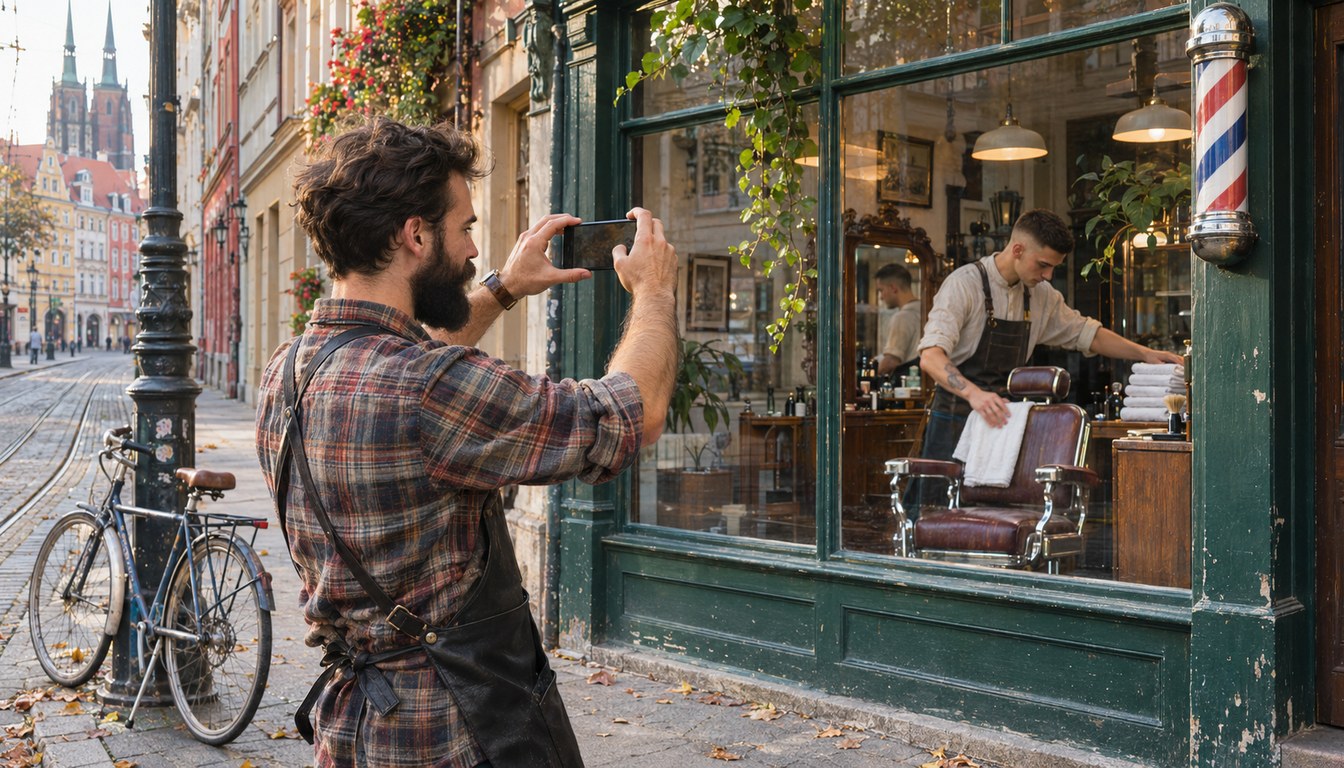
Before a new client sits in your chair, they spend a dozen or so seconds looking at their phone. They type “barber Wrocław” or “barber + district name” and click one of the three places Google shows them. Below we take that results page apart: what exactly the client sees, who occupies those places today, and how to take them yourself, with no agency and no ad budget
In brief
- The client searches locally and specifically: “barber Wrocław” alone is 2,400 searches a month, and with spelling variants and districts the cluster grows past 5,000; nobody types “the best barber in Poland”
- Google ranks the map, not a price list: according to Google, position depends on relevance, distance and prominence, and you cannot pay for a higher place
- The Google Business Profile is underrated: according to Google, clients are 2.7 times more likely to consider a business reputable when they find its complete Business Profile, and yet most salons fill it in once and forget it
- A booking can start and end inside Google: with the Book via Google integration the client books straight from the map, without moving to any other site, and the appointment lands in your calendar by itself (Google does not offer the button in every country yet: the Altegio knowledge base lists Poland among the countries where the service is still planned, so add your online booking link to the profile too)
How the client searches for a barber: the search data
Let us start with the numbers, because they frame everything else. This is what demand for a barber really looks like in one city: phrases from a keyword analysis tool, September 2026, average monthly searches.
| Phrase | Searches/month |
|---|---|
| barber wrocław | 2,400 |
| barber wroclaw (no Polish diacritics) | 1,000 |
| barbershop wrocław | 480 |
| barber shop wrocław | 480 |
| najlepszy barber wrocław (best barber) | 110 |
| dobry barber wrocław (good barber) | 30 |
Three conclusions from this table. First, the client searches for a city or a district, not a country, though not every district: Semrush (November 2026) records 390 monthly searches for “barber Bemowo” in Warsaw and none for “barber Krzyki” in Wrocław. Second, they type carelessly: the version without Polish diacritics is the second result on the list, and Google merges it into one query anyway. Third, the words “best” and “good” appear rarely, because the search engine does the ranking for the client: the order on the map and the stars replace a comparison site.
Add the phone. People search like this on the way somewhere or on the sofa, in the search engine or straight in the maps app. The takeaway for an owner: your fight for a new client happens on a small screen, within a dozen seconds.
What the client sees after typing “barber Wrocław”: the anatomy of the results
Type in your own city and look at the results, because the layout is the same everywhere. At the top, sometimes ads. Right below them, the local three-pack: a map and three profiles with stars, review counts and a booking button. Only lower come the classic links. In Semrush data from 6 November 2026, the top ten for “barber wrocław” holds the Booksy directory in first place, two Reddit threads where locals ask about a good barber, a local ranking “top 7 barber shops in Wrocław” and, next to them, barbershops’ own websites (including positions 3, 4 and 6).
This block with the map is Google Business Profiles in action, and it is usually where the client decides. Put plainly: for a barbershop, the fight for the Google client is a fight for a place in the local three-pack, not for a blog position in the links.
Let us calculate what that place is worth, with your own numbers: searches in your city × the share of people who open your profile × the share who book × the price of the service. A purely arithmetical example: “barber Wrocław” is 2,400 searches a month; if 5% open your profile, that is 120 people, and if one in ten of them books, that is 12 visits a month, or about 1,080 zł of revenue at 90 zł a haircut, not counting returns. The percentages and the price are assumptions of the example, not market data: substitute your own from the profile statistics and your till. An empty profile hands those visits to the barber next door.
The Google Business Profile: the place in the results you can take yourself
No price list leads into the local three-pack: Google builds it from Business Profiles, distance signals and reviews. The difference between an empty and a complete profile is real: according to Google, clients are 2.7 times more likely to consider a business reputable when they find its complete Business Profile.
The minimum, done in one afternoon:
- Primary category “barber shop”, not a generic “hair salon”: the category is one of the strongest signals Google uses to match you to a query
- A name without promotional add-ons: “Cut&Go Barbershop”, not “Cut&Go Barbershop | best barber Wrocław cheap”; keyword stuffing in the name can cost you the profile
- Hours, address, phone identical to the letter with your website and directories: inconsistent data lowers the search engine’s trust
- Photos of the interior and your work, a dozen or so to start and new ones monthly: profiles with photos get visibly more direction requests and phone clicks
- Services with prices: a client who knows the price before the visit cancels less often
Posts and Q&A are the superstructure: nice, but the foundation above comes first.
Reviews: the fastest-growing ranking factor
Google states in its Business Profile help that more reviews and positive ratings can improve a business’s local ranking. For the client it is even simpler: two profiles side by side, one has 4.9 and 300 reviews, the other 4.4 and 17. The choice takes a second.
How to collect them without buying or begging. The most effective moment is a few hours after the visit, while the haircut still pleases: a short thank-you message with a link to leave a review does more than a sign by the mirror. You generate the review link in the Business Profile and paste it into the automatic after-visit message in your booking system, so the request goes out by itself, with no reception involved. Reply to reviews, including the weak ones: the reply is read by the next hundred clients, not by the author. And never buy reviews or ask the team to post them from private accounts: since 1 January 2023, the Polish Act on Counteracting Unfair Market Practices (Art. 7, point 26) has banned posting or commissioning fake reviews in all circumstances.
Booking straight from Google: the map instead of the reception desk
The shortest route from search to visit never leaves Google at all. With the Book via Google service, a client who found your profile on the map or in search clicks “Book” and picks the service, the barber and the time without moving to any other site. In Altegio this integration is built in: you switch it on in the online booking settings following the step-by-step guide in the knowledge base, and every appointment made through the map lands in the calendar by itself, with reminders and the client’s record like any other booking. Availability depends on the country, though: the Altegio knowledge base lists Poland among the countries where Google is still planning to launch the service, so after connecting check that the button shows on your profile – a link to your online booking in the profile leads to the same calendar either way.
Why this matters specifically for search: every extra step between “found it” and “booked it” loses some clients. A phone nobody answers mid-cut loses the most; a form on the website fewer; booking without leaving the map the fewest. Since the client starts on the map anyway, let them finish there.
Directories and marketplaces: visibility that is not yours
Back to the classic links under the three-pack: the “top 7 barbers” rankings are written by booking portals, and it is they who collect that traffic. You can be there and sometimes it is worth it, but understand the arrangement. A client from a directory books “in the app”, not “at your place”: their account, history and habits grow on the platform’s side, and for a client acquired through promotion you pay a commission. In Booksy Boost, according to its price list, it is 45% net of the value of services from a new Boost client’s first completed visit, capped at 250 zł net. You are then building someone else’s brand with your own money, while competing inside the catalogue with the barber around the corner, to whom the platform shows your client.
The Google profile works the other way round: the profile is yours, the reviews are yours, the booking from the map lands in your system, and the client remembers the name above the door, not the app’s logo. Hence the order: your own channels at maximum first, directories as a supplement, never as the foundation.
The salon website and local SEO in an hour a month
The website does not have to be big to do its job in the results. One polished page is enough: the salon’s name plus city and district in the page title, the same hours and phone as in the profile, a few photos, a price list and an online booking button. If clients keep asking you the same things, add a short FAQ: questions in natural language are exactly what people type into search engines and read out loud to voice assistants.
An hour a month of upkeep is enough: new photos for the profile, replies to reviews, updated hours before holidays. More on how to set the foundations from day one of the business in the piece on opening a salon step by step.
FAQ
How do I add a barbershop to Google Maps?
Create a Business Profile at business.google.com, enter the address and the “barber shop” category, then confirm your right to the business with a code from Google. After verification, fill in hours, photos, services and prices: according to Google, a complete profile makes clients 2.7 times more likely to consider a business reputable.
How much does a Google profile for a salon cost?
Nothing: Google does not charge for adding a business or claiming it, and you cannot pay for a higher position on the map. An agency can be an add-on, but the real cost of the profile is your time: about an hour a month of upkeep.
How do I collect Google reviews legally?
Ask after the visit: a short automatic thank-you message with a review link, sent from your booking system, works best. Reply to all reviews, including critical ones. Do not buy reviews and do not post them from the team’s accounts: Art. 7, point 26 of the Polish Act on Counteracting Unfair Market Practices prohibits this.
Does a barbershop need its own website?
The Google profile is enough to start, but a website adds trust and a second place in the results. One page is enough: the name with the district in the title, a price list, photos, the same contact details as in the profile and an online booking button.
The client travels from “barber Wrocław” to your chair in a dozen seconds, and that whole journey is visible in Google. In Altegio a booking from the map, the website and social media lands in one calendar, and the review request goes out by itself after the visit
- Online booking 24/7 from Google Maps, your website and social media
- Automatic after-visit messages with a review request
- Client records and reminders without reception