
Here are eleven tools to pick from for two jobs; you will not use all of them. The code-it half writes and launches the product: an AI editor like Cursor, a backend, a host such as Vercel, and payments. Before any of that comes one fork, write it yourself or hand the build to a studio for founders who would rather pay someone than open an editor. The sell-it half puts the product in front of salons: a demo, analytics, the system emails, a sales inbox or CRM, and the billing. Below: the stack in that order, who each tool fits, what it costs, and what makes salon software its own problem.
In short
- A salon product is two jobs: code it (AI editor, backend, host, payments) and sell it (the demo, the sales inbox or CRM, product analytics, system emails and billing), and the selling is the part a technical founder finds harder.
- A paying stack starts at one Vercel Pro seat a month: Vercel’s free tier is non-commercial, so a product you sell needs the paid seat, with Supabase free and Stripe charging a per-transaction fee on top; add Supabase Pro and the stack sits at a modest $45/mo.
- Decide who codes before you pick tools: write it yourself with Cursor or Claude Code, or hand it to a studio that moves a no-code prototype onto real code.
- VAT is part of the selling half, and you need to decide on it earlier than you’d expect: as merchant of record, Lemon Squeezy settles VAT for you, where Stripe Payments leaves it to you.
The tools compared
How we chose: first the tools that write and launch the product (code it), then the tools that sell it to salons (sell it); inside each half, from the general-purpose ones down to the narrower tools for a specific step. We left out the finished salon platforms: those are the platforms your product competes with, not tools you build with.
| Tool | Role | Starts free? | Smallest paid | Best for |
|---|---|---|---|---|
| Cursor | Code | Yes | $8/mo | Writing code yourself |
| Claude Code | Code | No | Usage-based | Delegating whole tasks |
| Supabase | Code | Yes | from $25/mo | Skipping a hand-built backend |
| Vercel | Code | Not for commercial | $20/mo per seat | Shipping without servers |
| Stripe | Code / sell | No monthly fee | 1.5% + €0.25 per charge | A flexible payment layer |
| Invental | Code | No | By quote | Not coding it yourself |
| Resend | Sell | Yes | $20/mo | Your product’s system emails |
| PostHog | Sell | Yes | Usage-based | Reading product usage |
| Naoma AI | Sell | No | $249/mo (billed yearly) | Demoing without a sales team |
| CRMchat | Sell | Yes | see crmchat.ai | Running deals in one window |
| Lemon Squeezy | Sell | No monthly fee | 5% + 50¢ per charge | Selling worldwide without a tax team |
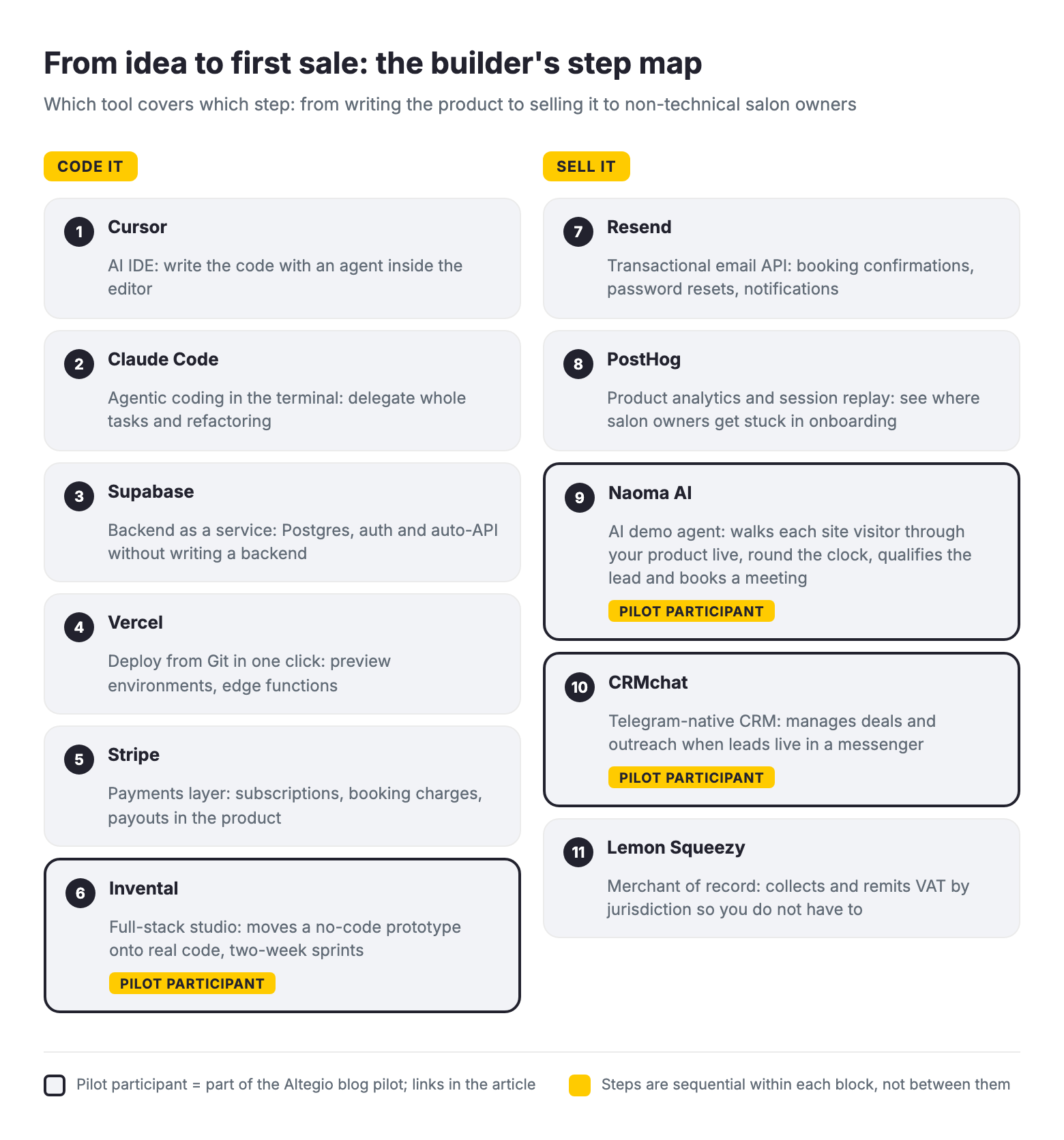
Every local business is turning into a software company, and the salon ones have a stack worth copying. The next two sections walk it in that order.
Which stack do you need to write the product?
Cursor or Claude Code writes the code, Supabase runs the backend, Vercel hosts it and Stripe moves the money. That is the short version of the first half: four jobs, one tool for each, plus a studio if you would rather not open an editor at all. The parts below are the ones every builder ends up assembling in some form.
Cursor: the editor where code lives
Cursor is the editor the rest of the stack grows around, an AI IDE built as a fork of VS Code that writes and edits code with an AI agent beside you. You type, it suggests, you accept or rewrite.
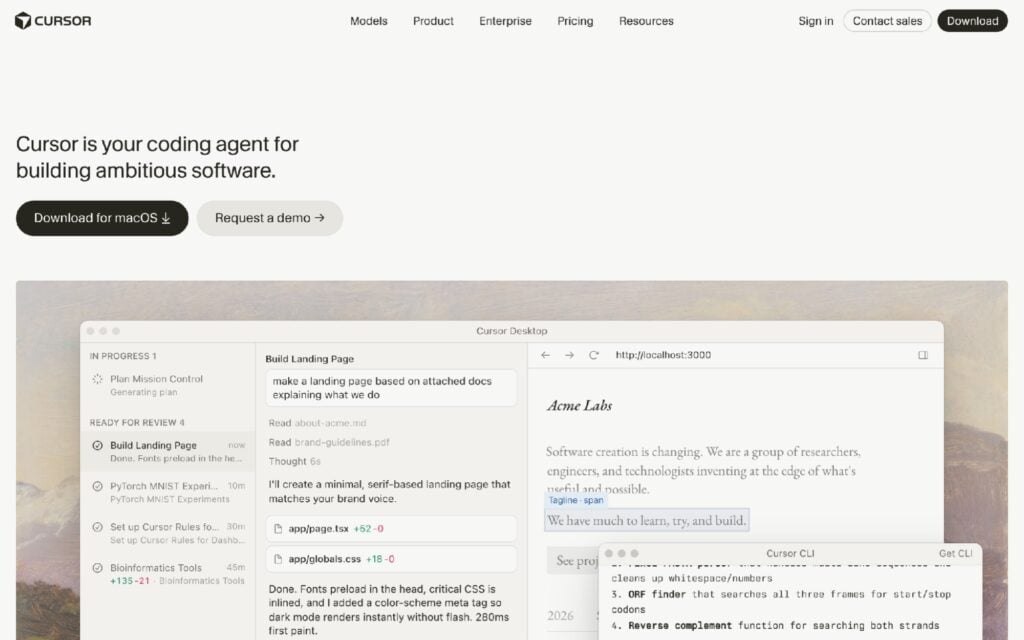
The free tier runs on a limited pool of agent and chat requests, enough to try the workflow before you pay. Cursor Plus at $8/mo runs on Cursor’s own models (Grok and Composer models), no third-party Claude or GPT. The latest Claude and GPT models come with Premium at $30/mo; those models bill on top at usage rates, and the plan adds cloud agents and code reviews.
Best for: a founder who writes the code themselves.
Skip it if: you do not want to open an editor at all, which is where a studio or a no-code builder fits instead.
Claude Code: an agent in your terminal
Claude Code works across the whole project from the terminal instead of inside one editor window alone. It reads your repository, writes and edits code, and runs your tests, so you can hand it a whole task to carry end to end.
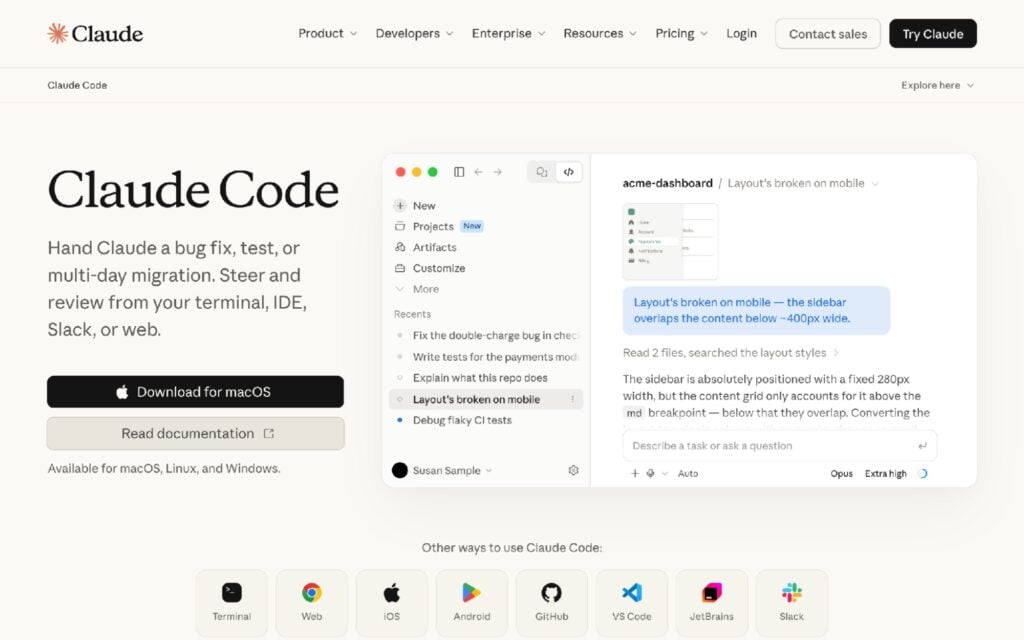
There is no separate price tag: it comes with a Claude subscription (Pro, Max or Team), or runs pay-as-you-go on API tokens if you reach it through the API.
Best for: a builder who wants to delegate whole tasks and refactors.
Skip it if: you do not already know the basics of development, since the agent speeds you up without replacing the understanding.
Supabase: the backend without writing one
Supabase hands you a Postgres database, authentication, an auto-generated API and storage, which fits a multi-tenant product, one tenant per salon. You wire your app to it instead of standing up servers.
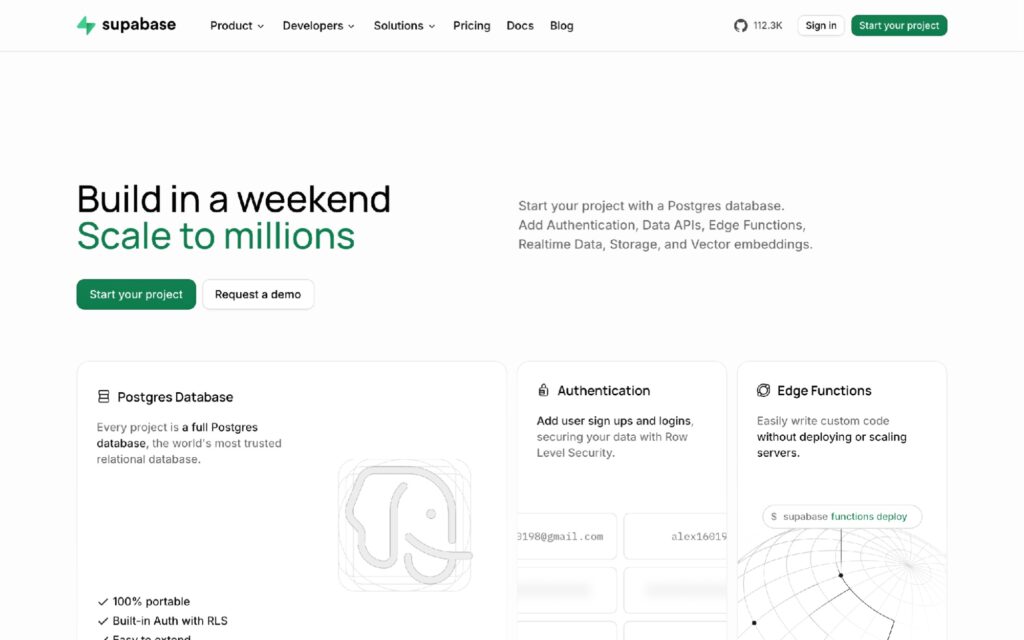
The free tier gives you a 500 MB database, 50,000 monthly active users and 5 GB of egress, though a free project pauses after a week of inactivity and only two can stay active at once. Pro from $25/mo raises those limits once paying salons come on board.
Best for: a builder who would rather not write a backend from scratch.
Skip it if: you need full control over your infrastructure from day one.
Vercel: deploy from a git push
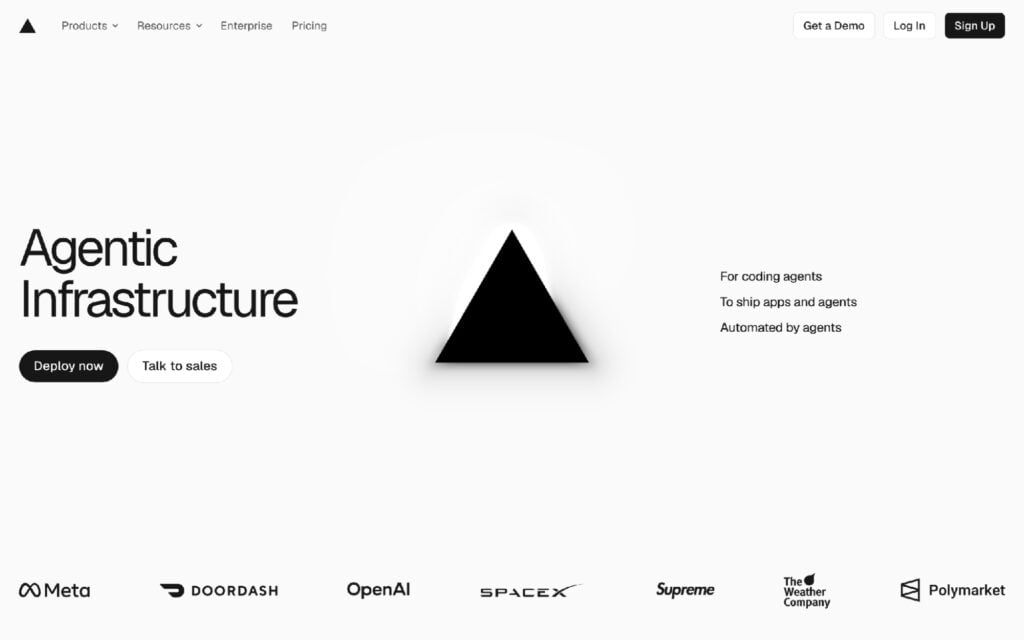
Vercel deploys straight from a git push and spins up preview environments for every branch, but its free Hobby plan at $0 is, in Vercel’s own words, for personal, non-commercial use, which rules it out for a product you sell. The smallest plan allowed for commercial use is Pro at $20/mo per seat, one seat per developer who deploys.
Best for: a builder who wants to ship without running servers.
Skip it if: you are only building a personal project or prototype, where the free Hobby plan already covers you.
Stripe: payments inside your product
Stripe handles cards and subscriptions and drops a payment layer into your product for subscriptions, booking payments and payouts. The VAT stays with you. Its add-on Stripe Tax can calculate and collect the tax, but Stripe does not become the merchant of record, so the tax liability stays with you.

Pricing is 1.5% + €0.25 per charge on standard EEA cards, with no setup charge and no monthly fee, so you pay only when a salon pays you.
Best for: a builder who wants a flexible payment layer in the product.
Skip it if: you do not want to track VAT country by country, which is what the seller-of-record route takes off your hands.
Invental: real code when you would rather not write it
Invental is a development studio you hand the build to when a no-code prototype has outgrown its builder. You validate the idea on Bubble, Webflow or Wix, hit the ceiling, and pass the migration to a team working in the same stack as the tools above: React, Next.js, TypeScript, Postgres and React Native. The point is that the stack stays the same, only who writes it changes.
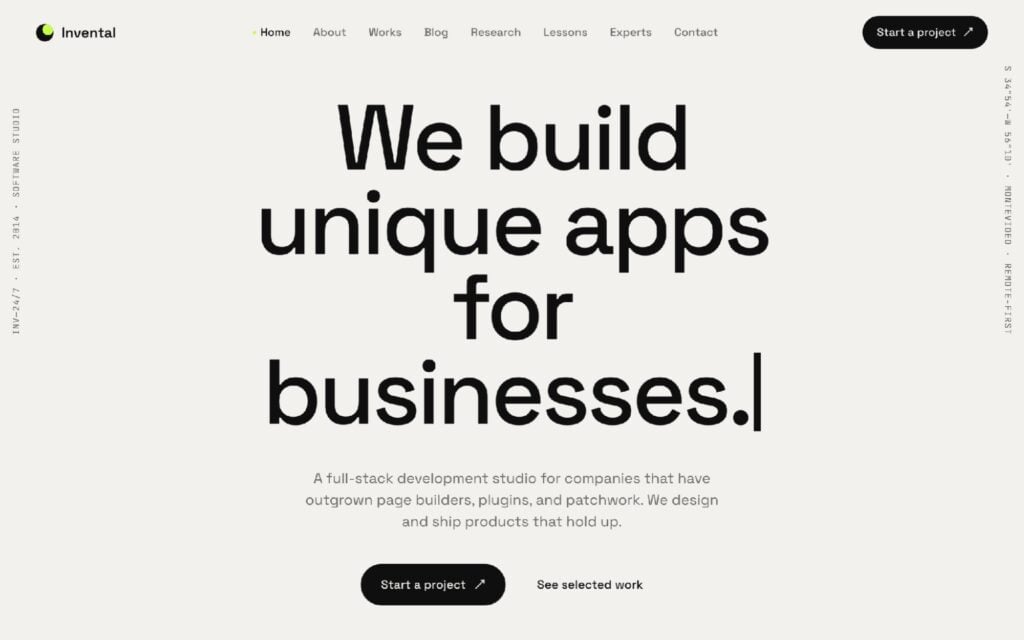
Invental builds websites, web and mobile apps, Shopify extensions and full rebuilds of products running on no-code tools. There is no public price list: work is scoped by quote, which means no fixed monthly cost and no way to compare the spend against a self-serve tool upfront.
Best for: a founder who has proven the idea on no-code and wants a product built to sell, with no team of their own.
Skip it if: you want to write it yourself and keep everything in hand, which the tools above are for.
How do you sell salon software to non-technical owners?
Salons buy on a demo and on trust rather than on API docs, so selling is a job of its own and the harder half. The owner of a growing chain or a cosmetology clinic does not read your changelog; they want to see the product work across their locations and know someone will answer the phone. The tools below cover the four parts of that: showing the product, reading what buyers do, sending the emails it depends on, and keeping the deals in one place.
Resend: the emails your product depends on
Resend is built for developers, a REST API, SMTP and SDKs, aimed at the system emails a product sends, with marketing broadcasts on separate plans. Booking confirmations, password resets and status notices go out through it.

The free tier covers 3,000 emails a month with a 100-a-day cap across 3 domains, which is enough only for the earliest start: a product sending booking confirmations to salon clients outgrows the daily limit fast. The smallest paid tier lifts that to 50,000 and drops the daily limit.
Best for: the system emails your product sends.
Skip it if: you need mass marketing email to salons, which Resend bills on a separate marketing plan.
PostHog: what salons actually do in your product
PostHog puts analytics, session replay and feature flags in one usage-based tool, so it shows where salons stall in onboarding instead of leaving it to guesswork. You watch the replay of a stuck owner and fix the step they never finish.
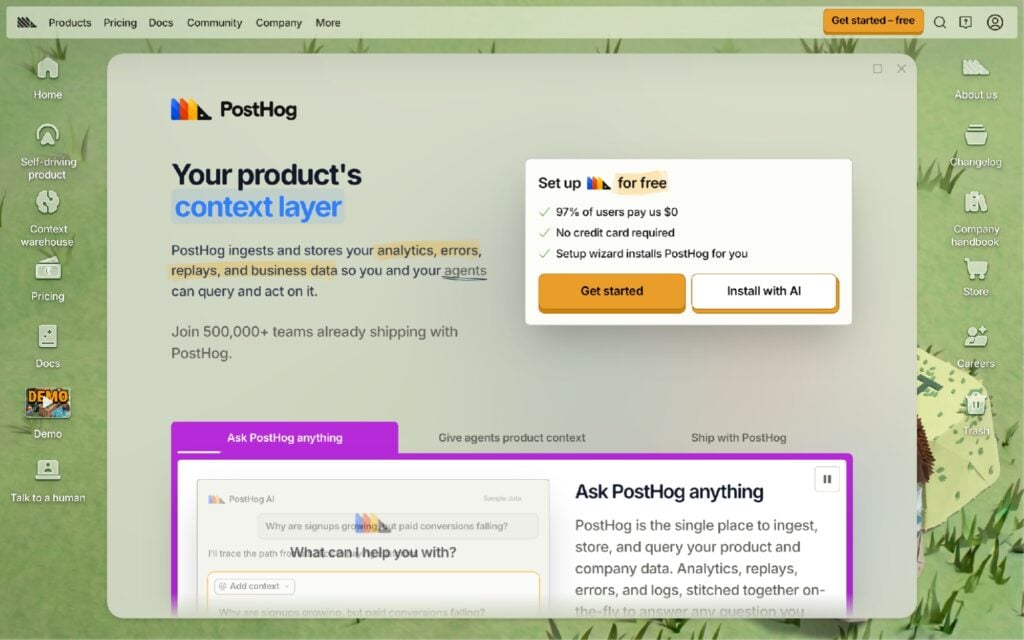
The free tier covers 1M analytics events a month with no card, enough to run well past the first salons. Past that the bill runs on the volume of events, with no fixed monthly fee.
Best for: seeing where salons stall in onboarding.
Skip it if: simple metrics are enough for now, which can wait until your first paying salons.
Naoma AI: an automated demo for every visitor
Naoma AI shows the product to every visitor as an automated demo and screens out the ones who will never buy, with no sales team on call. Salon owners are non-technical and want to watch the product work before they commit, so the first selling question for a builder is how to show it to each visitor without someone running the demo live.

Naoma AI is an AI demo agent for B2B SaaS that runs an automated demo around the clock on your site, answers questions, qualifies the lead and passes it to your CRM. There is no free tier. Starter at $249/mo, billed yearly covers 50 engaged demos built from your slides and screenshots, where a visitor counts as engaged after 3 minutes and bounces are not charged. Growth at $750/mo, also billed yearly, is the tier where the agent drives your actual product in a live walkthrough, books the meeting and runs multilingual demos in 80+ languages.
Best for: a product that is hard to grasp from a landing page, and a team with no salespeople.
Skip it if: your leads are still a handful a month, where the demo allowance is more than you need, or the product is obvious without a demo.
CRMchat: deals and outreach in one window
CRMchat keeps deals and outreach in one place when the leads and partners you sell to live in a messenger. Founder-led sales means you are the one chasing salon owners, so the pipeline and the conversation stay together instead of scattered across inboxes.

CRMchat is a Telegram-native CRM and outreach tool for sales teams, built around a deal pipeline, message sequences, lead search and tasks on deals. The free tier covers one Telegram account, a capped set of CRM leads and unlimited campaigns; Personal opens one seat with unlimited leads, Zapier and the API. Team adds shared workspaces and extra team members, with pricing at crmchat.ai.
Best for: a founder who sells themselves and runs the whole pipeline from Telegram.
Skip it if: your sales run on email and forms only, where the Telegram side is not needed.
Lemon Squeezy: it becomes the merchant of record and handles the tax
Lemon Squeezy becomes the merchant of record and settles VAT across jurisdictions, which costs more per charge than Stripe but takes the tax work off you. Instead of a payment layer you own, the sale runs through Lemon Squeezy itself.

Pricing is 5% + 50¢ per charge (+1.5% outside the US, +0.5% on subscriptions), with no monthly fee for the e-commerce features.
Best for: a solo founder selling software worldwide without a tax team.
Skip it if: the per-charge fee costs more than running your own tax accounting, which it can at higher volume.
What is different about salon software specifically?
A salon lives by its schedule, so a product without a solid booking core does not get bought. From there the differences stack up: no-shows and deposits, chains that want one dashboard across locations, a buyer who runs a chair rather than a codebase, and integrations the salon already runs. Each is a reason the generic SaaS checklist is not enough here.
Part of this is already built. Booking, no-shows, payroll and stock are solved by mature products, and your software will compete with the booking platforms salons already run instead of entering an empty field. Altegio is one of them, an operational platform for beauty businesses that keeps scheduling, the client base, payments, communications and analytics in one place, with an open API, webhooks, MCP servers and the Integrations Hub. That open layer matters for a builder. You can build on top of a mature product instead of against it, connecting through the API or publishing to the Integrations Hub, which is often the faster route into a salon that already has what salons need running. Where you do build your own, the buyer decides it by demo and fit, the same way salons choose a booking system.
What does the stack cost to start?
The floor for a product you can charge for is the Vercel Pro seat on its own, $240 a year, with Stripe taking its cut of each charge on top. The numbers are a model; substitute your own and the order of magnitude stays.
The free host is not allowed for commercial use, which puts the Pro seat at the bottom of any paid stack. Everything beyond that one paid seat is free at the start. Supabase runs on its free tier until the first paying salons sign up, and PostHog gives you 1M events a month at no cost. Stripe charges a share of revenue instead of a subscription, so its per-transaction fee sits outside the monthly figure and gets paid only when a salon pays you.
The rest is optional and kicks in only when you choose it. Supabase Pro adds $25 a month once the free limits run out, which brings the stack to a modest $45/mo. Cursor adds $8 a month if you write the code yourself, and nothing if you stay on its free tier or pass the build to a studio instead. Resend, the demo agent and the sales tools each carry their own free tier or price when you add them. So the honest answer is one Vercel seat to go live, and a short list of add-ons you reach for as the product grows.
FAQ
Can you build salon software without writing code?
Yes, up to a point. No-code builders like Bubble and Webflow stand up a prototype, but they hit a ceiling on scale and integrations. A studio then moves that prototype onto real code, which is the usual path from a validated idea to a product you can sell and support.
Should you build salon software or buy an existing platform?
Part of a salon’s work, booking, no-shows and payroll, is already handled by mature products, so your product will compete with them from day one. Building makes sense on a niche they miss or as an integration layered on top of an open API, rather than as a full replacement from scratch.
Do you need to handle VAT when selling your app worldwide?
Yes. Stripe Payments leaves the VAT with you, while a merchant of record such as Lemon Squeezy collects and remits VAT across jurisdictions on your behalf for a per-charge fee. Which you want depends on whether you would rather keep the margin or skip the paperwork.
How do salons pay for software you sell them?
Usually by subscription or by paying inside the product, say for a booking. Stripe handles this at 1.5% + €0.25 per transaction for EEA-issued cards (plus 0.7% for Stripe Billing subscriptions), billed only when a payment goes through, so you add a card layer and the salon pays as it uses the product.