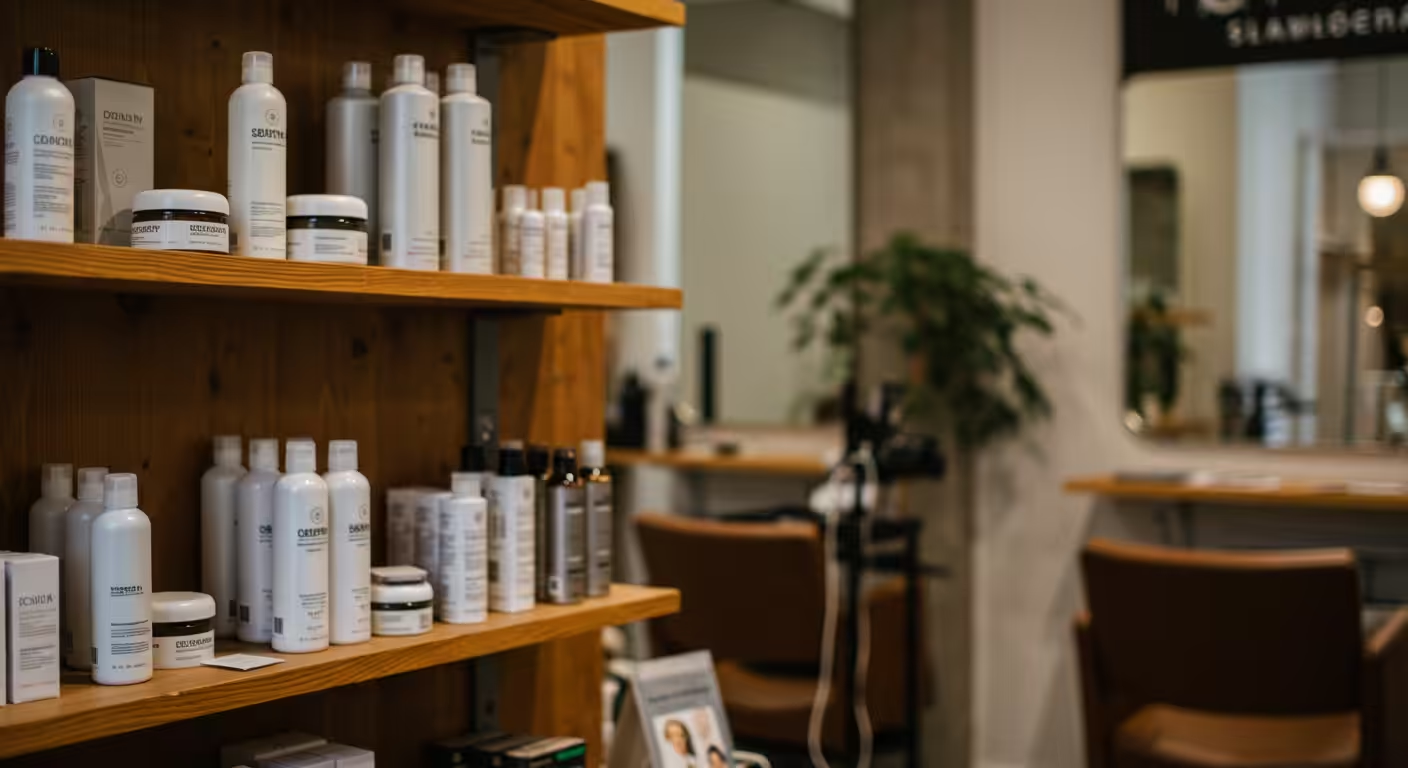
Why Retail Is Your Most Overlooked Profit Center
Most salon owners obsess over chair occupancy. They track booking rates, optimize schedules, and chase new clients through promotions and social media. But there is a revenue stream sitting right in their physical space — often neglected, rarely optimized — that could increase per-client revenue by 30–50% without adding a single new appointment.
Retail. Professional products, take-home treatments, styling tools — whatever sits on your shelves and your online store.
The numbers tell a blunt story. The average salon generates somewhere between 5% and 12% of total revenue from retail. The top-performing salons? They hit 25–35%. At a $400,000 annual revenue salon, the difference between 8% retail and 25% retail is $68,000 — almost pure profit, since retail carries far higher margins than services. That is not a side hustle. That is a second business hiding inside your first one.
But here is the tension every salon owner feels: you did not become a stylist or esthetician to be a salesperson. Your clients did not come to your salon to be sold to. Pushy upselling erodes trust. Done wrong, retail efforts actually damage your brand.
This guide is about the third way — a systematic approach to retail that feels consultative, not transactional. No scripts, no high-pressure tactics. Just 17 practical systems that turn your salon into a place where products genuinely sell themselves.
Part 1: Know Your Baseline — Because You Cannot Improve What You Do Not Measure
1. Calculate Your Retail-to-Service Ratio
Before buying a single new display or training anyone, get the number. Divide total retail product sales by total revenue, then multiply by 100. That is your retail percentage. Do it monthly, not once a year. If you use a salon management platform like Altegio, pull the report in 30 seconds — revenue dashboards already segment product vs. service income.
Set a realistic target. If you are at 5%, shoot for 10% within six months. If you are at 15%, push for 20%. Incremental progress compounds.
2. Identify Your Velocity Products
The shelf is not a museum. Some products move fast, others gather dust for months. Run a product sales report for the last 90 days. Sort by units sold, not by revenue — a $12 leave-in conditioner that sells 40 units monthly is more valuable real estate than a $45 serum selling two units.
Your top five products by velocity deserve the best shelf positions, the most reorders, and the most staff attention. Everything else is a candidate for discontinuation or relegation to secondary displays.
3. Audit Margin Per Linear Inch
Not all sales are equal. A $60 product with 30% margin earns you $18. A $30 product with 60% margin earns exactly the same $18 — but occupies half the shelf space. Map your product margins against the physical space they consume. Optimize shelf allocation toward high-margin, high-velocity items. This is retail math most salons never do, and it is the fastest way to increase profit without increasing foot traffic.
Part 2: Design a Retail Environment That Sells Without a Word
4. Build a Proper Power Wall
The power wall is the centerpiece of salon retail — a curated, well-lit display positioned in a high-traffic zone, typically near reception or checkout. It should be impossible to miss and impossible to ignore.
The rules: position it at eye level; light it twice as bright as surrounding areas; place it to the right of incoming traffic (most people scan right upon entry); feature your three best-selling products prominently; and rotate the arrangement every month. A static display becomes invisible within weeks — your regular clients stop seeing it. Monthly rotation keeps the wall fresh and signals that there is always something new to discover.
5. Deploy Strategic Disruptors Throughout the Space
A power wall is the anchor. Disruptors are the satellites. These are smaller, unexpected displays placed where clients naturally pause — the styling station, the shampoo bowl area, the waiting chairs. The psychology is simple: a client sitting with processing color or waiting for a toner to develop has idle hands and an idle mind. A small acrylic stand with three products at the styling station is not aggressive — it is convenient.
Stock disruptors differently from the main wall. The power wall carries your staples. Disruptors carry discovery products: new arrivals, seasonal items, limited-run collections. The goal is impulse, not education.
6. Make Testers Visible, Accessible, and Replaceable
Nothing kills a retail sale faster than a grimy, half-empty tester. If you are going to offer testers — and you should — commit to maintaining them. Full bottles, clean packaging, clearly labeled. Place them at the front of the shelf, not hidden behind the sealed stock.
The unspoken rule of salon retail: a product your client has touched, smelled, or felt on their skin is 4–5 times more likely to end up in their bag. Reduce the friction between curiosity and purchase and the math takes care of itself.
7. Retail Starts at the Back Bar — Not at the Shelf
This is the single biggest mindset shift. Your stylists and estheticians are already using professional products on every client, every day. They are already narrating what they do: “I am using this volumizing mousse because your hair type responds well to lightweight hold.” The only missing link is making that product findable and purchasable.
Stock your back bar with products available for retail purchase. When the client loves how their hair feels, the product is right there — used on them, trusted, proven. The conversation flows naturally: “You mentioned loving the texture — that is the mousse I used. We have it at the front if you want to take one home.” No pitch required.
Part 3: Build Your Digital Retail Engine
8. Launch an Online Store Integrated With Your Booking System
Retail does not stop when the client walks out the door. An online store turns every client into a potential repeat retail buyer between appointments. The key is integration — not a standalone Shopify store that lives in a disconnected universe, but a storefront that shares data with your booking platform.
When your booking system knows that a client purchases a specific shampoo every eight weeks, you can send a replenishment reminder at week seven. When your platform tracks in-salon purchases alongside online orders, you have a complete view of client value — not just what they spend on services, but what they spend between visits. Platforms like Altegio make this connection native: client profiles, purchase history, and automated follow-ups live in one place.
9. Optimize for Mobile First, Desktop Second
Over 60% of salon-related online purchases happen on a phone. If your online store requires pinch-zooming, sideways scrolling, or hunting for tiny buttons, you are losing sales on every visit. Product images must load fast and render cleanly on a 6-inch screen. Category navigation should be thumb-friendly. Checkout should be two taps, not seven fields.
Test it yourself. Open your online store on your own phone. Try to buy something. Count the steps. Every unnecessary tap costs you conversion rate.
10. Send Replenishment Campaigns, Not Generic Blasts
The difference between spam and a helpful reminder is timing and relevance. A generic “20% off all products” email to your entire list burns trust and trains clients to wait for discounts. A personalized message that says “Your Kérastase shampoo is likely running low — reorder here” at the right interval feels like a concierge service.
This requires data: purchase dates, average product lifespan, client communication preferences. Your salon software should track all three. Segment your list by product category and purchase recency. Automate the triggers. One well-timed, relevant message outperforms ten spray-and-pray campaigns.
11. Turn Social Media Into a Product Discovery Channel
Social media is not just for before-and-after photos. It is the most powerful product education channel you own. Format matters: a 45-second video of a stylist explaining why they chose a specific heat protectant for a client’s fine hair will outsell a static product photo by a factor of three or four.
Post tutorial-style content: how to use a curling wand, why sulfate-free matters for color-treated hair, the difference between a hair oil and a hair serum. Link directly to the product in your online store. Instagram and TikTok both support shoppable posts. Use them. Every educational video is a retail touchpoint disguised as content.
Part 4: Equip Your Team — Because They Are Your Sales Force Whether You Like It or Not
12. Ditch the Hard Sell. Teach Consultative Recommendation Instead
Stylists are not natural salespeople — and that is a feature, not a bug. Clients trust stylists because they perceive them as experts, not vendors. The moment a recommendation feels scripted or commission-driven, trust evaporates.
Train your team in education-based selling instead. The goal is not to close a sale; it is to solve a problem the client mentioned. “My hair feels dry between appointments” is a retail opportunity, but the response must be diagnostic first, product second. “That is common with color-treated hair — let me show you what is happening at the cuticle level, and the product I would use to fix it” is a consultation. “You should buy this mask” is a pitch. Clients can tell the difference in under three seconds.
13. Build a Commission Structure That Rewards Consistency, Not Spikes
Flat percentage commissions on retail sales create short-term spikes and long-term burnout. Stylists push hard one month, earn a bonus, and coast the next. A better model: tiered commissions that increase with consistency. For example, 10% on monthly retail sales up to $800, 15% on $801–$1,500, 20% above $1,500. This rewards sustained performance and makes every additional unit more valuable than the last.
Booth renters present a different challenge — they are independent contractors. An effective approach with renters: deduct retail commissions from their booth rent. Sell $300 in products, get $45 off your rent. The incentive aligns without requiring employment structures.
14. Run Monthly Product Knowledge Sprints
You cannot sell what you do not understand. Fifteen minutes at the start of every month, pick one product line or category. Have the team use the products themselves — feel the texture, smell the fragrance, note the results on their own hair or skin. When a stylist has genuine personal experience with a product, their recommendation carries conviction that no script can replicate.
Rotate who leads each sprint. The stylist who loves the curl cream should champion it that month. Peer-to-peer enthusiasm is contagious in a way that manager-led training is not.
15. Celebrate Wins Publicly, Coach Misses Privately
Retail performance should be visible — not as a ranking that shames the bottom performers, but as a team dashboard that celebrates momentum. A simple weekly Slack message or team chat post: “Top retail performer this week: Maria, $340 in product sales. She moved six units of the new Olaplex line. Ask her what worked.” This normalizes retail as part of the culture, not an awkward add-on.
For stylists who struggle, pull them aside one-on-one. Ask what makes them uncomfortable about recommending products. Often the barrier is not laziness — it is a belief that selling is somehow beneath their craft. Reframe it: recommending the product that maintains your work between appointments is not selling. It is completing the service.
Part 5: Automate the Mechanics So Your Team Focuses on People
16. Use Booking Data to Predict Retail Demand
Your appointment calendar is a retail demand forecast hiding in plain sight. Ten balayage bookings next Thursday? That means ten opportunities to recommend color-safe shampoo, ten people whose hair just went through a high-lift process. A spike in keratin treatments this month? Stock up on sulfate-free products and schedule the replenishment email campaign to hit four weeks later.
Modern booking platforms can surface these patterns automatically. When your system connects appointment type to product recommendation logic, you move from reactive retail to predictive retail — and your stylists always have the right recommendation ready.
17. Automate Post-Visit Follow-Ups With Product Links
The 24-hour window after an appointment is the highest-converting retail moment. The client just experienced the products first-hand. Their hair looks and feels exactly how they want it. Capitalize on that moment before the memory fades.
Automated follow-ups — a simple message thanking them for their visit, naming the products used during their service, with a one-click reorder link — convert at 3–5x the rate of cold retail emails. Set it once in your salon management system. It runs forever. No manual effort, consistent returns.
The Math That Makes It All Worth It
Let us put numbers to the system. Assume a mid-sized salon with:
- $35,000 monthly service revenue
- Current retail at 8% = $2,800/month
- Average retail margin: 55%
- Current retail profit: $1,540/month
Now push retail to 20% of revenue through the 17 tactics above. That is $7,000/month in retail, at 55% margin = $3,850/month in profit. The difference: $2,310 in additional monthly profit, or $27,720 per year — from products you are already using behind the chair, to clients who already trust you, in a space you already rent.
That is not a marketing campaign. That is an operational upgrade.
The One Thing to Start Tomorrow
If you take nothing else from this guide, do one thing: tomorrow morning, pull your retail sales report for the last three months. Identify your top five products by units sold. Move them to eye level on your best-lit shelf. Put testers in front of the sealed stock. And tell your team at the morning huddle: “These are our five stars. If a client asks about one of them, here is a one-sentence way to describe why you love it.”
That is 20 minutes of work. It will pay for itself by Friday.
Retail is not a side project. It is the highest-margin revenue in your entire business. Treat it accordingly.